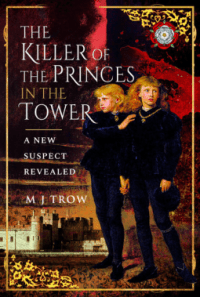
The fate of the Princes in the Tower – Edward V and his younger brother Richard, Duke of York – remains one of the greatest unsolved mysteries of all time. Reportedly last seen in the grounds of the Tower of London in the summer of 1483, the disappearance of the two boys has divided historians ever since. Their uncle, Richard III, is the man most often accused of being responsible for their deaths, while the names of Henry VII and Henry Stafford, Duke of Buckingham have also been suggested as possible culprits. In all three cases there is a logical political motive: to remove rival claimants to the throne. But what if the murder (assuming that it was actually murder) was not politically motivated at all? What if the princes were killed for an entirely different reason, by someone completely unexpected?
MJ Trow’s new book, The Killer of the Princes in the Tower, is subtitled A New Suspect Revealed, and I have to admit, when I first started reading, I was very sceptical about this. The Wars of the Roses and Richard III’s reign in particular is a period of history I’m very interested in and I’ve read a lot of books over the years, both fiction and non-fiction, that deal with the subject of the Princes in the Tower. Could Trow really come up with a ‘new suspect’? Well, yes he does – or at least, one that I can’t remember being suggested in any of the other books I’ve read.
If you have any prior knowledge of the period and the controversy surrounding the princes, it will probably be helpful, but if not Trow does provide plenty of background information, describing the whole sequence of events following the death of the boys’ father, Edward IV, and explaining how Richard III came to take the throne before the young Edward V could be crowned. He spends some time discussing the idea that the princes could have been secretly released from the Tower and not murdered at all – a theory some people believe is supported by the appearance a few years later of a ‘pretender’, Perkin Warbeck, claiming to be the younger of the princes, Richard of York – but (sensibly, in my opinion), he doesn’t consider this as a serious possibility. He then looks at all of the potential suspects one by one, presenting the evidence for each one being the murderer and then dismissing it, until only one name is left…
Trow approaches the mystery like a modern day police investigation, believing that no stone should be left unturned and looking for motive, means and opportunity. Beginning with the three most obvious suspects, he moves on to consider their supporters, servants and family members; even Richard III’s wife, Anne Neville, and the princes’ own mother, Elizabeth Woodville, are discussed – because, as Trow says, they would certainly have been interviewed by the police if the boys had disappeared today. He also examines the reliability of the various sources and what we can learn from them.
The revelation of the new suspect did take me by surprise because it’s not someone who would ever have occurred to me. It’s true that this person certainly had the means and the opportunity, but I wasn’t at all convinced about the motive, even though Trow devotes a whole chapter to drawing comparisons with other people throughout history who have killed for similar reasons. Although what Trow suggests is not impossible, I don’t think it’s very likely either and as far as I’m concerned the mystery remains unsolved! Still, it’s good to read a theory that is neither pro-Ricardian nor anti-Ricardian and that looks at the whole subject from a very different angle. I found this book almost as gripping as fiction, so despite not agreeing with the conclusion I still really enjoyed reading it.
Thanks to Pen & Sword for providing a copy of this book for review via NetGalley.
 She Reads Novels