 It’s always good to come across a Greek mythology retelling that has nothing to do with the Trojan War! There have been so many over the last few years (Natalie Haynes’ A Thousand Ships being one of the best I’ve read) that it makes a refreshing change to read about other characters and other myths.
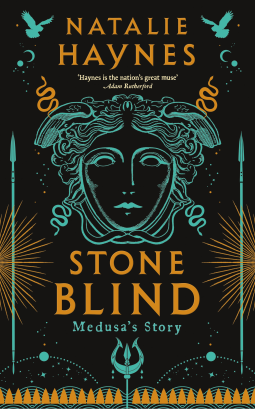
Stone Blind is subtitled Medusa’s Story but is actually written from the perspectives of many different characters, all coming together to tell the tale of the Gorgon Medusa and Perseus’ quest to capture her head. In traditional accounts of this myth, Perseus is seen as the hero, bravely slaying the monstrous snake-haired Medusa whose eyes can turn living creatures to stone. This version looks at things from a different angle, questioning whether it’s really fair to refer to Medusa as a monster and painting Perseus as, if not exactly a villain, a thoughtless, dim-witted boy who ends up completing his quest almost by accident.
While part of the story is told from Medusa’s point of view, we also hear the voices of many other gods, mortals and mythical beings including the other two Gorgons, their sisters the Graia, who share one eye and one tooth between them, the Ethiopian princess Andromeda, who is chained to a rock as a sacrifice, and even the olive trees of Athens. Some have a lot to say, others appear only for a few pages, but each one has an important contribution to make. This is the same style Natalie Haynes used in A Thousand Ships, but I found it more effective here. Whereas in the previous book the various characters’ narratives felt as though they were appearing in a random order, almost like a collection of separate short stories, here they are ordered in a way that makes chronological sense, with each new voice helping to move the story forward.
Medusa, as she is portrayed here, is a very sympathetic character. The only mortal Gorgon of the three and therefore the most vulnerable, she is raised by her two older sisters, Sthenno and Euryale. Medusa’s monstrous features only appear after she is raped by Poseidon in Athena’s temple and the angry goddess punishes her by transforming her hair into a seething mass of snakes and cursing her with the ability to turn everything around her to stone. Condemned to a life of blindness, afraid to uncover her eyes in case her gaze should fall upon one of her beloved sisters, Medusa’s story is very sad – and we know that it is only going to get worse because, far away, Polydectes, King of Seriphos, has challenged Perseus to bring him the severed head of a Gorgon. Fortunately, Haynes doesn’t dwell on the Gorgon-slaying episode, moving straight on with other parts of the myth.
Despite the tragic elements of the plot, the story is told with plenty of humour, particularly in the scenes dealing with the petty squabbling of Zeus, Hera, Athena, Hermes and the other Olympian gods. Haynes does an excellent job of capturing their fickle, petulant natures and the childish rivalries between them. In fact, I can’t really say anything negative about this book, other than that the title is slightly misleading as this is so much more than just Medusa’s story. I’m looking forward to future books by Natalie Haynes and must also go back and read her earlier novel, The Children of Jocasta.
Have you read any other retellings of this myth? If so, I would be interested in any recommendations.
Thanks to Mantle for providing a copy of this book for review via NetGalley.
 She Reads Novels