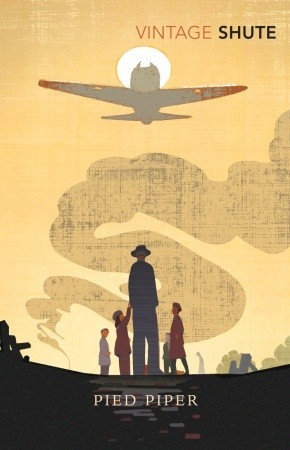
 Nevil Shute is an author I’ve been intending to try for a long time. His 1942 novel, Pied Piper, is on my Classics Club list and I decided to also put it on my 20 Books of Summer list to give me some extra motivation to pick it up and read it sooner rather than later! I have no idea whether this was the best Shute novel to begin with – A Town Like Alice and On the Beach are probably better known; however, it turned out to be a good choice for me.
The ‘pied piper’ of the title is John Sidney Howard, an elderly Englishman who goes to France in the spring of 1940 to spend some time fishing, relaxing and trying to come to terms with the death of his son whose plane came down in the Battle of the Heligoland Bight. It may seem a strange time to be taking a holiday in Europe, but Howard believes the situation in France is stable and that he won’t be in any danger. However, when the Nazis begin to advance much more quickly than he expected, Howard decides to return home immediately. His departure is delayed when an English couple staying in the same hotel ask him to take their two young children with him to the safety of England, but soon Howard, accompanied by little Sheila and Ronnie, is boarding the train to Paris for the first stage of his journey.
Of course, things don’t go according to plan and Howard and the children find themselves facing one obstacle after another, including sickness, cancelled trains and German bombing raids. Along the way, Howard collects more lost or orphaned children and together they try to avoid the rapidly advancing German army and make their way to safety.
I usually enjoy novels with World War II settings, but I find it particularly interesting when they were actually written during the war itself. It makes a book feel very different when you know that at the time of writing, the author had no idea what would happen next or how the war would eventually end. It’s intriguing to think of how a 1942 reader may have viewed a book like this compared to those of us who are reading it today with the benefit of hindsight and a knowledge of history.
Another thing which makes Pied Piper different from a lot of other wartime novels is that Shute’s protagonist is so ordinary – not a soldier or a spy or a romantic young lover, but a quiet, unassuming old man who becomes a hero unintentionally through a mixture of circumstance and his own basic decency and humanity. The only link between Howard and the sinister ‘Pied Piper of Hamelin’ (apart from the obvious connection with children) comes when we see Howard making whistles from hazel twigs for his young companions to play with.
Although Howard and the children witness and experience some terrible things during their journey, they also encounter several people who offer kindness and generosity, so the novel shows us both the best and the worst of human nature. The book is structured using a framing narrative where Howard is relating the story of his adventures in France to a friend in a London club during an air raid several weeks into the future. This means we know almost from the first page that Howard has survived to tell the tale, yet there’s still plenty of suspense and I was genuinely afraid for him and for the children at various points throughout the novel!
Which of Nevil Shute’s books should I read next?
~

This is book 7/20 from my 20 Books of Summer list.
~
This is also book 29/50 from my second Classics Club list.
 She Reads Novels