After reading my first Nicholas Blake novel last year, I knew I wanted to read more. Nicholas Blake was a pseudonym of the poet Cecil Day-Lewis and the name under which his series of Nigel Strangeways mysteries was published. With plenty to choose from (sixteen in the series in total) I found myself picking up two in quick succession, so I am writing about both of them here.
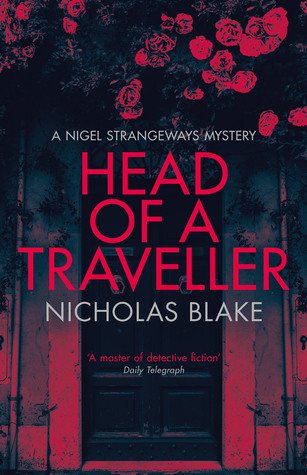 Head of a Traveller (published in 1949) is the ninth in the series. At the beginning of the book, private investigator Nigel Strangeways is staying with a friend in Oxfordshire and is introduced to the poet Robert Seaton, who lives at the nearby estate of Plash Meadows with his wife and two children. Nigel is enchanted by their beautiful house and intrigued to hear the history of how it came to be in Robert’s possession. A few months later he is summoned back to Plash Meadows under less happy circumstances: a headless body has been found in the river just upstream from the Seatons’ house. Superintendent Blount has been called in to investigate and Nigel, who has worked with Blount before, decides to make some unofficial enquiries of his own.
This is a complex mystery with a surprisingly simple solution. My first assumptions proved to be right, but I was misled by discussions of alibis and timescales, mistaken identities and who could be protecting whom. I enjoyed following the investigations of Nigel and Blount, who have a great partnership and complement each other perfectly, but they were certainly making things more complicated than they needed to be!
Bearing in mind that this is a book from the 1940s, there are some attitudes which could be offensive to modern day readers, particularly surrounding the character of Finny Black, who is a dwarf, and also regarding the rape of another character ten years earlier. These views are not at all uncommon in books from this era, but are still a little bit uncomfortable to read. Overall, though, I enjoyed this book – not as much as The Corpse in the Snowman, but it still kept me entertained for a while. And as a poet himself, Nicholas Blake writes convincingly about Robert Seaton and his work, and has some interesting thoughts to share.
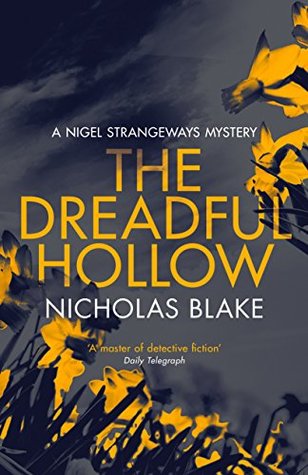 Now, The Dreadful Hollow, which was first published in 1953. I’ve had a terrible time with that title…I keep wanting to call it The Deathly Hallows, although there’s nothing remotely Harry Potter-ish about the book! The title is actually taken from a poem by Tennyson (“I hate the dreadful hollow behind the little wood”). Anyway, this is the tenth book in the Nigel Strangeways series and in this one, Nigel is commissioned by the financier Sir Archibald Blick to investigate a number of anonymous letters received by the residents of Prior’s Umborne, a small village in Dorset. On his arrival, Nigel is quickly able to identify some possible suspects: Blick’s two sons, the eccentric, reclusive Stanford and the serious, hardworking Charles; Rosebay Chantmerle and her sister Celandine, who has been confined to a wheelchair for many years; and the sinister, religiously obsessed Daniel Durdle.
It doesn’t take Nigel long to solve the mystery of the poison pen letters – or to think that he has, anyway – but everything is thrown into doubt again when a man’s dead body is found in the quarry. Are the murderer and the letter writer the same person or are these two separate crimes?
Again, this is a very complicated mystery and I needed to concentrate to follow Nigel’s deductions and to keep the sequence of events straight in my mind. I thought it was easy to spot the culprit (or culprits, as I’m not saying whether there were one, two or more of them) but the interest is in watching Nigel – and Blount, who arrives in Prior’s Umborne after the murder is committed – try to gather the evidence to prove it. This is my least favourite of the Strangeways novels I’ve read so far, though, and that’s partly because I found the characters in this one so unlikeable. It’s quite normal for a crime novel to have some unlikeable characters, of course, but I really did think the Blicks, the Chantmerles and the Durdles were all particularly unpleasant!
The final chapter is excellent with the tension building as the story moves towards a dramatic conclusion and this helps to make up for the novel’s weaker points. Although I didn’t like either of these books as much as the first Strangeways mystery I read, I think I’ll probably read more of them at some point.
 She Reads Novels