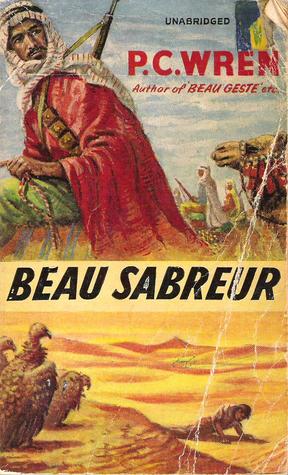
 I loved PC Wren’s 1924 classic Beau Geste and when I discovered that it was the first in a trilogy I knew I would have to read the other two. It has taken me more than five years, but a few weeks ago I finally got around to picking up the second book, Beau Sabreur, which was first published in 1926. Although this is a sequel to Beau Geste and features a few of the same characters, it’s not really a direct continuation of the story so would probably work as a standalone; however, some parts of the plot will make more sense if you have already read the previous book.
Beau Sabreur is divided into two sections and really is a book of two very distinct and different halves! The first half, Failure: The Making of a Beau Sabreur, is narrated by Major Henri de Beaujolais, whom you may remember as the French army officer who discovered the eerie abandoned fort at the beginning of Beau Geste. Henri’s narrative follows his early days with his regiment, the friends and enemies he makes, each of whom will have an impact on his future career, and the challenges he faces in settling into army life.
After completing his training, Henri is sent to North Africa with the cavalry where he has a series of adventures that wouldn’t be out of place in Lawrence of Arabia: camel rides across the desert; encounters with bands of Touareg robbers; and negotiations with Emirs and Viziers. It is here in the Sahara that Henri meets the beautiful Mary Vanbrugh, a guest of the colonel of the French-occupied city of Zaguig, who is ‘doing Algeria and seeing something of the desert’ with her brother and her maid-companion, Maudie. Henri is captivated by Miss Vanbrugh, but when the city comes under attack, he must decide whether she is more important to him than his duty to France.
I really enjoyed the first section of the book. Henri de Beaujolais is an engaging narrator and although his story encompasses serious themes of love, honour and duty, it is told with a lot of humour; I found the part where he visits a tailor to be fitted with his army uniform particularly funny. Bearing in mind that this is a novel written in the 1920s and some of the views on race and gender would be considered problematic today, I was pleased to find that Mary Vanbrugh is depicted as a courageous, independent and intelligent woman with a mind of her own (although Maudie, who dreams of being carried off on horseback by a handsome Sheikh, is less so). This first half comes to an end with a surprising plot twist that I hadn’t seen coming, before the whole style and tone of the novel changes entirely as we enter Part Two – Success: The Making of a Monarch.
The second half of the novel, sadly, didn’t live up to the promise of the first half. The focus moved away from Henri to concentrate on two of the characters from Beau Geste whom I liked in that book but didn’t care for in this one. The dry wit of Henri’s narrative was replaced by a much less subtle humour and I found the story in Part Two became quite tedious after the excitement and drama of Part One. I was still interested enough to keep reading to the end and I was rewarded with several more plot twists which made me glad I had persevered, but the abrupt change in the middle of the book didn’t work for me at all. I will probably still try the third book, Beau Ideal, and will hope for something more consistent from that one!

 She Reads Novels