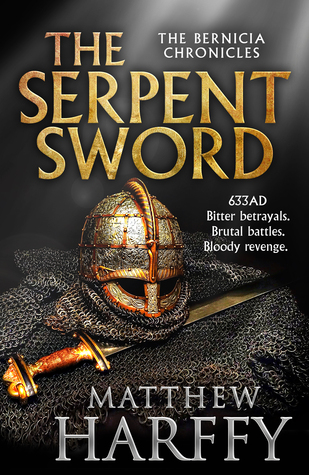
 Much as I enjoy reading historical fiction set in other countries, it’s also nice to have the opportunity to learn about the history of my own little corner of the world. This novel by Matthew Harffy, the first of a series, is set in the same time and place as Edoardo Albert’s Northumbrian Thrones trilogy, but as soon as I started to read The Serpent Sword I could tell it was going to be a very different type of book – not necessarily better or worse; just different.
The Serpent Sword opens in the year 633, when Britain is still made up of a collection of warring kingdoms. It begins with murder – the murder of Octa, a favoured warrior of King Edwin, and his lover, a woman called Elda. We don’t know the killer’s identity, but we see him lurking in the shadows of the fortress of Bebbanburg and we learn that there are two motives for what he is about to do. The first is that he has been rejected by Elda, who has chosen Octa instead, and the second, he is unhappy that Edwin has gifted the magnificent sword known as Hrunting to Octa rather than himself.
It was a sword fit for a king. The blades forged from twisted rods of iron. The metal shone with the pattern of rippling water, or the slick skin of a snake. The hilt was inlaid with fine bone and intricate carvings. All who had seen the weapon coveted it.
Too late to be of assistance, Octa’s younger brother Beobrand arrives from Cantware in the south, keen to join the service of a great lord, only to be met with the devastating news of Octa’s death. On a happier note, despite Beobrand’s lack of experience, he impresses Edwin enough to be given a place in the king’s army for his upcoming battle against Penda of Mercia and the Waelisc king, Cadwallon of Gwynedd. However, the battle ends in disaster for Edwin and he and many of his men are killed.
Beobrand, one of the few survivors, is taken to a nearby monastery to recover and this proves to be another turning point in his life. Having formed some new but important friendships at the monastery, he sets off again in search of another lord to serve. He will learn some important lessons on his journey as he grows and develops as a person, acquires new skills and has the chance to fall in love – but he never loses sight of his mission to take revenge upon the man who killed Octa and recover his brother’s sword.
The Serpent Sword is a well-researched work of historical fiction and those readers who like their novels fast-paced and action-packed with plenty of scenes involving battles, weapons and fighting will find a lot to enjoy here. Matthew Harffy’s books have been receiving excellent reviews, many drawing comparisons with Bernard Cornwell, which is clearly high praise if that’s where your tastes lie. However, although I can understand the appeal of this book, the overall feel and style of Edoardo Albert’s novels works better for me with their fantasy-like atmosphere and deeper exploration of the political and religious changes taking place during that period.
Still, it was good to have the opportunity to add to my limited knowledge of Northumbrian history. The focus of Harffy’s novel (and the series, the Bernicia Chronicles) is on the history of Bernicia, the northern half of Northumbria, rather than the southern part, Deira. Bebbanburg with its coastal fort, for example, is modern-day Bamburgh, where an impressive castle still stands, and Hadrian’s Wall, the famous wall built by the Romans, is also referenced, although the characters in the book don’t seem to have a name for it. In some ways, the region described in the book seems almost like a completely different world from the area I know today, but in others it’s strangely familiar.
Despite not really loving The Serpent Sword, I did still find it an interesting read, touching on many different aspects of 7th century life. It is a satisfying novel in itself, but it also feels like the first book in a series, following our hero Beobrand’s transformation from an inexperienced young man to a brave warrior skilled with sword and shield. On reaching the end, there’s the sense that there are many more adventures to come for Beobrand – and yes, there are now another four books that make up the Bernicia Chronicles. Will I be reading them? At the moment I’m not sure, but I could possibly be tempted.
I do have a copy of Bernard Cornwell’s The Last Kingdom which I will get to eventually, although I want to wait a while as I think it could be quite similar to this book – and I suspect it may not be entirely to my taste either. I’m more intrigued by the sound of Cornwell’s new Elizabethan novel, Fools and Mortals, coming later this year.
Thanks to the publisher Head of Zeus for providing a review copy of this book via NetGalley.
 She Reads Novels