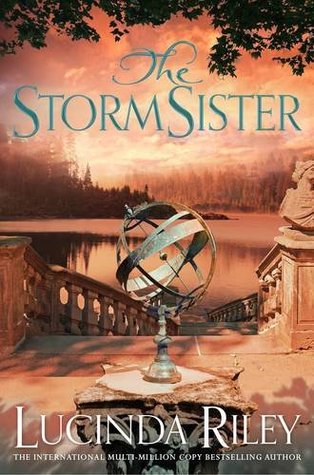
The Storm Sister by Lucinda Riley

The Storm Sister The Storm Sister is the second book in Lucinda Riley’s ambitious new series, The Seven Sisters. Based on the mythology surrounding the Pleiades (or ‘seven sisters’) star cluster, each novel in the series will tell the story of one of the adopted daughters of a reclusive millionaire known only as Pa Salt. Maia, Alycone (Ally), Asterope (Star), Celaeno (CeCe), Taygete (Tiggy) and Electra D’Aplièse have all been named after one of the stars in the constellation and have grown up together at Pa Salt’s estate, Atlantis, near Lake Geneva, Switzerland. The first book, which I read last year, is Maia’s story; The Storm Sister is Ally’s.

The beginning of this novel is very similar to the first: the sisters have been informed of Pa Salt’s death and have all hurried home to Atlantis, where they find that their adoptive father has left each of them a set of clues which will enable them to discover the truth about their own origins. At first, Ally’s clues mean nothing to her: a small brown frog and a pair of coordinates directing her to a museum in Norway. She is intrigued but has no time to investigate because, as a professional sailor, she is preparing to take part in one of the biggest yacht races of her career. When tragedy strikes, however, Ally decides to travel to Norway where she attempts to unravel the secrets of her past.

Following the trail left by Pa Salt, Ally learns of a talented young singer, Anna Landvik, who sang at the premiere of Peer Gynt more than a hundred years earlier. It seems that Anna’s story – and that of Jens Halvorsen, one of the musicians in the orchestra – could be linked to Ally’s own, but Ally is not quite sure what the connection could be. With the help of Thom Halvorsen, who tells her he is the great-great-grandson of Jens, Ally is able to fill in the gaps and in the process makes some surprising discoveries that will change the course of her own life.

I enjoyed The Storm Sister but I think I preferred the first book in the series (I suppose in a seven-book series it’s understandable that I’m going to like some more than others). The Storm Sister is a very long novel and I think I would have been happier if less time had been spent at the beginning of the book on Ally’s sailing and her romance with her fellow sailor, Theo. It seemed to take such a long time for the historical storyline to begin! I did become much more engrossed in Ally’s story in later sections of the book, though; I loved the way things came together towards the end and the links between several different generations of Halvorsens grew stronger.

The Anna and Jens storyline was fascinating and made me want to pause in my reading and listen to parts of Edvard Grieg’s Peer Gynt to help me imagine Anna singing Solveig’s Song and Jens playing the opening bars of Morning Mood on his flute. There is a musical theme running throughout the entire book and I was reminded of one of Lucinda Riley’s other novels, The Italian Girl, in that respect.

As part of a larger series, I had hoped that this book might shed more light on some of the central mysteries. Who was Pa Salt? What were the true circumstances surrounding his death and burial at sea? And what happened to the seventh sister, who should have been called Merope? However, we don’t learn much more about any of these things in this book; based on the two that I’ve read, it seems that each novel will stand alone and can be read in any order – presumably until we reach the seventh book when our questions should finally be answered!

Book three will focus on Star, or Asterope, and I’m already looking forward to it. Star is not one of the strongest characters among the sisters, but I like her and I think her story will be an interesting one.

Thanks to the publisher for providing a review copy of The Storm Sister.

Burned by Thomas Enger

Burned is the first in a new series of crime novels by Norwegian author Thomas Enger. This book is set in Oslo and introduces us to Henning Juul, a journalist working for 123news, an internet-based newspaper. When we first meet Henning he is trying to come to terms with the tragic death of his son, Jonas, in a house fire. On his first day back at work after a long absence, he is asked to cover the story of a young woman who has been found brutally murdered in a tent on Ekeberg Common. Henning’s research leads him from Oslo’s Muslim community to the world of film-making, but will his investigations make him the killer’s next target?

This series has a lot of potential and I’m pleased I could be there at the beginning rather than coming in halfway through the series which is what usually seems to happen to me! Although I didn’t think it was an outstanding book, there was a lot to like about Burned and I’m pleased to have discovered another Scandinavian crime writer whose work I enjoy. With its short chapters and fast-paced plot the book was difficult to put down and despite its length was a quick read.

There were plenty of twists and turns in the plot which helped to keep me interested, but while plot twists can be an important element of a good crime novel, I thought there were too many towards the end of the book. I wasn’t quite sure exactly what was supposed to be happening and I started to get slightly confused. The writing doesn’t always flow very well either, though this could be due to the translation (the book has been translated from the original Norwegian by Charlotte Barslund).

I enjoyed the descriptions of daily life in an internet newspaper office and the processes involved in researching, writing and publishing news items. I’ve never worked as a journalist but it all seemed quite realistic to me (which is to be expected as I believe Thomas Enger has experience in journalism himself). I also really liked Henning Juul and found him an intriguing character. I was left thinking that there must be a lot of aspects of his history and his personality still to explore, and that is why I’m already looking forward to the publication of the second book in the series.

I received a copy of this book from LibraryThing Early Reviewers

Review: I’ll Never Be Young Again by Daphne du Maurier

I’ll Never Be Young Again was Daphne du Maurier’s second novel, written when she was only twenty three years old. It’s different from the other books of hers that I’ve read so far. It doesn’t have the suspense or the gothic feel of some of her other works – this is more of a psychological, character-driven book. It’s the story of Richard, a young man who has grown up in the shadow of his famous father, and his struggle to find his own identity. I’m not really a fan of ‘coming-of-age’ novels, but I’m glad I chose to read this one. It certainly seems to be one of her least well known novels –  and I was concerned that this might mean it wasn’t very good. Well, I can tell you that it is good and I enjoyed it a lot more than I was expecting to.

The book opens with Richard – or Dick as he prefers to call himself – standing on a bridge, preparing to jump. Immediately the reader is intrigued, wondering what has happened to drive him to suicide.  At the last minute Dick feels a hand on his shoulder – this is Jake, a complete stranger who saves his life and becomes his closest friend. The first half of the book follows the adventures of Dick and Jake as they leave England and sail to Scandinavia together in search of a new life. The second half is the story of Dick’s relationship with Hesta, a girl he meets in Paris.

The whole book is written in the first person from Dick’s perspective, which is significant as it was apparently the first time Daphne du Maurier wrote from a man’s point of view – and I thought she captured the male voice perfectly. The only problem I had was that I just didn’t like Dick very much. I found his immaturity and whining very irritating – although I understood that the point of the book was to follow his development from an insecure, selfish youth into a sensible, mature adult. Eventually he does begin to grow up and want different things out of life, but this comes too late in the book for me to be able to warm to him. However, the book is so well-written I could still enjoy it even with such an unsympathetic narrator. Her writing is absolutely beautiful and quite dreamlike, as she lets us get right inside Dick’s head and share his thoughts and emotions. There are also some vivid descriptions of the mountains and fjords of Norway and the other places that the characters visit, particularly Paris with its cafés and boulevards.

This would probably not be the best Daphne du Maurier book for a newcomer to begin with, but it’s a good choice for someone who wants to venture away from Rebecca and read one of her less popular novels. A word of warning, though – if you’re going to read the Virago Modern Classics edition, leave the introduction until last as it gives away the entire plot, including the ending (this is good advice with any book – I’ve learned from experience never to read the introduction first).

This is my first book for the Daphne du Maurier Challenge hosted by Chris at Book-a-rama. I wasn’t planning to take part in this challenge until I discovered my local library had almost all of her books. I’m looking forward to reading some more of her work during the next year, as there are still a lot of her books I haven’t read yet. This book also counts towards the 1930s challenge as it was a contemporary novel published in 1932 and set in 1930s Europe – and also the Typically British challenge.

Pages: 304/Publisher: Virago Press (Virago Modern Classics 515)/Year: 2005 (originally published 1932)/Source: Library book

Review: The Christmas Mystery by Jostein Gaarder

“They were going to Bethlehem, to Bethlehem- because that’s where the Christ-child was born.”

The Christmas Mystery begins in Norway on 30th November when a boy named Joachim discovers a hand-made Advent calendar in a book shop. The next day, when Joachim opens the first door, he finds a tiny piece of paper telling the story of a little girl called Elisabet who spots a lamb in a department store. The lamb begins to run away, but Elisabet is determined to stroke it and chases after it. The lamb leads her outside and into the woods where she meets the angel Ephiriel, who explains to her that she is now part of a very special pilgrimage to Bethlehem – not only will they be travelling across land, they will also be travelling back through time to the day when Jesus was born.

As Elisabet, Ephiriel and the lamb move closer to Bethlehem and further back in time, they are joined by an assortment of other Biblical characters including shepherds and Wise Men. A little more of their story is revealed every day through the pieces of paper hidden in Joachim’s advent calendar, but as the tale of Elisabet’s journey unfolds, Joachim and his parents become involved in another mystery: the mystery of John, the mysterious flower-seller who made the magic Advent calendar and the real-life Elisabet who disappeared on Christmas Eve in 1948.

The book is divided into 24 chapters, with each chapter representing one door on the Advent calendar. If you have children, the structure of the book would make it perfect for reading aloud, one chapter per day in the weeks leading up to Christmas. This is not really a ‘children’s book’ though – it’s one of those books that can be enjoyed on different levels by people of all ages. As with all of Jostein Gaarder’s books the story introduces us to a large number of philosophical ideas. We also learn some interesting historical and geographical facts about the countries Elisabet passes through on her way to Bethlehem.
Although this is not as good as some of Gaarder’s other books such as Sophie’s World or The Solitaire Mystery, it has to be one of the most unusual and imaginative Christmas stories I’ve ever read.

Genre: General Fiction/Pages: 247/Publisher: Phoenix – Translated by Elizabeth Rokkan & Illustrated by Rosemary Wells/Year: 1996/Source: Bought new