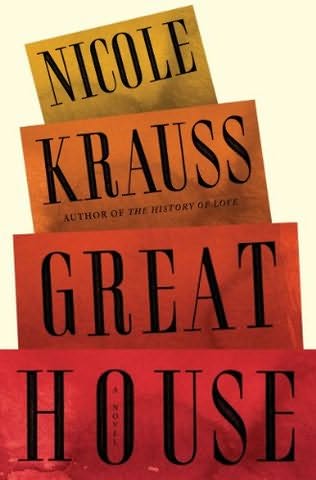
Great House by Nicole Krauss

I picked up Great House after it was named on the Orange Prize longlist in April and probably wouldn’t have thought about reading it otherwise. Based on what I had heard about the book before I started reading it I suspected I wouldn’t enjoy it, but I wanted to give it a try anyway. I liked the central concept of a number of different people being linked by an item of furniture (a desk) and was curious to see how this would work. Having read the book, though, it would be inaccurate to describe it as ‘a book about a desk’ – in fact, in several of the book’s eight sections the desk is barely mentioned at all.

The novel is made up of four separate stories, with two chapters devoted to each one. The first story is narrated by Nadia, an author living in New York, who receives a writing desk from a Chilean poet, Daniel Varsky. At the end of the first chapter we leave Nadia behind for a while and move to Israel, where we meet Aaron and learn about the difficult relationship he has with his son, Dov. Next the action switches to England and our third narrator, Arthur, who tells us about his wife, Lotte. Lotte, another writer, has a secret which is only revealed as she grows older and begins to suffer from Alzheimer’s. The fourth storyline involves Izzy and her relationship with Yoav and Leah Weisz, the son and daughter of a collector of antique furniture.

There are some themes that recur throughout most or all of these four narratives: authors, relationships between parents and children, loss and memories. All four storylines interested me but the one that I found the most engaging was Aaron’s. I thought his voice was the strongest of all the narrators; the others were not as easy to distinguish between.

Great House is a novel that requires a lot of patience and concentration. The ways in which the four stories are linked are not immediately obvious and you need to read the entire book to be able to fit the various pieces of the puzzle together. Although I didn’t enjoy it enough to want to read it again, it’s a book that would almost certainly benefit from a re-read. Even reading slowly and making a few notes as I went along there were still things that didn’t quite make sense to me, but I think if I started the book again with my knowledge of the later sections I should be able to pick up on little details in the earlier chapters that I’d missed the first time.

The quality of the writing is excellent; there were sentences that were so beautifully constructed that I had to go back and read them twice. It’s a clever book and definitely not an easy read, but one that leaves the reader with a lot to think about, and although the book wasn’t really to my taste it’s undeniably a very impressive novel.
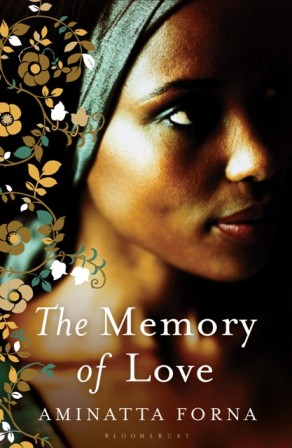
The Memory of Love by Aminatta Forna

Adrian Lockheart is a British psychologist working in Freetown, the capital city of Sierra Leone. For ten years the country has been torn apart by civil war and a large percentage of the population have been left suffering from post-traumatic stress disorder. Adrian’s job is to help people cope in the aftermath of the war. One man, who set fire to people’s houses during the war is now haunted by the smell of burning meat. Another woman is showing symptoms of fugue – a rare condition which occasionally causes her to disappear from her everyday life and turn up in another place miles away from her home. But Elias Cole is the patient Adrian spends the longest with and who intrigues him more than any of the others.

Elias Cole is an elderly retired professor who is dying of lung disease and he relates to Adrian his memories of the woman he once loved: her name was Saffia and she was married to a fellow academic, Julius Kamara. As Adrian learns more about Elias and his relationships with both Saffia and Julius during the period of political unrest in the late 1960s, it becomes clear that Elias’s story may have an effect on Adrian’s own life. We also meet Kai Mansaray, a young surgeon at the hospital where Adrian works, who has been left traumatised by the war and is suffering from insomnia and recurrent nightmares. He and Adrian become friends but their friendship comes with its own set of obstacles that need to be overcome.

The Memory of Love is the first book I’ve read set in Sierra Leone. One of the great things about fiction is that it gives us the opportunity to learn about countries that we may otherwise have gone through our whole lives knowing very little about. The descriptions of life in Sierra Leone are beautifully written: the sights and sounds, the trees and flowers, the colours of the sky. I didn’t know anything about the history and politics behind the civil war but it wasn’t really necessary to have any prior knowledge – and even after finishing the book I didn’t feel I’d really learned much about the war itself. But what the book does do, and does very well, is show the effects the war had on the personal lives of the population, particularly the fear and uncertainty people felt, not knowing who they could and couldn’t trust.

I wish I could say I had loved this book, but I didn’t. It was extremely well written but after about 100 pages I was bored. I put the book aside for a few days and then picked it up again. This time I managed to finish it, but it still seemed to take forever to read. And towards the end, when the various threads of the story began to come together it all seemed a bit too convenient – too predictable, too many coincidences. But the fact that I didn’t enjoy this book probably says more about me as a reader than it does about The Memory of Love as a novel. It was too detailed and descriptive for me and I found it very, very slow. I do seem to be in the minority though, so maybe you’ll have better luck with it than I did!

The Tiger’s Wife by Téa Obreht

As you may know, the winner of the 2011 Orange Prize for Fiction will be announced on 8th June. I’ve read three of the six books from this year’s shortlist but I’ve been so far behind with my reviews this year that I haven’t yet posted on any of them – even though it’s now been a while since I finished reading them. I’m beginning to catch up now so hopefully I’ll be posting my thoughts on all three books this week. As for the other three shortlisted books, I would still like to read them eventually.

The Tiger’s Wife, Téa Obreht’s first novel, was one of the Orange titles I was most looking forward to reading and although I did enjoy it, I felt that it didn’t quite fulfil its promise. There were parts of the book that I loved, but I thought the story was made up of too many separate elements that in my opinion never really came together as a whole.

Set in an unnamed Balkan nation, The Tiger’s Wife is an unusual mixture of myth, magic and reality. The main thread of the story follows Natalia, a doctor who is on a goodwill mission to inoculate the children at an orphanage in the fictional town of Brejevina. When Natalia discovers that her beloved grandfather has died, not at home with her grandmother as might be expected, but in a village not far from the orphanage where she is headed, she decides to investigate and find out what he was doing there.

Interspersed with Natalia’s story are accounts of important events in her grandfather’s life and some of the Balkan folk-tales she remembers him telling her. One of these is the story of an escaped tiger living near a remote village in the mountains and a young deaf-mute woman said to be the tiger’s wife; another involves Darisa the bear hunter. I particularly enjoyed reading about the grandfather’s encounters with the ‘deathless man’, a mysterious individual who can predict the deaths of other people without ever dying himself. However, some of these tales were so long and involved that by the time we returned to the present day storyline I found it difficult to pick up where we had left off. And to be honest, I found Natalia’s grandfather and his magical stories a lot more interesting than the character of Natalia herself.

Although the country in which the book is set is never named and any towns and villages that are mentioned are fictional, it’s not difficult to tell that we’re reading about the former Yugoslavia. The city in which Natalia lives is referred to only as ‘The City’ but is probably Belgrade. But despite the anonymity of the setting, Obreht still conveys a great sense of place through her wonderfully descriptive writing.

I can see why this book has been getting so many accolades, but for me, I think it may have been a little bit too ambitious and the disjointed structure of the book stopped me from loving it as much as I had hoped to. The ending of the book left me feeling confused and with the impression that all the separate threads of the story hadn’t been adequately pulled together. If only the author could have found a way to weave the various parts of the novel into a more coherent story The Tiger’s Wife had the potential to be an excellent book, and I’m looking forward to seeing what Téa Obreht does next.

Swamplandia! by Karen Russell

Swamplandia! is an alligator-themed amusement park in the Everglades run by Chief Bigtree, his wife, Hilola, and their three children. For years tourists have been flocking to the park to see the star attraction: Hilola Bigtree and her alligator-wrestling act. The fortunes of the Bigtree family start to change, however, when Hilola dies of cancer – and then a rival theme park called World of Darkness opens on the mainland nearby and the downfall of Swamplandia! is complete.

Swamplandia! first came to my attention when it appeared on the Orange Prize longlist. Not having read anything by Karen Russell before I didn’t know what to expect from this book but was intrigued by the unusual setting and subject. And at first I loved the originality and quirkiness of the story. I loved reading about the Swamplandia! theme park (complete with Swamp Café and Bigtree Family Museum), the alligator-wrestling and the other details of the Bigtree family’s life on the island. After a while the novelty started to wear off, but luckily the characters were strong enough to keep me interested.

The three Bigtree children all have an innocence that makes them likeable and endearing characters. It’s understandable in a way, as they haven’t had the most conventional of childhoods. They’ve been homeschooled on the island and the only other children they’ve really come into contact with have been tourists visiting the park. After their mother’s death, each of the three tries in their own way to cope with what has happened, unable to rely on their father who is reluctant to accept that his beloved park is in trouble and who fails to be there for his family when they need his support.

Osceola, the elder sister, announces that she’s in love with a dead man – and begins ‘dating’ him via séances and possessions. Ossie’s ghostly romance seemed ridiculous at first, but was actually quite a poignant and moving story. Her brother, seventeen-year-old Kiwi, runs away from Swamplandia! quite early in the story and goes to work on the mainland in an attempt to earn money to solve his family’s financial problems. But it’s Ava, as the youngest girl, who is particularly vulnerable. It’s Ava’s narration (including some disturbing scenes involving a ‘journey to the underworld’ with a stranger who calls himself the Bird Man) that gives the book an underlying darkness, with some moments of real sadness and heartbreak.

I loved the chapters narrated by Ava and I was also interested in Ossie’s storyline, but whenever the action switched to Kiwi’s adventures on the mainland, I quickly got bored. I can see why the Kiwi sections were included, as a way of lightening the mood of the book and to show how his childhood growing up in the swamps left him completely unequipped for life on the mainland, but to me they just didn’t fit with the rest of the book and I would rather have stayed with Ava’s narration. This was potentially a great book but the uneven plot let it down.

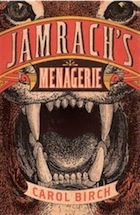
Jamrach’s Menagerie by Carol Birch

When young Jaffy Brown comes face to face with an escaped tiger in the streets of London, it leads to him being offered a job with Mr Jamrach, a dealer in wild animals. For the next few years Jaffy works at Jamrach’s menagerie, helping to take care of the animals – until one day he gets the chance to go to sea in search of a very special creature…

This novel, the first I’ve read by Carol Birch, grabbed me from the very first page. It was everything I love in a book: historical fiction set in the Victorian period with a fast-paced plot and quirky, interesting characters. When a few chapters into the novel Jaffy set off on his voyage and it became clear that most of the book was going to take place at sea I was slightly worried as I often find seafaring stories boring – but not this time! I was pleased to find that I enjoyed reading about Jaffy’s adventures on board the Lysander, visiting distant lands and battling against storms, starvation and superstition as much as I enjoyed the chapters set in working-class 19th century London.

From tigers and whales to exotic birds and giant reptiles we encounter a large number of animals, both at Jamrach’s London menagerie and in their natural habitat (and be warned that Birch doesn’t shy away from describing the cruel ways in which these creatures were treated in the 19th century). But more importantly, we learn a lot about human nature, about friendship, love and loyalty. Jaffy, as our narrator, is the character around whom all the others revolve including Ishbel, the girl he loves; Tim, his childhood friend and rival; and Dan Rymer, the older sailor who becomes a father figure to the boys.

Birch’s writing is atmospheric and descriptive, giving the story an almost supernatural, mystical feel at times. And although there were a few occasions where I thought the plot suffered slightly from taking second place to the detailed descriptions, for the most part I found the book completely gripping. A good old-fashioned adventure story and a very enjoyable and entertaining read!

The Seas by Samantha Hunt

If you’ve been following this year’s Orange Prize for Fiction, it probably won’t have escaped your attention that the shortlist was announced on Tuesday (following the earlier announcement of the longlist last month). I don’t necessarily have any plans to read all of the books on either list, but am picking out the ones that sound appealing or that I can get hold of easily. The Seas is one of the longlisted titles that didn’t make the shortlist. This book (which was Samantha Hunt’s first) was originally published in 2004, but became eligible for the Orange Prize after being published in the UK last year.

Ever since she was a little girl and her father told her she was a mermaid, the unnamed narrator of The Seas has felt different from everyone else in her town. Now, at the age of nineteen there are two main influences on her life: one is her love for Jude, an older man who has recently returned from fighting in Iraq. The other is the lonely, oppressive atmosphere of the town itself – a town so far north ‘the highway only goes south’ – and the sea that surrounds it.

There is a lot of this kind of sadness here. It slips in like the fog at night. The fog that creeps out of the ocean to survey the land that one day she thinks will eventually be hers.

This is not the type of book I usually choose to read, but sometimes it’s good to take a risk and try something a bit different. And The Seas is certainly different! As well as being a strange and unusual novel, it’s also a surprisingly short one. In just 200 pages, Samantha Hunt manages to cover a number of topics such as the Iraq War, post traumatic stress disorder and mermaid mythology – as well as creating some interesting minor characters, including the narrator’s grandfather, a retired typesetter who is busy working on a new dictionary – yet I never felt that the author had tried to pack too much into too few pages, which proves that sometimes a book doesn’t have to be long in order to say everything it needs to say.

Although there didn’t seem to be much of a plot and I wasn’t sure where everything was leading, I enjoyed the first half of the book and was pulled into the narrative by the quality of the beautiful, dreamlike prose, filled with wonderful ocean imagery. It wasn’t enough to hold my attention right to the final page, though, and towards the end of the book I started to lose interest. Sadly there were too many things about this book that didn’t quite work for me, but overall I thought it was an impressive debut novel.