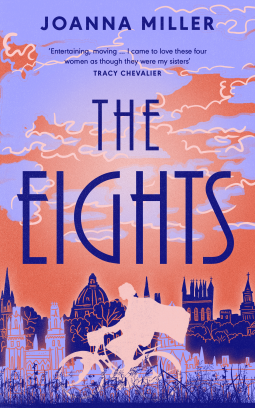
 Although women had been able to study at Oxford University since the 19th century, October 1920 marked the first time they were able to matriculate (or be formally admitted). In her new novel, The Eights, Joanna Miller imagines the stories of four fictional women who were part of this historic moment.
Beatrice Sparks, Theodora Greenwood, Marianne Grey and Ottoline Wallace-Kerr refer to themselves as the Eights because they occupy the four rooms on corridor eight of St Hugh’s, one of the Oxford colleges that is admitting female students. They also each have a name with eight letters, something which pleases Otto, who is a mathematician and loves the number eight. Otto’s family and friends, who are wealthy socialites, are surprised by her decision to study for a degree rather than concentrate on making a good marriage, but Otto is desperate to prove herself after feeling that she failed as a VAD nurse during the war.
Beatrice is the daughter of a suffragette and has grown up in the shadow of her formidable, overbearing mother. For her, university means independence, freedom and a chance to lead her own life at last. Theodora – known as Dora – is also grateful for the opportunity she has been given, but at the same time she feels a sense of guilt knowing that her brother, who was killed in the war, was supposed to be the one to go to Oxford. Dora also lost her fiancé in the war and she’s still struggling to come to terms with both tragedies. The final member of the Eights is Marianne, the quiet, clever daughter of a widowed vicar. Marianne seems to have led a sheltered life compared to some of the other girls at St Hugh’s, but she has a secret that she’s determined to keep hidden.
The Eights describes the experiences of these four young women during their first year at Oxford. There’s not really an overarching plot – more a series of episodes – but I didn’t have a problem with that as I was so absorbed in the lives of the four main characters. My favourite was probably Marianne, but I liked and admired all of them and enjoyed watching their friendships develop over the course of the year. The women all face a different set of challenges and struggle with self-doubt – about fitting in, coping with the work or living up to expectations – and it was good to see them grow in confidence and overcome some of the obstacles in their way. I liked the use of flashbacks to provide background information about each woman and the very different paths they followed that led them to Oxford.
Obviously I wasn’t at Oxford in 1920, so I have no idea how accurate the book is – all I can say is that the setting feels very authentic and it’s clear that Joanna Miller has done her research. She weaves historical detail throughout the novel, often beginning chapters with a real newspaper excerpt or a set of university rules and regulations (which illustrate the double standards in the way male and female students were treated). There’s a glossary at the end, as some readers may be unfamiliar with the academic terms used in the book, many of which are unique to Oxford. There are also some cameo appearances from real-life authors Vera Brittain and Winifred Holtby, who are attending Somerville College, one of Oxford’s other women’s colleges.
My only real criticism is that I found Marianne’s secret far too easy to guess and would have preferred to have been surprised by it, like the other students were. Otherwise, I really enjoyed this book and loved getting to know the Eights. It would be good to meet them again when they return for their second year at Oxford!
Thanks to Fig Tree for providing a copy of this book for review via NetGalley.

 She Reads Novels