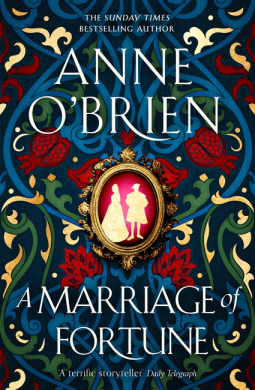
 This sequel to The Royal Game continues the story of the Paston family. The Pastons were an influential Norfolk family during the 15th century and left behind a collection of private correspondence, known as the Paston Letters, which are a valuable source of information on life in England at this time. In this novel and her previous one, Anne O’Brien brings the story of the Pastons to life, using their letters to provide the outline of the plot. You could read this book as a standalone if you wanted to, but I would recommend reading both in order if you can.
A Marriage of Fortune is again narrated by several of the Paston women. First there’s Margaret Mautby Paston, now a widow with seven children. Her eldest son, Sir John, is now head of the family following the death of his father, but Margaret still takes an active part in managing the household, arranging the marriages of her younger children and continuing the ongoing feud against the Duke of Norfolk over the ownership of Caister Castle. Margaret’s priority is seeing that the Pastons continue to rise through the ranks of society, so she is furious when her eldest daughter Margery announces that she is in love with the family bailiff, Richard Calle. She refuses to allow a marriage between the two, but is unprepared for the lengths to which Margery is prepared to go.
The relationship between Margaret and Margery is very sad to read about. Margery is another of our narrators, which means we get to know exactly how she feels about her mother’s refusal to accept her love for Richard and the family estrangement that occurs as a result. Margaret believes that a daughter’s first duty should be to her parents and that Margery has no right to consider her own happiness, but there’s always a sense that she might come to regret taking this stance and we are kept wondering whether mother and daughter will be reconciled in the end.
We also hear from Margaret’s sister-in-law, Elizabeth Paston Poynings, whose husband has been killed fighting on the Yorkist side at the Second Battle of St Alban’s, leaving her a widow with a young son. Like Margaret, Elizabeth has found herself facing a struggle to hold on to her late husband’s estates, which are being claimed by the powerful Percy family. A fourth narrator is Anne Haute, cousin of Elizabeth Woodville, Edward IV’s queen. Anne is betrothed to Margaret’s son, Sir John Paston, but with the rapidly changing political situation in England – Edward IV on the throne one minute, Henry VI the next – it seems that Sir John is reluctant to either make the marriage official or release her from it. I had a lot of sympathy for poor Anne when she begins to discover that she’s wasted years of her life on a man who clearly doesn’t really love her.
I enjoyed A Marriage of Fortune; this is one of my favourite periods to read about, but I still haven’t read the original Paston Letters or Helen Castor’s non-fiction account of them, Blood and Roses, despite having had the latter on my TBR pile for several years now. This was maybe a good thing as far as this novel was concerned, as it meant that although I was familiar with the historical background – the kings and queens, the battles and rebellions – I didn’t know the personal stories of the individual Paston family members, so I never knew what was going to happen to them next. However, I do think this novel, like the first one, was slightly too long, with a lot of information packed into it. It may have been better to have focused on fewer characters; Elizabeth Poynings’ story, in particular, felt very separate from the others and could possibly have been left out.
I’m not sure whether there will be a third book on the Pastons or whether Anne O’Brien will be moving on to something else now. Either way, she always chooses interesting historical women to write about so I know it will be worth looking forward to.
Thanks to Orion for providing a copy of this book for review via NetGalley.
This is book 2/50 read for the 2023 Historical Fiction Reading Challenge.

 She Reads Novels