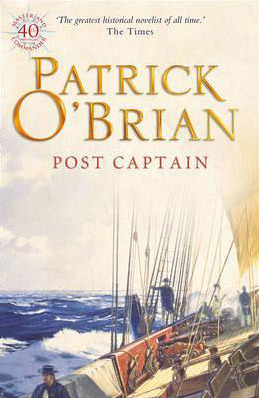
 This is the second book in Patrick O’Brian’s Aubrey-Maturin series following the adventures of Royal Navy Captain Jack Aubrey and his friend, ship’s surgeon Stephen Maturin.
Post Captain continues the story begun in Master and Commander. As the novel opens, the French Revolutionary Wars have come to a sudden end with the Peace of Amiens and Aubrey and Maturin have returned to England where Jack has rented a country estate – which happens to be near the home of Mrs Williams, a lady with several daughters of marriageable age. For the first hundred or so pages of the book, we follow Jack and Stephen as they live the lives of country gentleman, attending social engagements and becoming involved in complex romantic relationships with the eldest Williams daughter, Sophia, and her widowed cousin, Diana Villiers.
This period of peace soon comes to an end, though. Jack and Stephen are forced to flee to France when Jack finds himself in financial difficulties and while they are there, war breaks out again. The rest of the book centres around their return to naval action, Jack’s efforts to avoid being arrested for debt, and the conflict between Jack and Stephen caused by their involvement with Sophie and Diana.
After I posted my thoughts on the previous book, Master and Commander, and mentioned my general dislike of nautical books, I was told that this one might be more to my taste as it had more land-based action. And I did enjoy this book a lot more than the previous one. I still struggled at times with the sea battles and naval terminology, but I think I can cope with not being able to follow all the details of what is happening as long as I can understand the final outcome. As for the land-based chapters, I don’t think I’ve ever read anything more Austenesque that wasn’t actually written by Jane Austen! The Austen comparison, by the way, is not just because of the plot but also the writing style and language.
The fact that fewer pages are devoted to descriptions of naval action means there’s lots of time to develop the two main characters and explore various aspects of their personalities and their relationships. I also enjoyed meeting Sophie and Diana and I look forward to getting to know them better. Obviously when Aubrey and Maturin are at sea it’s a very male-dominated environment, so I was pleased to see that O’Brian also writes such convincing female characters.
With the friendship between Jack and Stephen being threatened by their romantic entanglements, there’s a lot of tension in this book but there are plenty of funny moments too, including a scene with a dancing bear on the road to Spain. I also loved Stephen’s attempts at beekeeping while at sea…
“There! A glass hive. Is it not ingenious, charming? I have always wanted to keep bees.”
“But how in God’s name do you expect to keep bees on a man-of-war?” cried Jack. “Where in God’s name do you expect them to find flowers, at sea? How will they eat?”
“You can see their every motion,” said Stephen, close against the glass, entranced. “Oh, as for their feeding, never fret your anxious mind; they will feed with us upon a saucer of sugar, at stated intervals. If the ingenious Monsieur Huber can keep bees, and he blind, the poor man, surely we can manage in a great spacious xebec?”
Having enjoyed this book so much, I now feel much more enthusiastic about reading the rest of the series than I did after the first book. I’m looking forward to H.M.S Surprise!
 She Reads Novels