Review: The Victorian Chaise-longue by Marghanita Laski

Of all the books in the Persephone catalogue this is the one I’ve been looking forward to reading the most. Maybe it was the word ‘Victorian’ that appealed to me (I’m slightly obsessed with the Victorian period) or maybe it’s just that it has sounded so fascinating in every review I’ve read. I’ve seen this book described as a horror story – ‘a little jewel of horror’. For me, though, it wasn’t so much frightening as unsettling and creepy.

Melanie Langdon is a young mother recovering from tuberculosis in bed at her home in 1950s London. When the doctor tells her she can move to another room for a change of scenery, Melanie decides to lie on the chaise-longue in the drawing room, an ugly item of Victorian furniture she had purchased in an antique shop.

Melanie lies on the chaise-longue and falls asleep – but when she awakens, something has changed. She’s still lying on the same chaise-longue, she still has TB, but it’s now the year 1864, she’s being cared for her by her hostile sister Adelaide, and her name is no longer Melanie – it’s Milly. Is Melanie dreaming? Remembering a previous life? Has she really travelled back in time and become somebody else?

Who is Milly Baines? came the gradual inquiry, and at last she looked, as she had not dared to before, at what was immediately around her, examined, tested, interpreted the feeling of this body of Milly Baines in which was imprisoned the brain of Melanie Langdon.

I have to admit I’m not sure that I fully understood what was supposed to be happening in this book. After thinking about it though, maybe that was the point – the reader isn’t supposed to understand because Melanie herself doesn’t understand. The book conveys a sense of confusion, panic and disorientation and I could really feel Melanie’s helplessness as she lay on the chaise-longue, trapped in Milly’s body, desperately trying to work out who she was and how she could escape.

What makes Melanie’s story so disturbing and nightmarish is that although she has apparently been transported back in time, she has kept all of her twentieth-century ideas and sensibilities. As Milly, she finds herself a victim of the repression of Victorian society and there’s nothing she can do to change her situation.

At only 99 pages, this book can easily be read in an hour, but there’s so much packed into those 99 pages that the story will stay in your mind for a lot longer than that.

Recommended

Good Evening, Mrs Craven: The Wartime Stories of Mollie Panter-Downes

Mollie Panter-Downes was the London correspondent for the New Yorker and this collection from Persephone Books brings together a number of her contributions to the magazine which were written during World War II. The book opens with her Letter from London dated 3 September 1939 and ends with another dated 11 June 1944. Between the two letters are twenty-one short stories, each of which offers an insight into the hopes and fears of British people trying to deal with the changes the war has brought to their lives.

These stories are not particularly dramatic or sensational in any way. They are realistic stories that focus not so much on the war itself, but on the effects of the war on the women (and a few of the men) who were left behind at home. We read about women attending sewing parties, worrying about loved ones who are away fighting, preparing for their husbands to go to war, coping with being pregnant during the war and experiencing almost any other wartime situation you can think of.

After finishing the book, there are a few stories that stand out in my memory more than the others. In Clover, for example, is a story about a rich woman called Mrs Fletcher who takes in a family of evacuees from a poor part of London. This was an interesting study into how the war pushed together people of different social backgrounds who wouldn’t usually have mixed with each other. This Flower, Safety follows Miss Mildred Ewing as she moves from one hotel to another in an attempt to escape from danger, beginning to despair of ever finding somewhere safe to live. Then there’s the story of Miss Burton, who is so hungry she can think about nothing else. The title story is also one of the best; it’s about a woman who has been having an affair with a married man. On the evening before he leaves to go to Libya, she wonders how she’ll be able to find out whether he’s dead or alive:

“Don’t think I’m being stupid and morbid,” she said, “but supposing anything happens. I’ve been worrying about that. You might be wounded or ill and I wouldn’t know.” She tried to laugh. “The War Office doesn’t have a service for sending telegrams to mistresses, does it?”

The stories are published in chronological order, as they appeared in New Yorker between 1939 and 1944, showing how life in Britain changed as the war progressed. Despite the subject matter, these stories are not all bleak and depressing – there’s also a lot of humour in Panter-Downes’ writing, in the form of gentle wit and irony.

As with most of the short story collections that I’ve read, there were some that didn’t interest me very much, but others that I loved and wished were longer. However, I think reading them all at once was a mistake as it was a bit too much for me. I think I would have enjoyed this collection even more if I had dipped in and out and taken the time to appreciate each story individually.

Recommended.

Review: Miss Ranskill Comes Home by Barbara Euphan Todd

Barbara Euphan Todd was best known as the children’s author who wrote the Worzel Gummidge series about a scarecrow who comes to life. Miss Ranskill Comes Home, first published in 1946, was her only adult novel.

Shortly before the start of World War II, Nona Ranskill was swept overboard whilst on a cruise and was washed up on a desert island. The only other inhabitant of the island is a man known as ‘the Carpenter’, who had also fallen overboard on an earlier occasion. At the beginning of the book, the Carpenter has died and we first meet Miss Ranskill as she’s digging his grave. Before his death however, he had managed to finish building a boat with which he had intended to sail himself and Miss Ranskill to safety. After burying the Carpenter, Miss Ranskill makes an attempt to escape from the island on her own. Luckily, before she becomes hopelessly lost at sea, she is rescued by the British Navy. Returning to England after almost four years, Miss Ranskill discovers that it’s not the England she left behind: in her absence, World War II has begun…

This may all sound very far-fetched, but Todd actually makes it seem believable. I thought the whole idea of someone being cut off from the world and returning home only to find themselves suddenly thrown into the middle of a war was absolutely fascinating. I particularly enjoyed the first half of the book which deals with the first few days of Miss Ranskill’s arrival in England, when everything feels strange and surreal. Even the English language seems different and full of unfamiliar words. When she tries to buy food she can’t understand why she’s asked for her ‘ration book’, or why she needs ‘coupons’ to purchase clothes. This leads to some very amusing situations but at the same time you can’t help but feel sorry for poor Miss Ranskill.

Although he’s dead before the story even begins, the strongest character in the book is the Carpenter. He is constantly in Miss Ranskill’s thoughts and his presence is there on almost every page in the form of flashbacks and memories. Although Miss Ranskill’s friends found it scandalous that she had spent four years in the company of a strange man – particularly a man they consider to be of a lower social standing – I think anyone who has read this book will agree that if we were stranded on a desert island, the Carpenter is exactly the type of person we would like to be stuck there with.

Makes it more homely-like, Miss Ranskill, see.
That had been one of his favourite expressions. He used it as he arranged stones round the smoky fire, and when he handed her a shell.
Saucer, see, Miss Ranskill. We mayn’t have cups, but we’ve plenty of saucers. Makes it more homely.

His optimism and words of wisdom had helped to sustain Miss Ranskill during her time on the island and continue to give her comfort on her return to wartime Britain. However, the years on the island and the company of the Carpenter have given her a new outlook on life and she finds it difficult to adjust. Unlike her friends and family who are all absorbed in their war work, Miss Ranskill feels detached from what’s going on and spends most of the book remembering the island and even feeling nostalgic about the fact that she had to eat fish for every meal and wear the same clothes for nearly four years! England may have changed, but Miss Ranskill has changed even more.

This book has the perfect blend of humour and poignancy and gives us an opportunity to explore World War II from a unique perspective. Recommended.

Pages: 328/Publisher: Persephone Books/Year: 2003 (originally published 1946)/Source: Library book

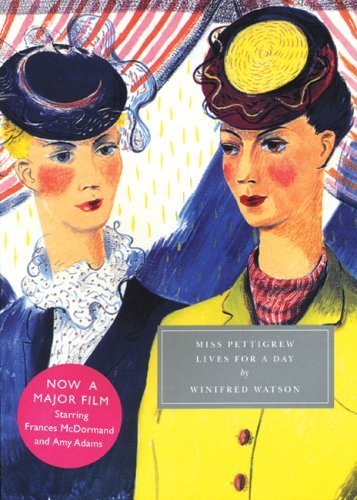
Review: Miss Pettigrew Lives for a Day by Winifred Watson


“She, Miss Pettigrew, spinster, maiden lady, dull nonentity, jobless, incompetent, was bound for a night club, clad in splendour: painted like the best of them, shameless as the worst of them, uplifted with ecstasy…”

Although I didn’t participate in the Persephone Reading Week hosted by Claire and Verity last month, I enjoyed reading everyone else’s reviews and they made me want to read some Persephone books myself. Miss Pettigrew Lives For a Day seems to be the usual recommendation for someone who is new to Persephone – I was a bit unsure about reading it because it didn’t sound like the kind of book I would usually choose to read, but when I found it in the library I grabbed it and immediately started reading it to see why so many people love the book so much.

Before I even started to read the story though, I was pleased to discover that Winifred Watson was from Newcastle like me. There are not many authors from the North East of England who have been internationally successful, so it’s quite exciting to unexpectedly discover one!

Now, what about the novel itself? I’ve seen it described as a romantic comedy, a fairy tale and a Cinderella fantasy – and it’s all of those things and more. It tells the story of Guinevere Pettigrew, a timid middle-aged governess.  When her employment agency accidentally send her to the wrong address, she finds herself at the home of the beautiful young actress and singer, Miss LaFosse.  Waiting for the right moment to tell Miss LaFosse that she thinks there’s been a mistake, and realising that her new friend needs her help, Miss Pettigrew is swept into a glamorous world of night clubs and cocktail parties – and to her surprise, discovers that she’s enjoying every minute of it!

I found Miss Pettigrew Lives for a Day very easy to read, and with the entire story taking place in a day, it moved along at a fast pace.  The perfect choice if you’re in the mood for something light hearted, fun and frivolous.  Although it didn’t immediately become a favourite book, it was a lively, entertaining read full of amusing scenes and witty dialogue that made me smile.  Here Miss Pettigrew attends a party wearing make-up and fashionable clothes for the first time in her life:

“I think,” said Miss Pettigrew simply, “I will stand just over there, so that if I look up I can see myself in the mirror across the room…I am not accustomed to myself yet, and if I can glance up every now and then merely to reassure myself of what I don’t look like, it will give me tremendous strength and encouragement”.

Although the book was written in the 1930s and does have a certain old fashioned charm, it still has a lot of relevance. I’m sure we’d all love to have a day like Miss Pettigrew’s where all our dreams comes true and we finally do all the things we’ve never been brave enough to do before.

I did like this book – and was surprised by how much I enjoyed it, as I wasn’t really expecting to – but I didn’t love it and will wait until I’ve read more Persephone books before I make up my mind about them. I have Little Boy Lost by Marghanita Laski waiting to be read and I think that one will probably be more to my taste.

As a side note, I really loved the illustrations in this book! It’s always nice to see illustrations and these beautiful drawings by Mary Thomson really added something extra to the story and helped bring the scenes to life.

Recommended

Publisher: Persephone Books/Year: 2008 (originally published 1938)/Pages: 256/Source: Library book