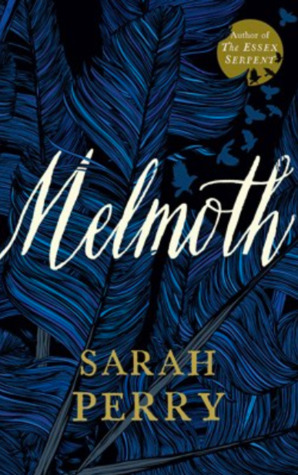
 Having read Sarah Perry’s previous novel, The Essex Serpent, last year, I was looking forward to reading her new one, Melmoth. I read it in October, just before Halloween, and found it the perfect read for the time of year: dark, atmospheric and Gothic. It’s very different from The Essex Serpent, but with some similar ideas and themes.
At the centre of the novel is the legend of Melmoth the Witness, the woman who stood by Christ’s empty tomb and denied the Resurrection. As punishment for lying about what she had witnessed, she is condemned to wander the earth alone forever, dressed in black and with bare, bleeding feet, forced to bear witness instead to all of the cruelty and misery humans cause for one another. Desperate for some company in her exile, she appears to those who have lost hope and holds out her hand to them, urging them to join her in her wandering.
Helen Franklin, an Englishwoman who lives in Prague where she works as a translator, is fascinated by the tale of Melmoth. Her friend Karel, a Czech academic, has inherited a collection of papers which explore Melmoth’s story, and he passes these on to Helen. As she delves more deeply into the subject, she discovers more documents and journals giving different accounts of Melmoth from earlier times and from around the world. But the story of Melmoth could have a personal significance for Helen herself – because Helen is hiding a secret of her own, which could make her an ideal target for a mysterious woman in black.
Melmoth is a wonderfully atmospheric novel, partly because Prague is such a great setting which lends itself to strong, vivid descriptions, but I think Sarah Perry’s writing style also adds to the mood. Here is the opening paragraph in which we are introduced to Helen Franklin for the first time:
“Look! It is winter in Prague: night is rising in the mother of cities and over her thousand spires. Look down at the darkness around your feet, in all the lanes and alleys, as if it were a soft black dust swept there by a broom; look at the stone apostles on the old Charles Bridge, and at all the blue-eyed jackdaws on the shoulders of St John of Nepomuk. Look! She is coming over the bridge, head bent down to the whitening cobblestones: Helen Franklin, forty-two, neither short nor tall, her hair neither dark nor fair…”
The writing style and some of the devices the author uses, such as speaking directly to the reader, give it an almost timeless feel; although the main part of the novel is set in the modern day, there’s a sense that it could have taken place at any time in history – and of course, the Melmoth legend is a very old one. Through the stories-within-stories which emerge as we continue to read, we see how the influence of Melmoth has touched the lives of not just Helen Franklin, but many other characters throughout history, the most memorable being a boy who faces the horrors of the Holocaust. I enjoyed some of the stories while others interested me less and in the middle of the book I found my concentration wandering; the writing style, which works so well in other ways, creates a distance between the reader and the characters and I felt that I was watching them from afar rather than engaging with them as real people.
On the whole, I preferred The Essex Serpent, but I did love what this book had to say about forgiveness, atonement and loneliness. I’ve also been reminded of Charles Maturin’s 1820 novel, Melmoth the Wanderer, which it might be interesting to read and compare with this one.
 She Reads Novels