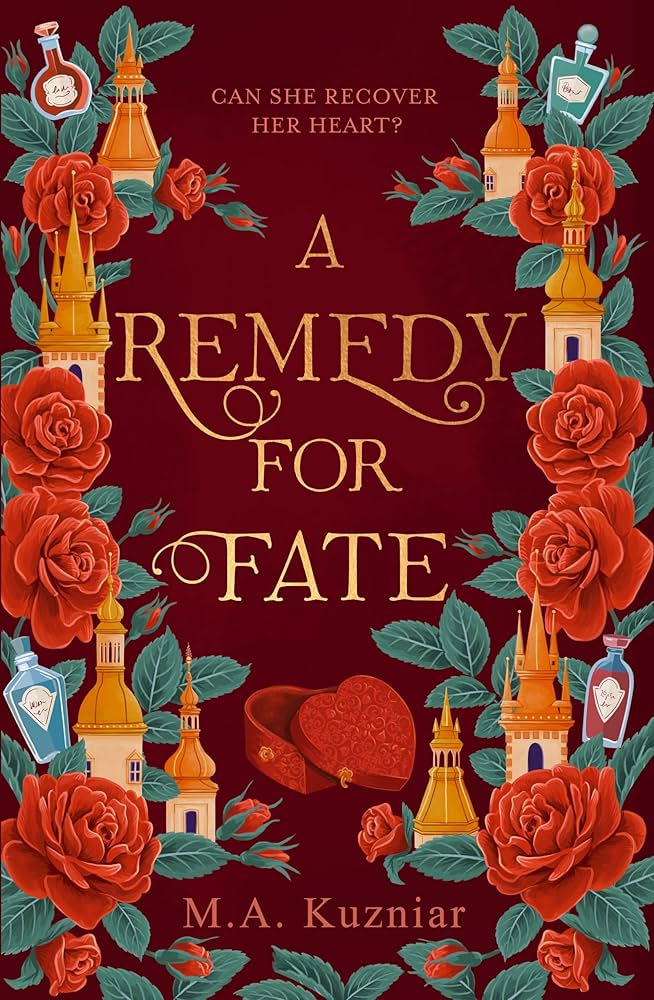
A Remedy for Fate by MA Kuzniar

I wasn’t sure whether to read this as I didn’t care for MA Kuzniar’s previous book, Midnight in Everwood, but I loved the idea of a story set in 18th century Prague so I decided to give her a second chance. I’m glad I did as I thought this book was much better.

A Remedy for Fate is very loosely based on the fairy tale Rumpelstiltskin and is written from the perspective of Thea, a ‘fate weaver’ who runs Stiltskin’s Apothecary, brewing special potions that can change her customers’ futures – for a terrible price. Thea herself paid that price seven years earlier when she agreed to lose her memories and her heart for reasons she can no longer remember and in return has been given the ability to weave fates. Although she’s still human, Thea’s body is held together by a spell controlled by her employer, Jasper Stiltskin. The only way to free herself from the spell is to correctly guess her birth name, which she has forgotten as it’s yet another memory taken from her by Jasper.

The Apothecary is located in Prague’s Magic Quarter, a secret world hidden beneath the city which can only be accessed by people in need of help. However, the protections that keep the Magic Quarter safe from those who wish it harm are starting to break down, allowing entry to the sinister Magic Hunters who are determined to find the evidence they need to close the whole area down.

Although the historical Prague setting was the thing that attracted me to this book, I found that we didn’t actually see as much of Prague as I’d expected. Although Thea does occasionally venture up into the city, most of the action takes place in the Magic Quarter, which is described very vividly – a maze of narrow streets, wreathed in mist and lined with enchanted pastel-painted shops. It’s also populated with colourful characters including Pani Dagmar, an elderly witch who claims to be five hundred years old; Wojslav the vampire, who leads a solitary life running an antique shop; and Thea’s friend Zofka, the kitchen-witch, who bakes magical cakes and pies. The world-building is wonderful and I loved the way Kuzniar creates a feeling of community where the residents of the Magic Quarter, despite not always seeing eye to eye, all come together to fight the forces threatening their lives and livelihoods.

Because the story is set mainly in the Magic Quarter, a fantasy land which is very separate from Prague itself, there’s very little sense of the time period. Apart from some references to Empress Maria Theresa’s recent banning of witch burning and torture in 1768, I felt that the book could really have been set in any period, past, present or future. I also thought Thea, although she’s supposed to be a woman in her thirties, felt much less mature and the book in general, like Midnight in Everwood, seemed to be aimed more at younger readers, despite them both being marketed as adult novels. Not necessarily a problem, but something to be aware of if you’re planning to read them.

Thea’s actions frustrated me at times, but I thought Jasper was a great character and I enjoyed watching his relationship with Thea unfold and change throughout the book. The answer to the question of Thea’s real name seemed quite obvious to me, though, and I’m surprised she was having so much trouble guessing it! Overall, then, I found this an entertaining read, with just a few negative points, and the writing style didn’t irritate me the way it did in Midnight in Everwood. I would be happy to try Kuzniar’s other adult novel, Upon a Frosted Star, which is based on Swan Lake.

Thanks to Hodderscape for providing a copy of this book for review via NetGalley
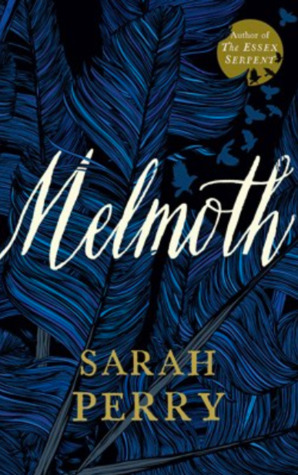
Melmoth by Sarah Perry

Having read Sarah Perry’s previous novel, The Essex Serpent, last year, I was looking forward to reading her new one, Melmoth. I read it in October, just before Halloween, and found it the perfect read for the time of year: dark, atmospheric and Gothic. It’s very different from The Essex Serpent, but with some similar ideas and themes.

At the centre of the novel is the legend of Melmoth the Witness, the woman who stood by Christ’s empty tomb and denied the Resurrection. As punishment for lying about what she had witnessed, she is condemned to wander the earth alone forever, dressed in black and with bare, bleeding feet, forced to bear witness instead to all of the cruelty and misery humans cause for one another. Desperate for some company in her exile, she appears to those who have lost hope and holds out her hand to them, urging them to join her in her wandering.

Helen Franklin, an Englishwoman who lives in Prague where she works as a translator, is fascinated by the tale of Melmoth. Her friend Karel, a Czech academic, has inherited a collection of papers which explore Melmoth’s story, and he passes these on to Helen. As she delves more deeply into the subject, she discovers more documents and journals giving different accounts of Melmoth from earlier times and from around the world. But the story of Melmoth could have a personal significance for Helen herself – because Helen is hiding a secret of her own, which could make her an ideal target for a mysterious woman in black.

Melmoth is a wonderfully atmospheric novel, partly because Prague is such a great setting which lends itself to strong, vivid descriptions, but I think Sarah Perry’s writing style also adds to the mood. Here is the opening paragraph in which we are introduced to Helen Franklin for the first time:

“Look! It is winter in Prague: night is rising in the mother of cities and over her thousand spires. Look down at the darkness around your feet, in all the lanes and alleys, as if it were a soft black dust swept there by a broom; look at the stone apostles on the old Charles Bridge, and at all the blue-eyed jackdaws on the shoulders of St John of Nepomuk. Look! She is coming over the bridge, head bent down to the whitening cobblestones: Helen Franklin, forty-two, neither short nor tall, her hair neither dark nor fair…”

The writing style and some of the devices the author uses, such as speaking directly to the reader, give it an almost timeless feel; although the main part of the novel is set in the modern day, there’s a sense that it could have taken place at any time in history – and of course, the Melmoth legend is a very old one. Through the stories-within-stories which emerge as we continue to read, we see how the influence of Melmoth has touched the lives of not just Helen Franklin, but many other characters throughout history, the most memorable being a boy who faces the horrors of the Holocaust. I enjoyed some of the stories while others interested me less and in the middle of the book I found my concentration wandering; the writing style, which works so well in other ways, creates a distance between the reader and the characters and I felt that I was watching them from afar rather than engaging with them as real people.

On the whole, I preferred The Essex Serpent, but I did love what this book had to say about forgiveness, atonement and loneliness. I’ve also been reminded of Charles Maturin’s 1820 novel, Melmoth the Wanderer, which it might be interesting to read and compare with this one.

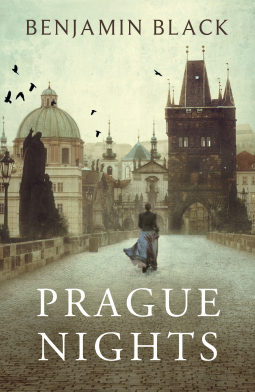
Prague Nights by Benjamin Black

I had never heard of Benjamin Black until I spotted his new novel available on NetGalley, but I quickly discovered that it is a pseudonym of the Irish author better known as John Banville. Not having read anything by Banville either, I had no idea what to expect from Prague Nights, but the title was enough to make me interested in reading it (note: the US title is Wolf on a String) – Prague is a beautiful city and one I would recommend visiting, if you haven’t already. To experience Prague as it is in this novel, however, you would need a time machine as the action takes place more than four hundred years ago, at the end of the sixteenth century.

It’s 1599 and Christian Stern, a young doctor from Regensburg, has just arrived in Prague. On his first night in the city he stumbles across the dead body of a young woman half buried in snow. He reports his discovery and expects that to be the end of the matter, so he is shocked when he is accused of killing the girl himself. Her identity is given as Magdalena Kroll, mistress of the Holy Roman Emperor Rudolf II and daughter of his ‘chief wizard’ Ulrich Kroll. Stern knows he is in serious trouble, but fortunately for him, the emperor – a superstitious man with a strong belief in the occult – believes him to be a messenger whose arrival in Prague had been predicted in a prophecy.

Freed of suspicion now, Stern is given the task of discovering who really did kill Magdalena Kroll. It is a mission which will bring him into conflict with some of the most powerful men in Prague, embroil him in a love affair with another of the emperor’s mistresses, Caterina Sardo, and send him to the town of Most in search of the English occultist Edward Kelley, who it is believed may hold the key to the mystery.

Prague Nights is one of those books that sounds as though it should be much better than it actually is. That’s not to say that I didn’t like it at all, because there were some aspects that I enjoyed, which I’ll return to shortly, but it definitely wasn’t the atmospheric, exciting historical mystery novel I had hoped it would be. I was disappointed that it wasn’t really much of a mystery; yes, there is a murder at the beginning and we find out who was responsible for it at the end, but in between, our narrator, Christian Stern, makes very little effort to actually investigate. Things happen around him but he takes no active part and by the time I reached the end of the book, I found that I no longer really cared how Magdalena Kroll had died and why.

The writing style is descriptive and detailed with a formal feel which suits the time period and the descriptions of Prague’s buildings, bridges and cobbled streets and squares are nicely done:

I had often tried to imagine Prague and its glories, but the reality of it was grander and more gracious than anything I could have dreamed of. Past the castle, we stopped on the height there to look out over the city. The sky was white and the air was draped with a freezing mist, pierced by many spires, all of them appearing black in that pervasive icy miasma. Despite the wintry murk, I could see the river and its bridges and, beyond, the clock tower in the Old Town Square.

This wasn’t enough to make me love the book, however. To be able to love a book I need to at least feel something for the characters and unfortunately I felt very little for Christian Stern or any of the other people who play a part in the novel. That’s particularly frustrating because, in real life, Rudolf II and the members of his court sound fascinating, especially his son, Don Julius Caesar. In his author’s note, Benjamin Black talks about the historical figures on which his characters are based, explaining where he sticks to factual information and where he uses his imagination. As I previously knew nothing about 16th century Prague or Rudolf’s court, it was good to have the opportunity to learn something new, even if the story itself didn’t really succeed in holding my attention.

Have you read anything by Benjamin Black/John Banville? And do you have any other books set in Prague to recommend?