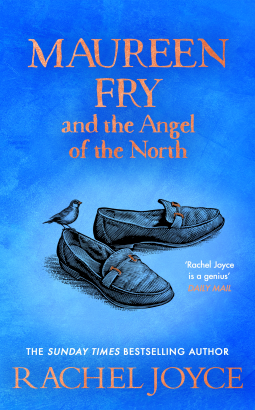
 Almost ten years ago I read Rachel Joyce’s first novel, The Unlikely Pilgrimage of Harold Fry, in which a man sets out to walk almost the entire length of England, from his home in Devon to a hospice in Berwick-upon-Tweed, to visit an old friend who has been diagnosed with cancer. A second book followed – The Love Song of Miss Queenie Hennessy, written from the friend’s perspective – but I didn’t read that one. Maureen Fry and the Angel of the North is the final part of the trilogy and I wondered whether I would struggle with it because of not having read the middle book first, but luckily that wasn’t the case.
At only 133 pages, Maureen Fry is a short, quick read but contains an entire journey, both physical and psychological. This time, though, it’s not Harold who is making the journey, but his wife, Maureen. It’s been several years since Queenie Hennessy’s death but the garden she created in Embleton on the Northumberland coast has become a tourist attraction. Hearing that the garden contains a memorial to her own son, David, who committed suicide, Maureen decides to go and see it for herself. It’s something she wants to do alone so, leaving Harold behind, she prepares to head north – not on foot like her husband, but by car.
I found the title of the book intriguing because the obvious reference is to the Angel of the North, Antony Gormley’s sculpture of the same name that stands on a hill overlooking the A1 in Gateshead, just south of Newcastle upon Tyne. I was at Newcastle College on the day it was erected in 1998 and remember watching from the tenth-floor window! Maureen Fry does see the Angel as she drives past, but it’s only mentioned briefly and there are several other possible meanings of the title (although I won’t tell you who or what the other Angels of the North could be). The US version doesn’t refer to angels in the title at all and is simply Maureen, just in case anyone thinks they are two different books!
Maureen’s journey is very different from Harold’s, not just because she chooses to drive instead of walk but also because she has a very different personality. While her husband was easy to like, she is not. She’s rude, unpleasant and unlike Harold, who made new friends during his pilgrimage, Maureen seems to make only enemies. It took me a long time to warm to her at all, but eventually I began to understand the reasons for her behaviour. For such a short book, there’s a lot of emotion within its pages as Maureen begins to face up to the grief she’s been trying to suppress for so many years.
If you’re new to this trilogy, I would definitely recommend reading Harold’s story before Maureen’s. I didn’t feel that I’d missed anything essential by not having read Queenie’s, but I would like to go back and read it now anyway – as well as all the other Rachel Joyce books I still haven’t read!
Thanks to Doubleday for providing a copy of this book for review via NetGalley.

I’m counting this book towards Novellas in November hosted by 746 Books and Bookish Beck.
 She Reads Novels