“Thief and pirate is what you heard Miss Bishop call me today – a thing of scorn, an outcast. And who made me that? Who made me thief and pirate?”
One of my favourite books of last year was Scaramouche by Rafael Sabatini, a classic historical adventure novel set during the French Revolution. I loved it so much I immediately added two more of Sabatini’s books to my Classics Club list – Captain Blood and The Sea-Hawk – though not without some reservations as these are both books about pirates and with my general dislike of books set on ships I thought the seafaring elements might be too much for me. I was wrong. Captain Blood is another wonderful book and I enjoyed it almost as much as Scaramouche!
Peter Blood, an Irish physician and former soldier, is arrested during the Monmouth Rebellion of 1685 when he is discovered tending the wounds of an enemy of King James II. Wrongly found guilty of treason, he is lucky enough to avoid hanging but instead he is sent into slavery on a sugar plantation in Barbados. Here Blood meets two people who will have a huge influence on his future: Colonel Bishop, the cruel, brutal plantation owner and his beautiful niece, Arabella, with whom Blood falls in love. When the island is attacked by Spanish raiders, he seizes his chance to escape by commandeering one of their ships and after transforming himself into the notorious Captain Blood, our hero becomes a pirate both feared and respected throughout the Caribbean.
Sailing up and down the shores of Barbados, Jamaica and Tortuga, Captain Blood becomes involved in a series of exciting adventures and daring escapades, while being pursued by both Colonel Bishop and a Spanish rival, Don Esteban, who has sworn revenge – but what sets Blood apart from the other pirates he meets is his sense of honour and his dream of one day clearing his name and settling down to a peaceful life with Arabella. To the reader, it’s obvious that Peter Blood has become a pirate because he feels he has no choice – his only other option is to remain in slavery – but Arabella doesn’t understand this and when she tells him she can never love a “thief and pirate”, he must find a way to redeem himself in her eyes.
It amazes me that Rafael Sabatini’s books are not more widely read. As well as his great writing style, clever plots and vividly described characters, his novels also have well-researched and believable historical settings. While I was reading this book, I never questioned that I was in the Caribbean of the 17th century, just as when I read Scaramouche I was fully immersed in revolutionary France. And my fears that I might struggle with the pirate theme proved to be completely unfounded!
Sabatini keeps the sailing terminology to a level that even I could cope with and I found that even without understanding every nautical reference it didn’t affect my understanding of the story (which is what I also discovered when I read Master and Commander by Patrick O’Brian earlier this year). Although there were a lot of sea battles, they weren’t too difficult to follow and in fact, not only could I follow them but I actually enjoyed them too, which is something I never thought I would say! I suspect that the descriptions of these battles were not completely realistic and in real life Blood would never have been able to overcome such great odds every time, but with my total lack of naval knowledge I’m happy to pretend that he could.
But Captain Blood is more than just a swashbuckling adventure story and even if it had only been half as exciting, I would still have loved it solely for the great characterisation of Peter Blood, a true romantic hero (in the old-fashioned sense of the term). Like Andre-Louis Moreau from Scaramouche, Edmond Dantes from The Count of Monte Cristo or Francis Crawford from the Lymond Chronicles, Blood is one of those characters who can sometimes seem to be almost superhuman. He has an intelligence and wit superior to everyone else’s, he’s charismatic and quick thinking, multilingual, as talented a swordsman as he is a surgeon, and when it comes to buccaneering, he’s a brilliant leader and tactician. However difficult the situation he and his men might find themselves in, he never fails to come up with an imaginative and ingenious way to get out of it. But despite his perfection or perhaps because of it, things don’t always go smoothly for Captain Blood and like the other characters I’ve mentioned, he experiences a series of injustices and misfortunes that makes him a character we can sympathise with and believe in.
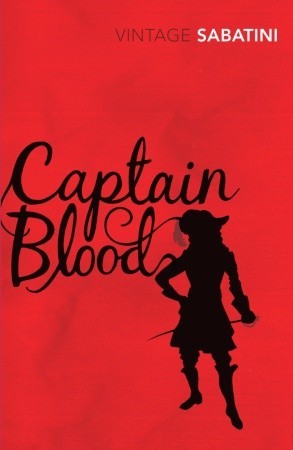
Captain Blood was published in 1922 and is available online as a free ebook, though the edition I read was the Vintage Classics paperback pictured here. I recommend giving it a try even if pirate stories don’t sound appealing to you, as it’s worth reading this one just to meet Peter Blood!
 She Reads Novels