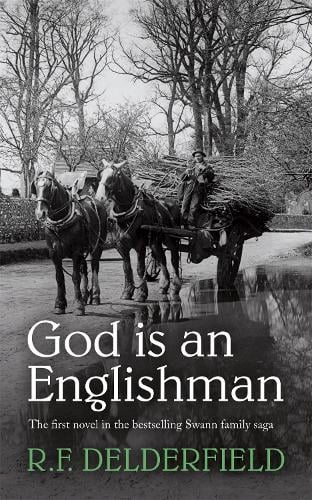
 My final book for this week’s 1970 Club hosted by Simon and Karen is one I was almost certain I would love – and I did! I’ve read several of RF Delderfield’s other books and particularly enjoyed his A Horseman Riding By trilogy, set in rural England during the first half of the 20th century. God is an Englishman, published in 1970, is the first in another trilogy, known as the Swann Saga, which promises to be equally enjoyable.
The novel begins with soldier Adam Swann fighting in India during the Sepoy Mutiny of 1857. In the chaos of the battlefield, Adam stumbles upon a valuable ruby necklace in a broken casket. With no way of finding its rightful owner and reluctant to hand it over to the East India Company, he decides to use it to start a new life for himself. Disillusioned by his experiences with the Mutiny and previously the Crimean War, Adam has been considering resigning from the army anyway and the money from the sale of the necklace will enable him to launch a new business venture.
On his return to England, Adam contemplates investing in railways but a better plan soon begins to emerge. What about the areas of the country that can’t be reached by train? He rides out into the countryside to investigate the possibility of a horse-drawn delivery service and after passing through Seddon Moss, a mill town near Manchester, he has his first encounter with the mill owner’s daughter, Henrietta Rawlinson, who is running away to avoid marriage to a man she doesn’t love. The rest of the novel follows the formation and expansion of Adam’s new business, Swann-on-Wheels, and his relationship with Henrietta as they marry and start a home and family.
At almost 700 pages in the edition I read, this book was quite a commitment, especially as I needed to finish it in time to review this week and should probably have started it earlier. However, once I became absorbed in the story, the pages went by a lot more quickly than I’d expected and I was sorry to reach the end.
While the Horseman Riding By books were set in the countryside with a focus on farming and rural life, this one is set in the very different world of trade, business and industry. It’s fascinating to see how Adam starts with nothing except some jewels and some good ideas and slowly builds up Swann-on-Wheels into a successful haulage company with depots all over the country. Adam gives each region a name (the Border Triangle, the Mountain Square, the Western Wedge…) and each one presents its own unique set of challenges and opportunities depending on the terrain, the existing infrastructure and the industries already operating in that area. He also puts a manager in charge of each area and although some of them are not much more than names on the page, others are brought to life and have adventures of their own.
The broad geographical setting and large number of characters allows Delderfield to address many specific topics and social issues relevant to life in Victorian Britain. Through Henrietta’s father, the miller Sam Rawlinson, we see first the dissatisfaction of the mill workers with their pay and working conditions and later the impact of the reduction in the supply of raw cotton due to the American Civil War. The fate of homeless children and the dangers facing young boys used as chimney sweeps are also explored – and if all of this makes you think of Charles Dickens, there’s a cameo appearance from the man himself as he and several of the Swann family become involved in the Staplehurst rail accident of 1865.
 At the heart of the novel, though, is the relationship between Adam and Henrietta and how it develops as both characters grow and change and make discoveries about themselves and each other. Henrietta, being a lot younger than Adam, is immature, innocent and frivolous at the start of the novel and there’s a sense that although Adam loves her he doesn’t fully understand or respect her. It’s only after the introduction of another woman, Edith Wadsworth, into both their lives, that Henrietta begins to take control of her future and Adam comes to see her as more of an equal. Ironically, Edith, the daughter of one of Swann-on-Wheels’ area managers, is in love with Adam herself, but I won’t tell you what happens there or whether she acts on her feelings!
I think some readers will probably enjoy this book more for the Swann family storylines and others for the insights into the building of a business empire. I found both interesting and felt that Delderfield got the balance between the two just about right. I will be continuing with the second book, Theirs Was the Kingdom!

Book 45/50 for the Historical Fiction Reading Challenge 2024

 She Reads Novels