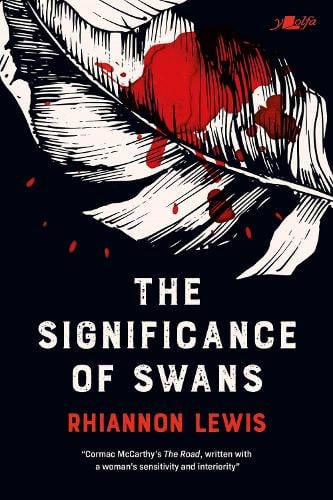
 In this fascinating new dystopian novella, Rhiannon Lewis expands on a short story from her 2021 collection I am the Mask Maker. When I read that short story, I actually mentioned in my review that it was one I found particularly intriguing and wished was longer, so I was pleased to learn that my wish had come true!
The book begins with Aeronwy visiting her brother at his farm on the Welsh coast. Just before she says goodbye and returns home, they spot the unusual sight of seven swans flying in formation through the winter sky. The next day thousands of disappearances are reported – not just in Aeronwy’s small corner of Wales, but all over the country and beyond.
As the days and weeks go by, the overnight ‘removals’, as they become known in the media, continue. Every morning, people awake to find an empty space in their bed, the impression left by their partner’s body still visible; every morning, adults fail to arrive at work and children fail to attend school. Aeronwy and her husband do their best to continue with their lives, hoping that whoever or whatever is behind the removals will leave them alone, but the rapidly declining population means that public services and infrastructure are affected and soon there’s no more television, no more radio, no way of finding out what’s going on in the outside world. Eventually, the inevitable happens and Aeronwy’s husband is removed. She sets out alone to make the hundred-mile journey to her brother’s farm, in the hope that he might still be alive, but what will she find when she gets there?
I don’t read many post-apocalyptic novels, but I find that most of them tend to tackle the same questions. What caused the apocalyptic event? Is there a reason why some people were able to survive and not others? If we meet another human being, can they be trusted or will they see us a threat to their own survival? Will it be possible to build a better world from the ruins of the old one? In The Significance of Swans, Rhiannon Lewis does explore these things and provides some answers, while leaving other issues open to interpretation. What makes this book different from others I’ve read is the idea of the seven swans, glimpsed by Aeronwy and her brother the day before the removals begin. The swans appear to have some significance, but what is it?
With the whole book being written from Aeronwy’s perspective, this means we only get a limited view of what is going on, particularly once communication with the rest of the world is lost and she finds herself alone with nobody to talk to. Yet it’s fascinating to see things through Aeronwy’s eyes and to watch this ordinary middle-aged woman from Wales try to make sense of her situation. I thoroughly enjoyed this unusual novella and thought it was the perfect length – long enough to develop the themes hinted at in the shorter version from I am the Mask Maker and short enough to keep things moving at a steady pace without ever becoming boring. I received a copy for review courtesy of Y Lolfa, an independent Welsh publisher. You can find out more about this and the other books they publish here.
 She Reads Novels