Thoughts on finishing The Tawny Man Trilogy (The Golden Fool and Fool’s Fate)

After reading Fool’s Errand a few months ago, I knew I didn’t want to wait too long before reading the other two books in Robin Hobb’s Tawny Man Trilogy; on the other hand, I didn’t want to read them too quickly because then it would all be over and I wouldn’t have them to look forward to anymore (I’m sure I’m not the only one who feels that way about long-anticipated books). Once I started reading The Golden Fool, though, I had to keep going until I’d reached the end of the trilogy. I cared too deeply about the characters to abandon them while I read other books.

Before I go any further, I will give my usual advice that if you are new to Robin Hobb, the place to start is the Farseer Trilogy, which begins with Assassin’s Apprentice. After that, you should read The Liveship Traders Trilogy – it’s not completely necessary but I strongly recommend it as it will give you a better understanding of the world Hobb has created – and then move on to Fool’s Errand. If you have not yet read all of those books, you will come across spoilers for them in the rest of this post (it would be impossible for me to avoid them).
First, The Golden Fool. As the middle book in the trilogy, this one is neither as tightly plotted as the first nor as epic as the third. Its main function seems to be to tie up some of the storylines begun in the first book (such as Laudwine and the Piebalds), while setting the scene for the quest that will form the basis of the final book. The foundations of this quest are laid during negotiations for Prince Dutiful’s betrothal to an Outislander princess, the Narcheska Elliania. Dutiful’s mother, Queen Kettricken, intends this marriage to form a lasting alliance between the Six Duchies and the Outislands, but it seems that things aren’t going to go quite as smoothly as she’d hoped. Before the Narcheska will agree to marry the prince, she insists that he will have to prove himself worthy…by bringing her the head of the black dragon Icefyre, who lies in a glacier on a distant ice-covered island.

To help Dutiful prepare for his mission, Fitz – still posing as Tom Badgerlock, servant to the nobleman Lord Golden (the Fool) – reluctantly agrees to take on the role of Skillmaster, tutoring the prince in the Farseer magic known as the Skill. The importance of creating a coterie for Dutiful – a circle of those gifted in the Skill who will offer support and strength to the prince – is clear, but at present Fitz has other things on his mind. His adopted son, Hap, is in love with a girl from Buckkeep Town whose parents strongly disapprove of the match, and Hap risks losing his apprenticeship as a result. Meanwhile, his daughter Nettle, with whom he is linked through the Skill, is being visited in her dreams by a blue dragon; Kettricken and Chade want her brought to the safety of Buckkeep Castle and raised as befits a Farseer heir, but Fitz disagrees…

Worst of all, the friendship between Fitz and the Fool, which has endured for so many years, comes under threat when a delegation from Bingtown arrives. Among them is a certain woman called Jek, who will be remembered by readers of the Liveship Traders, and who seems to be under a misapprehension about the Fool. And this is one of several points in the novel where I was glad I had resisted the temptation to go straight from the Farseer Trilogy to the Tawny Man – this particular scene would have made far less sense otherwise. Even with my understanding of what it was all about, I found this a difficult and uncomfortable scene to read – it’s never nice to see people who care so much about each other hurting each other so badly.
Fool’s Fate picks up the story in the middle of the preparations for Dutiful’s journey to the Outislands where he must hunt down and behead the dragon Icefyre. Along with his old mentor Chade, and the difficult but strongly-Skilled Thick, Fitz is accompanying the prince on his voyage but insists that the Fool, who has predicted his own death on the icy island of Aslevjal, must stay behind. Can the future really be changed as easily as that – or will fate refuse to be defied?

This is the book where the significance of everything we’ve learned in the previous eight novels regarding dragons, Elderlings, White Prophets and Catalysts finally starts to become clear and I found the ‘quest’ element of the novel more compelling than the one in the final Farseer novel, Assassin’s Quest – although, having said that, there are some direct links between the two and, remembering that earlier quest, I enjoyed the brief glimpses we are given of Girl on a Dragon and Verity as Dragon! This is such a visual book too; some of the scenes involving Icefyre, the glaciers of Aslevjal and the Elderling ruins beneath the ice are described so vividly, I almost felt as though I was watching them unfold on film. We also see both the Skill and the Wit being used in new and fascinating ways.

As the final book in the Tawny Man Trilogy and, until the publication of the Fitz and the Fool Trilogy in 2014 (which I still have to look forward to), the final book about Fitz, there are a lot of loose ends to tie up and a lot of ongoing storylines to be resolved. I think whether or not you will be satisfied with these resolutions will depend on how you feel about the characters concerned. Although one of Fitz’s relationships is given a happy ending, it comes at the expense of at least two others – and because I had felt much more closely engaged with the latter two characters than with the former, I found it a very bittersweet conclusion to Fitz’s story.

As usual, coming to the end of one of Robin Hobb’s trilogies has left me feeling bereft. I’m planning to start her Rain Wild Chronicles soon, but I’m wondering where the novella The Wilful Princess and the Piebald Prince fits in and whether I should maybe read that first.
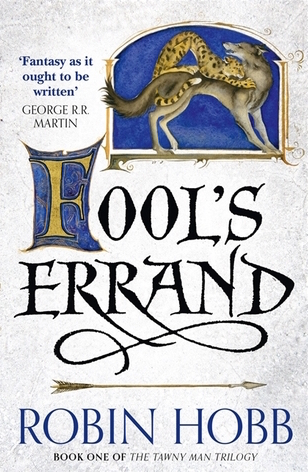
Fool’s Errand by Robin Hobb

As regular readers of my blog will know, it’s not very often that I read fantasy, yet Robin Hobb’s books have been some of my favourite reads of the last few years. In 2014 I discovered the Farseer Trilogy and then, last year, I moved on to her second trilogy, the Liveship Traders – set in the same world, the Realm of the Elderlings, but in a different part of that world and with different characters and storylines. Fool’s Errand is the first book in yet another trilogy – The Tawny Man – which leaves the liveships behind and returns to the story of FitzChivalry Farseer.

If you haven’t read the Farseer trilogy yet, you really need to do so before starting Fool’s Errand. It’s important to understand Fitz’s background, his relationships with other characters, and the magic and history of the world he inhabits, otherwise I think you’ll be very confused!

Anyway, Fool’s Errand begins fifteen years after the events of Assassin’s Quest, with Fitz living in a remote cottage in the countryside, far away from his former home in Buckkeep, having made the decision to stay out of the politics and intrigues which continue to surround the Farseer family. He has taken the name Tom Badgerlock and is leading a quiet life with his adopted son, Hap, and his wolf Nighteyes, with whom he shares a special bond, as his only companions. Then, unexpectedly, he receives a visit from Chade, his old mentor and instructor in the art of assassination. Chade tries, but fails, to persuade Fitz to return to Buckkeep to teach the magic known as the Skill to the young Prince Dutiful.

This visit is closely followed by another: this time from the Fool, who has matured from the pale boy of fifteen years ago into an elegant young man with golden hair and skin. The two quickly settle back into their old friendship, but even the Fool is unable to convince Fitz to come back with him to Buckkeep. It is only when Fitz receives shocking news regarding Prince Dutiful that he agrees to return to court and offer his assistance. The Prince has disappeared, just days before his betrothal ceremony, and Chade believes that Fitz is the only person who can find him. Did Dutiful run away or was he kidnapped? Could he have become the target of a carefully planned plot? And how is all of this connected with the little hunting-cat the Prince received recently as a gift?

Although I did enjoy the three Liveship Traders novels I read last year, it was wonderful to be reacquainted with Fitz and the other Farseer characters again. I don’t regret having taken the time to read the Liveship Traders, as it means I picked up on a few things in Fool’s Errand – such as the name of the Fool’s horse and a visit to a certain island – which wouldn’t have meant much to me otherwise, but I definitely prefer the world of the Six Duchies. I think this particular novel might even by my favourite by Robin Hobb so far. It feels more tightly plotted than any of the others, with the focus on one mission – to find Prince Dutiful and return him to Buckkeep – and with a slightly smaller cast of characters too, concentrating mainly on the very close relationships Fitz has with the Fool and with Nighteyes. It’s also a very moving book, with one particular scene that made me cry – even though I’d known from the beginning that it was going to happen sooner or later, I still wasn’t prepared for it!

Now that I’ve remembered how much I love reading about Fitz and his friends, I’m sure it won’t be long before I pick up the second book in the trilogy, The Golden Fool.

This is book 10/20 of my 20 Books of Summer.

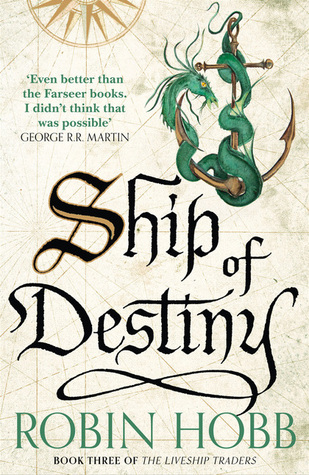
Ship of Destiny by Robin Hobb

This, the third of Robin Hobb’s Liveship Traders novels, brings the trilogy to an exciting and satisfying conclusion. Having become quite attached to the characters and swept away by the story over the course of the three novels, I’m sorry to have come to the end – but I have to admit, I’m also happy that I’ve finished and can now move on to the Tawny Man books and rejoin old friends from Hobb’s Farseer trilogy. First, though, I need to post my thoughts on Ship of Destiny – and as this is a trilogy which really needs to be read in order, I can’t avoid spoiling elements of the previous two books here; if you think you might want to read them I would recommend going no further with this review until you’ve read both Ship of Magic and The Mad Ship.

Ship of Destiny picks up each of the trilogy’s many storylines from where they left off at the end of The Mad Ship. For much of the novel, our main characters are divided into small groups, each having separate adventures of their own, until fate eventually brings them together in a dramatic sequence of events which brings The Liveship Traders to a close.

First of all, there’s Malta, who has escaped from the aftermath of the earthquake in Trehaug and has found herself sailing down the hazardous Rain Wild River in the company of the childish and petulant Satrap of Jamaillia. Malta’s betrothed, Reyn Khuprus, is desperately searching for her, with the reluctant help of Tintaglia the dragon. Newly released from her cocoon, Tintaglia would prefer to be getting down to more important business, such as saving her species from extinction.

On board the liveship Paragon, Althea Vestrit, Brashen Trell and Amber the wood-carver are getting closer and closer to the Vivacia, the Vestrit family liveship which Althea has her heart set on reclaiming. But Vivacia has already bonded with her new captain, the pirate Kennit, and with Althea’s nephew Wintrow; Althea could be facing disappointment when she finally catches up with her beloved ship. Meanwhile, Ronica and Keffria are trying to rebuild and reform Bingtown following the Chalcedean invasion – but for this they will need the cooperation of Serilla, the Satrap’s Companion, whose priority seems to be to obtain power for herself.

When I wrote about The Mad Ship a few weeks ago, I mentioned that I was particularly intrigued by Amber, as she made me think of another character from the Farseer trilogy. That character, of course, is the Fool, and I was pleased to find that my suspicions were confirmed in this book. Amber recarves Paragon’s figurehead to resemble Fitz, there are discussions of destiny, and there are exchanges like this:

“You’d have to be a fool to think you could change the course of the whole world.”

She was silent until she broke out in a shaky laugh. “Oh, Paragon, in that you are more right than you know, my friend.”

Other characters continued to interest me too, particularly Malta. Who would have thought the annoying, selfish girl we met in the first book would mature so quickly and turn out to be such a shrewd negotiator? Kennit, on the other hand, goes from being a complex and strangely sympathetic character to a villain whose treatment of Althea and Paragon made me lose all respect for him – although I did find his final scenes in the book quite moving.

On reaching the end of The Liveship Traders, I didn’t feel as bereft as at the end of The Farseer trilogy, which I think is partly because, while there were plenty of characters I liked and cared about, I never felt as close to any of them as I did to Fitz. I was less emotionally involved with this trilogy, but I did still thoroughly enjoy it; I loved the world Robin Hobb created here and I was impressed by her ability to handle multiple storylines and keep track of who knows what! Also, as someone who doesn’t read a lot of fantasy, I found the dragon element fascinating, which is probably fortunate as if I’m going to continue working through Hobb’s novels I will eventually need to read The Rain Wild Chronicles which, judging by the titles, sound very dragon-heavy! First, though, I’m looking forward to the Tawny Man trilogy – I have my copy of the first book, Fool’s Errand, ready and waiting…

The Mad Ship by Robin Hobb

This is the second volume of Robin Hobb’s The Liveship Traders trilogy. I read the first one, Ship of Magic, earlier this summer and enjoyed it so much I couldn’t wait to move on to this one. As it’s a trilogy that really needs to be read in order, I have found it impossible to write about this book without spoiling the previous one, so be warned!

The Mad Ship continues to develop storylines begun in the first novel. When we last saw the Vestrit family’s liveship, the Vivacia, she had been captured by pirates far from her home port of Bingtown and her captain, Kyle Haven, had been defeated and injured. Captain Kennit, the pirate leader, is delighted to have taken possession of such a valuable ship, particularly as he is already beginning to bond with Vivacia, the liveship’s sentient figurehead. Also on board is Kyle’s son, Wintrow, who has Vestrit blood and finds himself competing with Kennit for the ship’s affections.

When news of Vivacia’s capture reaches the rest of the family, they must find a way to work together to rescue her and to bring home Kyle and Wintrow. This is easier said than done given the divisions and tensions within the Vestrit household! Althea Vestrit still believes that the Vivacia should rightfully belong to her rather than to her sister (and Kyle’s wife) Keffria, while spoiled, selfish Malta continues to cause trouble for her mother and grandmother. However, Malta is forced to grow up very quickly and through her relationship with Reyn Khuprus of the Rain Wilds, she has a chance to redeem herself in the eyes of her family.

Meanwhile, Brashen Trell and Amber the bead merchant have come up with a plan of their own to help Vivacia – one which involves relaunching Paragon, the old, abandoned liveship who is believed to be mad, having killed his crew many years earlier. Will their plan succeed or is the Vivacia lost to them forever?

Despite loving the first book, it took me a while to really get into this one, but I think it was simply suffering from being the second in a trilogy – there wasn’t the novelty of discovering a new world or the excitement of following the story to its conclusion. Halfway through, though, several of the storylines took a more dramatic turn and I found that I was absolutely riveted! So much happens in this book that I can’t possibly mention everything here; instead, I have just picked out a few of the things I found most notable.

* Dragons and serpents – What I loved most about this book was that we learn much, much more about the dragons and sea serpents and how they are connected with the wizardwood used in the construction of the liveships. In Ship of Magic, all the talk of ‘tangles’, ‘silver providers’ and ‘She Who Remembers’ had me completely mystified, but now the pieces of the puzzle are falling into place. Some links with the dragons from Robin Hobb’s Farseer Trilogy are also emerging and bearing in mind how much I loved those books it’s great to come across anything that ties the two together.

* Amber – There continues to be an aura of mystery surrounding Amber; so far we know almost nothing about her origins or how she came to be in Bingtown. Remembering a certain character in The Farseer Trilogy, I’m starting to have my suspicions about her, but I will wait and see if anything else is revealed in the next book.

* Magic – The magical elements in this book are particularly strong. Not only do we have dragons, sea serpents and talking figureheads, but with the dream sequences and the abilities of certain beings to enter the thoughts of others, I was reminded of the Skill and the Wit from The Farseer books. I also loved the descriptions of Trehaug, the Trader city on the Rain Wild River where the Khuprus family live.

* Malta – I didn’t like her at all in the previous novel and in the first half of this one she continued to annoy me, but later in the book there are signs that she is growing and developing as a person. She is just one of several strong female characters in the trilogy; I have already mentioned Amber, but Althea, Keffria, Ronica and Etta all interest me too.

There is so much more I could say about this book but, to be honest, I just wanted to get this post written quickly so that I could move straight on to the final volume, Ship of Destiny, in which I hope some more of my questions will be answered!

This is book 13/20 for my 20 Books of Summer challenge.

Ship of Magic by Robin Hobb

After finishing Robin Hobb’s wonderful Farseer trilogy in November 2014 I knew I wanted to read more of her books. I was desperate to find out what would happen next to the Farseer characters so it was tempting to go straight to her Tawny Man trilogy, but after looking at some recommended reading orders, I decided it would be better to read her other series, The Liveship Traders, first. If none of this means anything to you because you’re unfamiliar with Robin Hobb, rest assured that reading Ship of Magic does not require any knowledge of previous Hobb novels and I’ve avoided spoiling them in the rest of this post!

Ship of Magic is set in the same world as the Farseer books, but the action this time centres around Bingtown, a coastal community of traders and merchants governed by the highly respected Bingtown Trader families, descendants of the original settlers of those shores who came from the mysterious Rain Wilds. The Bingtown Traders have maintained their connections with those who remained in the Rain Wilds and as part of this alliance the Rain Wild Traders provide the Bingtown Traders with the means to build a liveship – a debt so large that it can take generations to be paid off. Why is a liveship so important? Well, it is built from wizardwood – a magical wood with a mind of its own – and is the only type of vessel which can travel safely up the hazardous Rain Wild River to trade in the magnificent, enchanted goods that are available there.

At the beginning of the novel, the Vestrit family’s liveship, the Vivacia, is about to ‘quicken’ – the term given to the process by which a wizardwood ship comes to life after three generations of the family have died on board. Althea Vestrit is devastated by her father’s death, but excited at the thought of taking over the captaincy of the ship. After all, she has spent her childhood accompanying her father on his voyages and, as a blood-member of the family, she is the one who could be expected to share a close bond with the newly quickened Vivacia. She is bitterly disappointed, then, when it emerges that her father has actually left the ship to Kyle Haven, her elder sister’s husband, a man who has no understanding of what is involved in commanding a liveship. Furious and heartbroken, Althea decides to leave home and go out into the world where she can prove herself as a sailor and one day regain control of the Vivacia.

The edition of Ship of Magic I read is over 800 pages long, so you won’t be surprised to hear that there is a lot more to the plot than I have talked about so far. I don’t want to go into too much detail here, but I would like to briefly mention some of the other storylines and characters. First there’s Wintrow, Kyle’s son, who is taken from the monastery where he was studying to be a priest and not at all happy about being forced to serve with his father on board the Vivacia. Then there’s Wintrow’s sister Malta, left at home with her mother and grandmother. Malta longs for excitement in her life – to be allowed to go to balls, to wear grown-up dresses and be courted by young men – and she can’t understand why her family are so determined to stop her. Finally, there’s Kennit, a pirate captain who dreams of becoming a pirate king and is sailing up and down the coast waiting for the chance to capture a liveship of his own.

I really enjoyed this book; although I certainly hadn’t intended to wait three years before reading it, I’m glad I didn’t pick it up immediately after finishing the last Farseer book when I would undoubtedly have just wanted more of the same story. There were times when I felt there was a little bit too much going on in this novel and too many characters to get to know – but for the most part, I thought they were worth knowing! The only characters I actively disliked were Kyle, Malta and one of Kyle’s crew members, Torg. The rest were interesting, nuanced and well written. I was particularly intrigued by Kennit, who in many ways is one of the villains of the book, but who does seem to have a conscience in the form of a wizardwood charm worn on his wrist. I’m also hoping to learn more about the wood-carver Amber and the abandoned liveship Paragon in the next book.

The title of that next novel is The Mad Ship and I have included it on my 20 Books of Summer list, so expect to hear all about it soon!

Assassin’s Quest by Robin Hobb

Assassins Quest I’ve finished the Farseer Trilogy and now I feel bereft! After the cliffhanger ending of the previous book, Royal Assassin, I immediately moved on to the final instalment but now I wish I’d waited a while so that the whole experience wouldn’t have been over so quickly. This particular book wasn’t my favourite of the three – I had a few minor problems with this book that prevented me from enjoying it as much as the first two – but I can’t express how much I loved this trilogy as a whole.

It is almost impossible to discuss the final book of three without giving away things that happened in the previous two, so be aware that there will be spoilers throughout the rest of this post! If you’re new to Robin Hobb it wouldn’t be a good idea to start with this book anyway – Assassin’s Apprentice is where you need to begin.

Assassin’s Quest is slightly different from the first two Farseer novels because, while those two were centred around Buckkeep and its inhabitants, in this third book Fitz is on a mission that will take him across the Six Duchies and beyond. It feels more like a traditional fantasy adventure novel – and in fact, it does contain much stronger fantasy elements than the previous books. We learn more about the Wit and the Skill – and both of these types of magic are used in ways I hadn’t realised was possible – and we even meet some dragons (which isn’t surprising, as there’s one pictured on the book cover). While I thought the strengthening of the fantasy elements felt like a natural development as Fitz ventures further into the Realm of the Elderlings, I did prefer the more subtle fantasy atmosphere of Assassin’s Apprentice and Royal Assassin.

This novel picks up the story where Royal Assassin ended, with Fitz believed to have died at the hands of King Regal and his coterie. We, however, know that he has only left his body temporarily to join his wolf, Nighteyes, with whom he is Wit-bound. After a slow start in which Fitz returns to human form and has to come to terms with no longer being a wolf, he finally sets out on his quest. His aim is to hunt down Regal and kill him, but this proves to be more difficult than he expected and eventually he becomes aware that he has allowed himself to be distracted from what should have been his real purpose: finding Verity, his beloved uncle and rightful King of the Six Duchies.

Verity left Buckkeep halfway through the previous novel to go in search of the legendary Elderlings in the hope that they would help him to defeat the Red Ship Raiders. He has never been seen since, but Fitz is sure he’s still alive – he can sense Verity’s presence with his Skill and hear his command (“Come to me!”) in his mind. This certainty that his King is waiting for him is what keeps Fitz focused on his task, even when he wants nothing more than to return to Buck and look for Molly, the woman he loves, now only visible to him in Skill dreams.

As Fitz and Nighteyes travel across all of the Six Duchies and on into the Mountain Kingdom they are joined by some old friends, as well as making new ones such as Starling, a minstrel, and Kettle, an old woman who clearly knows a lot more about the Skill than she wants to admit to. That, by the way, was one of the little things that annoyed me about the book. It seemed that on a mission where everybody needed to pull together, every one of the party was keeping secrets from the others, making cryptic comments when a simple explanation could have saved so much trouble. Speaking of secrets and cryptic comments, we do learn quite a lot about the Fool in this book. However, the revelations that are made about the Fool just seem to raise more questions than they answer!

Unlike the first two books which I loved from the beginning, it took me a while to really get into Assassin’s Quest; the opening section with Fitz learning to be human again seemed to go on forever. After the journey got underway, I was quickly drawn into the story once again and became so absorbed in Fitz’s world I was dreading reaching the end of the book – especially as I was sure it wouldn’t end happily. This is a big, thick book (with over 800 pages in the edition I read) and there were a few points where I thought the story started to drag. I didn’t mind persevering through the slower parts, though, because there are some truly fantastic moments in this book, my favourites being the breathtaking scenes set inside Regal’s palace at Tradeford.

So, do Fitz and his friends find Verity and if so, has he succeeded in enlisting the help of the Elderlings? Will Fitz have another chance to kill Regal? Despite my spoiler warnings, I’m not going to answer those questions here. I will just say that I found the ending (the final two or three chapters, really) every bit as sad as I’d expected it to be, and yes, I cried. I’m not always a fan of happy, fairytale endings but after all the misery Fitz and the other characters had gone through in this trilogy I think I would have liked one here! As for the way everything was wrapped up in the last few pages in the style of an epilogue, I didn’t find that very satisfying either. I realise, though, that we’ll meet Fitz again later in the Tawny Man Trilogy and I’m looking forward to reading those books – but not until I’ve read the Liveship Traders first!

Royal Assassin by Robin Hobb

Royal Assassin The way I read has changed since I started blogging. I can no longer seem to just read one book at a time and often find myself with four or five on the go at once. Sometimes, though, there comes a point where one book becomes so absorbing that I have to drop everything else and concentrate solely on that book right to the end. That’s what happened with Royal Assassin; other books had to be pushed aside while I became immersed in the world of the Six Duchies.

Royal Assassin is the second of The Farseer Trilogy and continues the story begun in Assassin’s Apprentice. If you haven’t read the first book yet, be aware that spoilers may follow!

At the beginning of the novel, FitzChivalry Farseer has survived his mission in the Mountain Kingdom and is ready to return home. On arriving at Buckkeep, however, Fitz is confronted with a new set of problems. King Shrewd is suffering from a mysterious illness and is losing control of his kingdom, while his son, King-in-Waiting Verity, is preoccupied with defending the coastal Duchies from the persistent attacks of the Red Ship Raiders. Currently, Verity’s only weapon against the Raiders is the Skill – a form of magic known to only a select few within the keep – but it is having little effect. When he hears tales of the mythical Elderlings who once helped a previous king tackle the threat of the Raiders, Verity sets off to find them – a journey that will take him far away from Buckkeep.

It is left to Fitz, then, to try to protect Buckkeep and its inhabitants from the plots of Prince Regal who, with his elder brother gone and his father ill, has set his sights on taking the throne for himself. Fitz is not entirely alone and can rely on the help of old friends – Burrich the Stablemaster, Chade, his instructor in the arts of assassination, and his father’s widow, Patience – as well as new ones such as Verity’s Queen-in-Waiting, Kettricken, but with Regal intent on removing anyone who gets in the way of his ambitions, it’s a difficult and dangerous time for Fitz and his allies. He is able to find comfort in his reunion with Molly, the woman he loves, and also in a special bond with a wolf called Nighteyes, but even these relationships are not without their complications…

I loved Assassin’s Apprentice when I read it a couple of months ago and I’m pleased to say that I found this book just as good as the first – possibly even better. I can only think of two things that bothered me slightly about this book. First, I couldn’t quite believe that Verity would abandon Buckkeep at such a crucial moment. I understand why his leaving was necessary for the plot; it just seemed a bit unconvincing to me. Also, I find Regal a disappointingly one-dimensional villain. Unless things are going to change in the third book, he seems to have absolutely no good qualities or nuances to his character – though maybe this is only noticeable because most of the others are so interesting and well developed. I realise that I still haven’t mentioned one of the most intriguing characters in the book: the Fool. Sometimes he seems so clever and wise, at other times so vulnerable and childlike. I think I said in my review of Assassin’s Apprentice that I wanted to know more about the Fool; well, we do learn a little bit more, but he is still a character surrounded by mystery.

I find the inhabitants of Buckkeep and the relationships between them so interesting that the Red Ship Raiders and Forging storyline becomes secondary to me. I thought the Skilling and Wit passages in this book were particularly well written; sometimes novels with plots that rely on telepathic communications can seem unrealistic, but here I had no problem believing in Fitz’s conversations with Nighteyes, to give one example. In the previous novel I didn’t fully understand the implications of The Wit and the problems it could cause, but now things are a bit clearer. The role it plays in the story is fascinating, especially towards the end!

The first two books in this trilogy have been among the most enjoyable books I’ve read this year. The third one, Assassin’s Quest, is on my library pile and I’ll have to start it soon as it looks enormous!