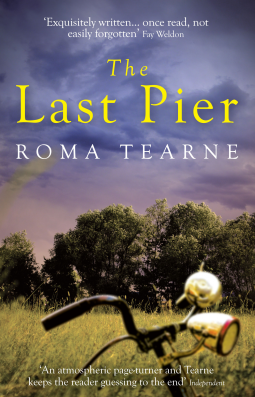
 This is the second novel I have read by Roma Tearne and very different from the first I read, The Swimmer, which was the story of a woman’s relationship with a Tamil refugee from Sri Lanka. I had the impression that all of her books covered similar themes of immigration, asylum and conflict in Sri Lanka, so I was surprised when I picked up The Last Pier, one of her more recent novels from 2015, and found that it was set on a fruit farm in rural England just before the start of World War II.
It’s the summer of 1939 and Cecily Maudsley is thirteen years old – that difficult age, no longer a young child but not an adult yet either. Cecily watches enviously as Rose, her beautiful sixteen-year-old sister, becomes the centre of attention that summer and catches the eye of every man in Suffolk, it seems. But Rose’s life is not as perfect as it appears; we learn in the very first chapter that a tragedy is going to take place – and that Cecily will be blamed for it.
The Last Pier is a novel in which secrets, revelations and surprises play an important part, so I will have to be careful not to say too much. Some of the secrets take a long time to be revealed; in fact, Cecily herself only uncovers the whole truth twenty-nine years later when she returns to England after a long absence. Part of the novel is written from the perspective of the young Cecily, giving an account of the events of 1939 as they happen, and part from the perspective of the older Cecily, remembering moments from the past. The way Roma Tearne handles the passing of time is very effective, moving between past and present to unveil the clues that we must put together before the full picture can be seen – but it also means the story feels very fragmented, which can be confusing at times.
There’s plenty of suspense as we wait to find out exactly what happens to Rose and who is responsible for it, and there is a feeling of danger and foreboding which hangs over the whole novel. At the same time, the outbreak of war is approaching, bringing with it the sense that very soon the lives of all of the Maudsleys will be changed forever. The novel covers an aspect of the Second World War which I haven’t read about very often – the fate of Italian people who were living in Britain at the beginning of the war – and this is explored through the story of the Molinello family who had arrived in Suffolk from Tuscany more than a decade earlier and opened an ice cream parlour not far from the Maudsleys’ farm. The two families have become very close over the years and, when Italy’s role in the war causes the Molinellos to be regarded with suspicion, the Maudsleys find that their fortunes have become entwined with their Italian friends’.
Cecily is particularly interested in what happens to the Molinello family because she is in love with Carlo, one of the Molinello sons. However, it seems to her that Carlo, like everyone else, only has eyes for Rose. As Cecily’s jealousy increases, she begins to watch Rose’s movements, following her when she can and eavesdropping on conversations. She also becomes curious about Robert Wilson, a stranger who claims to have been sent to Suffolk on government business, to carry out a survey of the farmland in preparation for the war. By watching and listening, Cecily picks up lots of little pieces of information about Rose, about Mr Wilson and about everyone else on the farm, but she lacks the maturity and experience to be able to understand the implications of what she has discovered.
Roma Tearne writes so well from the point of view of a teenage girl. I could really feel Cecily’s confusion as she tries to make sense of the things she has learned, her frustration at not quite being able to grasp what is going on, and her envy towards her sister, who appears to have everything Cecily wants and doesn’t have. I loved this beautifully written novel and I’m pleased that I’ve been reminded of Roma Tearne’s books, seven years after reading The Swimmer. I’m looking forward to reading some of her others.

 She Reads Novels