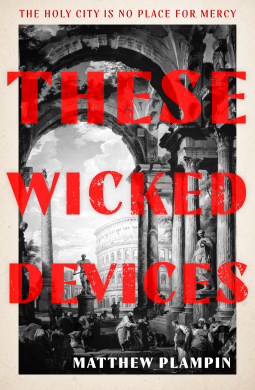
These Wicked Devices by Matthew Plampin

I’ve only read one Matthew Plampin book – Mrs Whistler, about the life of Maud Franklin, the model and muse of the artist James McNeill Whistler – so I was intrigued by the description of his new one, which is set in an entirely different time and place. These Wicked Devices takes us to Rome in the summer of 1650 and introduces us to three separate characters whose stories become entwined in various ways.

First, we meet Sister Orsola, a Benedictine nun who has fled to Rome after the city of Castro, including the convent that was her home, was razed to the ground on the Pope’s orders. Orsola is accompanied by Sister Serafina, a choir nun who goes into trance-like states where she endlessly recites the lives of the saints. In the final hours before Castro’s destruction, the Mother Abbess had asked Orsola to protect Serafina and help her find another convent where she could live in safety. Orsola agreed, hoping that performing this task would help her to atone for the sin of giving birth to a child who died unbaptised.

Another thread of the novel follows Donna Olimpia Maidalchini, the most important woman in Rome. As the sister-in-law of Pope Innocent X, she is regarded as the real power behind the papal throne, involving herself in politics and the appointment of positions within the church. At the beginning of the novel, Donna Olimpia is negotiating with France to help a French invasion force seize the Kingdom of Naples from Spain.

Finally, we meet Juan de Pareja , newly arrived in Rome from Spain. Juan is an assistant and slave of the Spanish artist, Diego Velázquez, who hopes to paint a portrait of the Pope. When Juan discovers some secret papers hidden inside a metal statue, however, he suspects that there’s also another reason for their presence in Rome.

These three storylines alternate throughout the book, clearly marked with the Latin headings Sorores (sisters), Domina (mistress) and Servus (servant), to indicate whose perspective we’ll be reading from next. The three do merge together a lot, but I did find myself preferring one over the others – the one about Sisters Orsola and Serafina. There’s a real sense of danger as they are suspected of being heretics due to their connection with Castro and Orsola isn’t sure who can and can’t be trusted as she tries to carry out her promise to the Abbess. There was a lot to interest me in Juan de Pareja’s story as well – his relationship with his master, Diego Velázquez, his own ambitions of becoming an artist and his desire to live his life as a free man – but I found Donna Olimpia’s sections less engaging, maybe because she herself is much less likeable as a person.

Plampin creates a strong sense of time and place, with vivid descriptions of the piazzas, fountains, palazzi and churches of Rome as the city bakes in a late spring heatwave. I found the writing style quite dry, though, so for me this was an interesting read rather than an entertaining one. Still, it was good to add to my knowledge of a period in Rome’s history that I knew very little about.

Thanks to The Borough Press for providing a copy of this book for review via NetGalley.

Book 7/20 for 20 Books of Summer 2025.
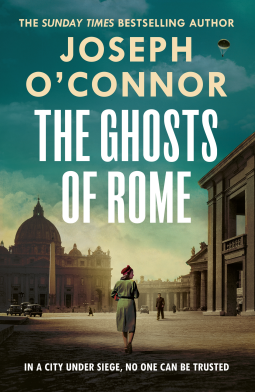
The Ghosts of Rome by Joseph O’Connor

The story of our Roman Escape Line has been characterised as a tale of courage. But it was always a story of friendship, first and last. The friends we knew and those we did not, some fleetingly encountered, others never at all. I am no sentimentalist, but I call it a love story.

This is the second book in Joseph O’Connor’s new trilogy inspired by the true story of the Rome Escape Line, a secret network that smuggled thousands of Jewish refugees and Allied soldiers out of Nazi-occupied Rome. The first novel, My Father’s House, introduces us to the work of the Escape Line who meet in the neutral Vatican under the guise of a choir to avoid the attentions of the Gestapo and focuses on one member in particular – Monsignor Hugh O’Flaherty, the Irish Catholic priest who is the leader of the network.

The Ghosts of Rome continues the story, beginning in February 1944, six months into the Nazi occupation. Although Hugh O’Flaherty is still part of the group, we see very little of him in this book as he steps into the background to let other characters’ stories be told. The main focus this time is the widowed Contessa Giovanna Landini, known as Jo, whose palazzo is commandeered by Gestapo officer Paul Hauptmann. Hitler isn’t satisfied with Hauptmann’s performance in Rome so far and he is under pressure to produce results. If he could obtain evidence of the Choir’s activities he’s sure that would help to improve his reputation with the Führer. Hauptmann hopes that the Contessa, whose house he is living in, will lead him to her fellow Escape Line members, but Jo is a resourceful woman and decides to take advantage of Hauptmann’s interest in her to try to protect herself and the Choir.

Another significant storyline revolves around a Polish airman who is shot down over Rome. Some members of the Escape Line want to help him, but others are more cautious. How can they be sure he is who he says he is? What if he betrays them? When it becomes obvious that he has life-threatening injuries and will die if not treated, they are faced with an important decision to make.

Of the two books, I think I preferred My Father’s House because it was more suspenseful, describing the countdown to a major mission on Christmas Eve, and because I found Hugh O’Flaherty such an interesting character. This is an excellent book as well, though, and I’m sure other readers will like it better than the first one. Although Jo Landini is at the forefront of the story, most of the characters we met in the previous book also reappear, including British Envoy Sir Francis D’Arcy Osborne, diplomat’s wife Delia Kiernan and escaped soldier Sam Derry. We also see a lot of Delia’s teenage daughter, Blon, who is angry when her mother leaves the Escape Line and insists on trying to take her place, which not everyone is happy about! These are all people who really existed, but O’Connor includes an author’s note to explain that the way they are portrayed in the book is just his interpretation and shouldn’t be relied on as fact.

If you haven’t read the previous novel, you’re probably wondering whether it’s necessary to have read it before starting this one. I would say it’s not really essential, but it would make it easier to follow what’s happening in this book. There are a lot of characters and O’Connor constantly switches between different perspectives throughout the novel, as well as inserting passages written in other styles – such as transcripts of (fictional) BBC interviews – which means you do need to pay attention otherwise it would be easy to lose track of things. As with My Father’s House, I was particularly interested in the insights we get into the mind of Paul Hauptmann – a very human villain, which just makes him all the more unsettling to read about. It’s the brave and tireless work of the Escape Line, however, that makes these novels so compelling; in this book, I loved the way they managed to hide hundreds of people inside a derelict old theatre right under the noses of the Gestapo.

This is a planned trilogy and although I can’t see any details of the third book yet, I know it will be something to look forward to!

Thanks to Harvill Secker for providing a copy of this book for review via NetGalley.

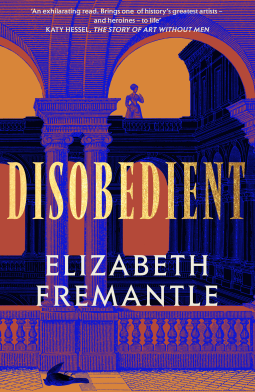
Disobedient by Elizabeth Fremantle

Elizabeth Fremantle is an author I always look forward to reading and I have enjoyed all six of her previous novels, including her two historical thrillers published under the name E.C. Fremantle. This seventh novel takes us to 17th century Italy and tells the story of Artemisia Gentileschi, one of the most important and accomplished female painters of her time.

Artemisia grows up in Rome, the daughter of the painter Orazio Gentileschi. Having lost her mother while still a child, Artemisia is raised by her father, spending time in his workshop learning to draw and paint. Orazio is a talented artist, heavily influenced by the more famous Caravaggio, but it quickly becomes obvious even to him that his daughter’s work is better than his own.

In 1611, the painter Agostino Tassi enters Artemisia’s life, first as her tutor and then as her intended husband. However, Tassi’s arrival leads to a terrible experience for Artemisia – something I won’t go into here because I think any reader who has come to this book with little or no knowledge of Artemisia’s life will probably prefer to discover her story for themselves. The second half of the book becomes quite dramatic as the repercussions of this incident become clear, so if you don’t already know all the details in advance, which I didn’t, it’s interesting just to watch it all unfold.

Artemisia is a great subject for historical fiction, being a strong, ambitious, determined woman whose work has left a lasting impact. Although we can’t know her true thoughts and feelings, Fremantle does a good job of getting inside Artemisia’s head and showing us what may have provided the inspiration for some of her paintings, such as Susanna and the Elders and Judith Slaying Holofernes. You’ll probably find yourself wanting to look up the paintings online as you read. As well as Artemisia, there are other characters in the novel who are equally well drawn; I’ve already mentioned Tassi and Artemisia’s father Orazio, but there’s also Zita, who becomes a model and chaperone for Artemisia, and Piero, Orazio’s assistant.

Disobedient covers only the earlier part of Artemisia’s life and the novel ends with a lot of her story still untold, but after reading Fremantle’s author’s note where she explains her personal reasons for wanting to write this book, I can see why she chose this period to focus on and I appreciate the courage it has taken for her to do so. I don’t think it’s my favourite of her novels, simply because some of the other settings and historical figures she has written about have interested me more, but I still enjoyed this book and am pleased to have had the opportunity to add to my knowledge of this fascinating artist.

Thanks to Penguin Random House/Michael Joseph for providing a copy of this book for review via NetGalley.

This is book 8/20 of my 20 Books of Summer 2023

This is book 29/50 for the 2023 Historical Fiction Reading Challenge.

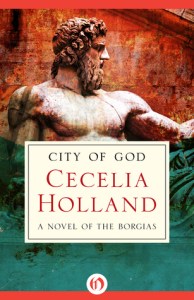
City of God by Cecelia Holland

City of God Since 1966 Cecelia Holland has written over thirty novels, most of them historical fiction, and some are now being re-released in ebook format by Open Road Integrated Media. As I’ve never read any of her work before, I was pleased to receive a copy of her 1979 novel, City of God, via NetGalley.

City of God is set in Rome at the beginning of the sixteenth century and, as the subtitle suggests, it is A Novel of the Borgias. With the former Rodrigo Borgia now Pope Alexander VI, the Borgia family already wield a large amount of influence in Rome, but the Pope’s illegitimate son, the condottiero Cesare Borgia, is now turning his attention to conquering the rest of the Italian city states. Cesare, known as Duke Valentino, has a reputation for being cruel and ruthless and even as he plots and schemes his way to power, his enemies are conspiring against him.

We see all of this through the eyes of Nicholas Dawson, secretary to the Florentine ambassador to Rome. Raised at a Spanish monastery after his English parents died in Pamplona, Nicholas is a man who seems to have no real connection or loyalty to any particular country or city. This makes him an ideal target for Valentino, who has his eye on Florence and needs a spy within the Florentine embassy. Nicholas has already been secretly rewriting the ambassador’s dispatches to suit his own political views – will betraying Florence to the Borgias be the next step?

As this is the first Cecelia Holland novel I’ve read I didn’t know what to expect – and I was quite surprised. This is a book with a very dark and claustrophobic atmosphere and the writing is completely unromantic, focusing firmly on the political machinations of Nicholas and the Borgias and the intrigue of the Papal Court.

I didn’t find this an easy book to read, but that’s because I’m not very familiar with the Borgias or the history of Rome in this period and Holland does seem to assume that the reader has some previous knowledge. She doesn’t spend much time explaining the negotiations, alliances and conflicts between Spain, France and the various Italian city states, but expects us to already understand the politics involved. I do like historical fiction that makes me think and that encourages me to look things up for myself so I can learn about the period, but I did wish I had known more about the subject before I started!

The characters in City of God are very unlikeable. The book doesn’t challenge the popular view of the Borgias as scheming and corrupt – Alexander is a Pope who gambles and who has mistresses and children, while Cesare is brutal and unscrupulous and Lucrezia, his sister, is the subject of gossip and suspicion – and the people around them are not much better. I found nobody to sympathise with or to admire, not even Nicholas. This wasn’t a big problem, though, as I can often still enjoy a book without liking the characters – and at least they were interesting.

Nicholas himself is a fascinating, complex character but it’s never obvious where his loyalties lie or if he even has any at all. He appears to be motivated by self-interest, ambition and the desire for power, and he enjoys using his brains to give advice to the Borgias and to act independently of the Ambassador. I’m not sure I ever fully understood what Nicholas was trying to do, but something that happens right at the end of the book made me think again about what he was hoping to achieve. Nicholas is also a gay man living in a time when it is dangerous to be openly homosexual and this adds another layer to the novel. His relationship with a young man called Stefano is an important aspect of the plot (though don’t expect a great love story, as even this part of the novel is free of romance and sentiment).

City of God was an interesting and unusual read; I didn’t love it but I do want to try another of Cecelia Holland’s books as I think I might prefer one with a different setting. Now that more of her books are being made available again I’ll have plenty to choose from!

I’m counting this book towards Week 3 of the Forgotten Histories Reading Challenge – Read a book with an LGBT protagonist.