Dacre’s War by Rosemary Goring

Dacres War It’s 1523 and ten years have passed since the armies of Scotland and England met at the Battle of Flodden, resulting in victory for the English and the death of King James IV of Scotland. With a child king (the young James V) and a regent who spends much of his time in France, Scotland lacks strong leadership and Henry VIII of England is taking advantage by ordering the destruction of Scottish border towns. The man responsible for doing this, as well as for keeping some sort of order in the lawless English and Scottish border lands is Thomas Dacre, Warden General of the English Marches.

Dacre is the most powerful man in the north, but he is also making a lot of enemies…including Adam Crozier, head of one of the leading families on the Scottish side of the border, who discovers that Dacre is to blame for the murder of his father. Crozier vows to take revenge and begins the process of forming alliances with other borderers and collecting evidence that will help to bring about the Warden’s downfall.

Dacre’s War is the sequel to After Flodden, Rosemary Goring’s first novel which describes the 1513 battle and its aftermath. I read After Flodden last year and thought it was a good book but nothing special, so I wasn’t sure whether or not to read this one. I am so glad I did decide to read it, because I loved it! The few criticisms I had of the first book (the confusing timeline and the predictability of the plot) were not problems for me this time; I thought this second book was more exciting, faster paced and just a stronger novel in general. If you have not read After Flodden yet, picking this one up first shouldn’t affect your enjoyment or understanding too much – while some of the characters are the same, it’s set ten years later and is a complete story with a beginning and an end.

About half of the story is told from the perspective of the Croziers and half from the Dacres’, although there are also a few chapters set within the Scottish and English courts. It would be easy just to accept Crozier as our hero and Dacre as our villain, but both characters are more complex than that. By allowing us to get inside Dacre’s head and see his point of view, he becomes a more fully developed character and we come to understand that, like most human beings, he is a mixture of good and bad. As well as Crozier and Dacre, there’s also an interesting cast of supporting characters, some new and some old – it was nice to see Louise and Hob again and I enjoyed watching Benoit Brenier going off and having adventures of his own.

My favourite thing about both Dacre’s War and After Flodden, though, is the setting. I love the way Rosemary Goring portrays life in the borders in the 16th century – the raids and feuds that made it such a dangerous place to live, as well as the natural beauty of the countryside. I will be happy if she revisits the world of the Croziers in a third novel, but if not then I’ll be interested to see what she chooses to write about next.
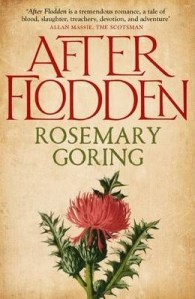
After Flodden by Rosemary Goring

After FloddenThe Battle of Flodden in 1513 was the largest and bloodiest battle fought between England and Scotland. The battle was fought near Branxton, Northumberland, in the north of England and despite the Scots having the biggest army in numbers, the result was a decisive victory for the English. It is estimated that while there were between 1,000-4,000 losses on the English side, there may have been over 10,000 Scottish casualties, including King James IV of Scotland.

After Flodden is a fictional account of the battle and its aftermath. Among the men who went to Flodden and never came back is Louise Brenier’s brother, Benoit. Since coming to Scotland from France several years earlier, the Brenier family have had more than their fair share of troubles, including the death of Louise’s sister, a mistress of James IV. Unwilling to accept that her brother could also be dead, Louise decides to search for him – but finding out the fate of one man among thousands is not going to be easy.

Accompanied by her faithful dog, ‘the vixen’, Louise leaves her home in Edinburgh behind and heads for the dangerous, lawless English/Scottish Borders. She is joined on her journey by two very different men: Gabriel Torrance, a nobleman from the court of King James, and Adam Crozier, leader of one of the Border clans. When both men offer to help look for Benoit, Louise must decide which of them she can trust.

After Flodden is Rosemary Goring’s first novel, published in 2013 to coincide with the 500th anniversary of the battle and having seen some very positive reviews of it last year I was looking forward to reading it myself. Now that I’ve read it, my feelings are mixed. After a slow start I did find myself enjoying the story but I didn’t think it was anything special – though maybe I was just expecting too much from it.

One thing I did love about this book was the choice of subject. Flodden has been mentioned briefly in other books I’ve read, but I have never come across a whole novel devoted to it until now. So many historical fiction novels are the ‘sweeping epic’ sort, covering several decades of history and spanning continents, so it was refreshing to see a book that was so tightly focused on one specific historical event. Reading After Flodden has helped me understand the reasons for the battle and why it was a disaster for the Scots.

In addition to the plot I’ve outlined above, other aspects of the battle and its consequences are also explored. The descriptions of the military preparations for the battle and the weapons and tactics involved are balanced by the more personal, human side. As well as seeing how Louise and her mother react to what has happened, we also meet a young boy who has carried his dying father from the battlefield. Some of the most emotional parts of the book are from the perspective of Patrick Paniter, secretary to James IV, who was one of the men advising the King before the battle and who feels responsible for the disastrous outcome.

I also found the sections of the book describing Louise’s journey south and her encounters with the Border clans very interesting as I only live around 60 miles from the border myself (on the English side). The history of this region is fascinating and I’m surprised it isn’t a more popular choice for historical fiction authors (The Disorderly Knights by Dorothy Dunnett features a feud between two rival Border families, the Scotts and the Kerrs, but I can’t think of many other books that I’ve read that even touch on this subject).

Dialogue is a difficult thing to get right in historical fiction but Goring’s attempt is reasonably good; it doesn’t sound too modern and she uses some Scottish dialect, but not too much. I was less convinced by the way she drops the occasional French word into Madame Brenier’s speech – it didn’t feel natural at all. A bigger problem, for me, is that the story is not told in chronological order but jumps around in time, which I found very confusing. It seemed unnecessary and made it difficult to follow the order of events.

The story was also too predictable, which is not always a bad thing, but when part of the plot revolves around the identity of a traitor it’s disappointing that it’s so easy to guess who that traitor is. It would have been nice to have been kept in suspense until Louise worked out the truth! On the plus side, the book included some useful character lists and a map so that readers can trace Louise’s journey through the Borders. I had to laugh at a misprint listing the members of the ‘Sottish Court’ (though knowing what some of these sixteenth century courts were like, maybe that was an accurate description!)

Although I didn’t enjoy this book as much as I’d hoped to, it was good to have the opportunity to learn more about this important battle.