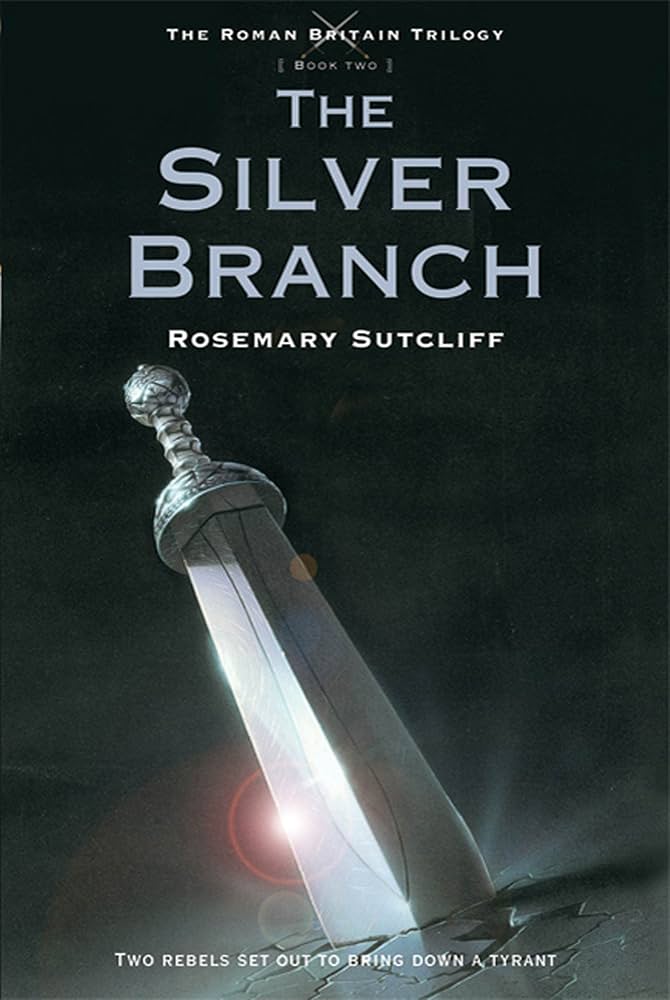
 After reading Rosemary Sutcliff’s The Eagle of the Ninth a few years ago, the first book in her Dolphin Ring Cycle, I wasn’t sure which one to read next. I was advised that it wouldn’t really matter as the books are all separate stories, but as I’m interested in reading all of them anyway, I decided to continue with the one listed next chronologically, which is The Silver Branch.
First published in 1957, The Silver Branch is set in Roman Britain more than a century after the events of The Eagle of the Ninth. The two main characters, Justin and Flavius, are descendants of Marcus Flavius Aquila, which provides the link between the two books. Towards the end of the 3rd century, Justin (Tiberius Lucius Justinianus) completes his apprenticeship as an army surgeon and is posted to Britain for the first time. Arriving at the fort of Rutupiae in Kent, he meets the centurion Flavius (Marcelus Flavius Aquila) and the two discover that they are distant cousins.
The Roman military commander Carausius has recently declared himself emperor of Britain and North Gaul. When the cousins overhear Allectus, the finance minister, plotting against Carausius, they try to warn the emperor but he seems reluctant to believe them and instead they find themselves sent north to Magnis, a fort near Hadrian’s Wall, apparently in disgrace. Worse still, they have now made an enemy of the powerful Allectus, who still has his sights set on the throne…
Although I thought The Eagle of the Ninth was the stronger book, I enjoyed this one as well. I knew nothing at all about this particular period of Roman history so I was able to learn a lot from it, not just about the historical and military events, but also about life in general in Roman Britain during and after Carausius’s reign. This is all described in vivid detail, making the novel completely immersive, and Sutcliff never talks down to the reader – it’s marketed as a children’s book, but it doesn’t actually feel like one and it definitely has a lot to offer readers of all ages.
Not all of the characters are Roman – for example, we meet Evicatos of the Spear, an exiled Dalriad hunter (Dalriada was an ancient Gaelic kingdom from western Scotland/north-eastern Ireland) – and although it’s a very male dominated story, Flavius’s great-aunt Honoria has an important role to play. The main focus of the book, though, is always on our two young protagonists and I found both of them very easy to like, particularly the shy, quiet Justin who grows as a person through his relationship with the more confident Flavius. It’s as much a story of male friendship as it is of the politics of Roman Britain.
If you’re wondering about the ‘silver branch’ of the title, it refers not to a tree but to an unusual musical instrument with silver apples on it belonging to Cullen, the emperor Carausius’s Fool, an eccentric man who calls himself a hound and wears a dog’s tail. The silver branch is a motif that appears several times throughout the novel, along with the dolphin signet ring, an Aquila family heirloom, and the lost eagle standard of the Ninth Legion.
This is book 50/50 from my second Classics Club list. Yes, I’ve completed it at last!







 She Reads Novels