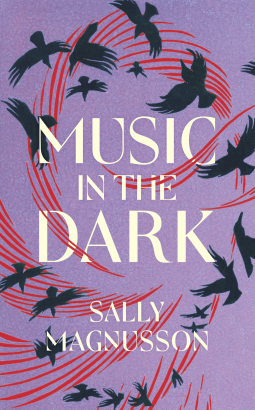
Music in the Dark by Sally Magnusson

This is the third novel by Scottish author Sally Magnusson and although I had a few problems with her first two – The Sealwoman’s Gift, the story of an Icelandic woman sold into slavery in Algeria, and The Ninth Child, about the construction of the Loch Katrine Waterworks – I still wanted to read this one because it sounded so interesting.

It begins in 1884 in a tenement in Rutherglen, a town near Glasgow, where the widowed Jamesina Bain is taking in a new lodger. The lodger is a man, newly arrived from America, where he has lived for many years. At first he has no idea who the Widow Bain is, but as he and Jamesina spend more time together, they discover that they have a shared past – they both lived through the forced eviction of Greenyards in Strathcarron.

The eviction was part of the Highland Clearances, the period when landowners in Scotland removed tenants from their estates so the land could be used for more profitable purposes – which, in the case of Greenyards, meant sheep farming. The clearances of Greenyards in 1854 and nearby Glencalvie a few years earlier, were particularly shocking, for reasons I won’t go into here as the novel will probably have more impact if you don’t already know what happened.

Sally Magnusson doesn’t delve too deeply into the politics surrounding the clearances or the reasons behind them – although Jamesina and her friends believe it was due to the Celtic people being considered inferior – and she acknowledges in her author’s note that it’s a very complex subject. Instead, she concentrates on exploring the long-term effects of the clearances, physically, emotionally and mentally, on the evicted people.

The novel is written from the perspectives of both Jamesina and her lodger, moving between the two as well as jumping backwards and forwards in time between 1884 and 1854. This structure is ultimately quite rewarding as things do eventually fall into place and we come to understand what happened during the Greenyards eviction and the sequence of events that sent Jamesina to Rutherglen and her lodger to America. However, it also means that the first half of the novel is slightly confusing and lacks focus, something that isn’t helped by the style in which Jamesina’s sections are written – often descending into a jumble of thoughts, word association and stream of consciousness. There was a reason for that style, which I understood later on, but it didn’t make this an easy book for me to get into.

I found this book very evocative of time and place, whether I was reading about Jamesina’s childhood in Greenyards or her life in the Rutherglen tenement, taking in laundry to earn a living and sleeping in the ‘kitchen bed’ to keep the bedroom available for lodgers. Magnusson also incorporates lots of other interesting issues, such as the healing power of music, the devastating impact of dementia and the joys of education. I found it very sad that the adult Jamesina, who had been such a bright child and was being taught Latin by the local minister, questions the point in being educated if you’re only going to be leading a life of drudgery.

I have deliberately not provided the name of Jamesina’s lodger, as we don’t immediately know who he is or how he fits into her life and I thought I would leave you to make that discovery for yourself. This is a fascinating novel in many ways and I did enjoy it once I got past the halfway point, which is why I don’t like abandoning books too early!

Thanks to John Murray Press for providing a copy of this book for review via NetGalley.
This is book 17/50 read for the 2023 Historical Fiction Reading Challenge.
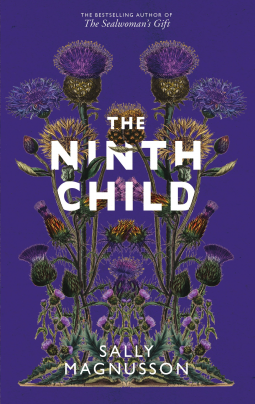
The Ninth Child by Sally Magnusson

I enjoyed Sally Magnusson’s first book, The Sealwoman’s Gift (with one or two reservations), so I had been looking forward to reading her next one, The Ninth Child, which sounded very different but equally interesting. However, although some aspects of it certainly are fascinating, there are other parts that I struggled with and on the whole I think I preferred The Sealwoman’s Gift.

The Ninth Child is set in Scotland in the 19th century and tells the story of the construction of the Loch Katrine Waterworks, an engineering scheme designed to provide clean water to the people of Glasgow. The story is told from the perspectives of several characters associated with the scheme, the main one being doctor’s wife Isabel Aird. Having suffered several miscarriages during her six years of marriage, Isabel is depressed and unhappy, a state of mind which is not improved when her husband, Alexander, informs her that they will be moving to the Trossachs where he will be involved in the building of the new waterworks.

As a doctor, Alexander believes that the recent outbreaks of cholera in Glasgow are caused by the contaminated water supply, so he is looking forward to doing something that can really make a difference to people’s lives. Isabel accompanies him, reluctantly at first, but as she settles into her new home she finds comfort in walking in the countryside by the loch, especially when she begins to believe she is receiving messages from her lost children. It is during one of these walks that she meets the Reverend Robert Kirke, a man said to have been taken by the fairies two hundred years earlier. Are the stories about Robert true – and if so, why has he returned to the land of the living and what is his interest in Isabel?

The novel is written from the perspectives of several different characters: Isabel herself; Robert Kirke; Kirsty, the wife of one of the men working at Loch Katrine; and, surprisingly, Prince Albert, who is staying at Balmoral with Queen Victoria and preparing to appear at the official opening of the new waterworks. Unfortunately, the transitions from one character’s narrative to another are not very smooth and sometimes I couldn’t immediately tell who was narrating (something which wasn’t helped by the poor formatting of the NetGalley copy I was reading and will presumably have been improved in the finished version). The Victoria and Albert storyline felt unnecessary and out of place to me, but the others all added something different and complemented each other well, with Robert and Kirsty’s stories steeped in Scottish folklore and “the hills and the hollows and the brown peat moors and the ancient mounds of the Sìthichean – that’s fairies to you.”

Robert Kirke was a real person – an Episcopalian minister who lived from 1644 to 1692 and was the author of The Secret Commonwealth of Elves, Fauns and Fairies, which was later published by Sir Walter Scott. Legends arose after Kirke’s death saying that he had been spirited away to fairyland after revealing their secrets and this is the basis of the story Sally Magnusson creates for him in The Ninth Child. I loved this aspect of the novel, which reminded me in some ways of James Hogg’s Private Memoirs and Confessions of a Justified Sinner, but I couldn’t help feeling that this magical, fantastical tale didn’t really belong in the same book as the much more realistic and factual story of the Loch Katrine Waterworks. Lots of fascinating ideas found their way into the pages of The Ninth Child, but in the end I felt that it didn’t quite work either as fantasy or historical fiction.

Thanks to John Murray Press for providing a copy of this book for review via NetGalley.

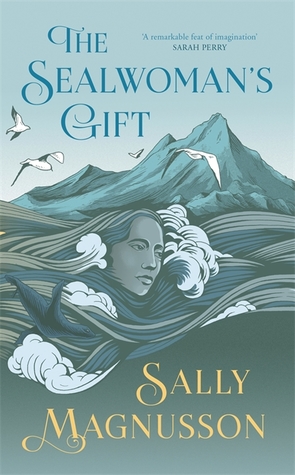
The Sealwoman’s Gift by Sally Magnusson

This is a beautifully written novel based on a little known historical event: the 1627 raid by Barbary pirates on Iceland’s Westman Islands. Around four hundred Icelanders were taken in captivity to Algiers to be sold at the slave markets, among them the priest Ólafur Egilsson, his pregnant wife Ásta Thórsteinsdottir, and two of their children. We know from historical records that Ólafur was released and sent to Denmark to petition the Danish king (Iceland’s ruler in those days) in the hope that he would provide the ransom to free his subjects. His story was preserved in a memoir describing his capture and the voyage there and back, but the story of Ásta, who was not allowed to accompany him on the journey home, has been lost to history.

In The Sealwoman’s Gift, Sally Magnusson has given a voice to Ásta, a woman who, like so many others in centuries gone by, has been ignored and forgotten by history. As we know little or nothing about what happened to Ásta and the other women and children after their arrival on the shores of Algeria, this gives the author the freedom to create an interesting, realistic and believable story to fill in the gaps. She writes with sensitivity and understanding as she describes Ásta’s pain at being separated from her husband and children, her changing feelings for the man who buys her – Ali Pitterling Cilleby – and the agonising decision she eventually has to make.

There’s a lot for Ásta to adjust to in her new life; Algeria and Iceland couldn’t be more different, with very different climates, customs, foods, languages and religions. The religious difference is one of the most difficult for Ásta to accept – as the wife of a Lutheran minister, the possibility of her children having to convert to Islam is not easy for her to come to terms with. We also follow Ólafur on his return to Heimaey in the Westman Islands and see both the short-term and long-term effects the raids have had on the community. With such a small population to begin with, the loss of several hundred of their people has a big impact; it seems that almost everyone has lost a husband or wife, a child or a parent or a friend.

Iceland has a strong tradition of storytelling and some of these myths, legends and sagas are woven into the novel as Ásta finds some solace in remembering the stories of her homeland and narrating them to her master and his wives. This is another aspect of the book that I liked; you can learn a lot about a country from its stories and its folklore.

Sally Magnusson (who is the daughter of the television presenter Magnus Magnusson) has previously written several non-fiction books, but this seems to be her first novel. I liked her writing, apart from the fact that she chose to write in the present tense. I’m really not a fan of present tense and in this case I found it distracting and distancing, which I’m sure is not what the author intended. It’s down to personal taste, I suppose – you either have a problem with it or you don’t. I also thought that, while Ásta, Ólafur and the other Icelandic people are strong, interesting characters, the characters they meet in Algiers feel less well developed. If I’d had a stronger feeling for Cilleby, for example, as a person, I think I would have found the later stages of the story more emotional.

These are just small criticisms and, as I’ve said, are probably just due to my tastes as a reader rather than the book itself, which is getting great reviews and really is a fascinating read.

Thanks to Two Roads for providing a copy of this book for review via NetGalley.