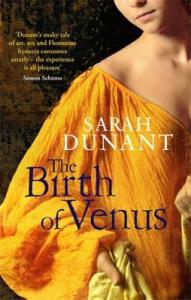
 I love books set in Renaissance Italy but although Sarah Dunant has written three or four of them, this is the first one I’ve read. I had started to read her novel on the Borgias, Blood and Beauty, a year or two ago and struggled to get into it, so that put me off trying any of her other books for a while. Something keeps drawing me to Dunant’s books on the library shelf, though, so a few weeks ago I decided it was time to give her another try.
The Birth of Venus is not, as I’d originally expected, a novel based on the story behind the Botticelli painting of the same name. What the title does actually refer to could be debated, but it seems to me that it alludes to the ‘birth’ or awakening of the novel’s narrator as she falls in love for the first time. The name of the narrator is Alessandra Cecchi and she is the daughter of a prosperous Florentine cloth merchant.
At the beginning of the novel, Alessandra is not quite fifteen years old. Despite her quick brain and artistic talent, she has had to resign herself to the fact that, due to the conventions of 15th century society, she will have no option but to marry the man her parents have chosen for her. When her father returns from a business trip, bringing with him a young artist whom he has commissioned to paint the walls of the family chapel, Alessandra is fascinated. She is curious to see the painter’s work and to learn more about his methods, but she is even more intrigued by the painter himself. Who is this young man, this ‘orphan brought up in a monastery on the edge of the northern sea’?
As the story of Alessandra and the painter unfolds, so does the story of Florence. Beginning with the death of Lorenzo de’ Medici, the novel takes us through the subsequent disastrous reign of Piero de’ Medici, the rise to power of the Dominican friar Savonarola, and the growing threat of a French invasion. This is always a fascinating time and place to read about and I think Dunant does a particularly good job of bringing the setting to life, not just in describing the sights and sounds, but also in showing us how the mood of Florence changes as the city is gripped by Savonarola’s religious extremism.
For a thick book, this was quite a quick read, the sort where you become so swept along with the story you don’t realise how fast the pages are turning. My only problem was that I found Dunant’s decision to refer to the painter as ‘the painter’ throughout the entire book slightly annoying. I’m not quite sure why there really needed to be a mystery surrounding his identity. I felt that the lack of a name created a distance between the character and the reader – I expect this was probably intentional (maybe it wasn’t supposed to matter who he was; all that mattered was what he represented to Alessandra), but if so, it didn’t work for me.
While I can’t really say that I loved this book, I did enjoy it and am now happy to try Sarah Dunant’s other Renaissance Italy novels, In the Company of the Courtesan and Sacred Hearts (maybe I should even give Blood and Beauty another chance). When I finished The Birth of Venus I didn’t want to leave Medici Florence behind, so the next book I picked up was Romola by George Eliot, which is set in the same period and which I’m thoroughly enjoying.
 She Reads Novels