Nonfiction November Week 2: Book Pairings – Tapestry of War and The Desert War

For Week 2 of Nonfiction November, the topic is as follows:

(Nov. 5 to 9, hosted by Sarah’s Bookshelves) – Fiction / Nonfiction Book Pairing – This week, pair up a nonfiction book with a fiction title. It can be a “If you loved this book, read this!” or just two titles that you think would go well together. Maybe it’s a historical novel and you’d like to get the real history by reading a nonfiction version of the story.

I’ve recently read two books that fit this week’s topic perfectly…

Fiction: Tapestry of War by Jane MacKenzie
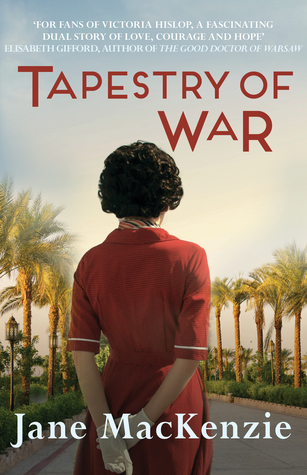
Tapestry of War follows the very different experiences of two young women during World War II. In Egypt, we meet Fran Trevillian, a journalist working for the Alexandria Journal, reporting on the issues that are important to the diverse communities that have made the city their home. As Rommel’s forces draw closer to Alexandria, Fran falls in love with Jim MacNeill, a Scottish radar specialist. Meanwhile, in Scotland, Jim’s sister Catriona has finished training to be a nurse and is hoping to use her new skills to provide therapy for injured soldiers who have been sent home from the war. On the Isle of Islay, where she lives with her father, however, nursing opportunities seem limited and Catriona longs to move away to somewhere where she feels her work can really make a difference.

Although there is occasionally some drama in the stories of our two main characters and their friends, this is a very character driven novel. Both women change and grow as people as a result of the work they carry out during the war and the new relationships they develop. I enjoyed each storyline equally, drawn more to Fran’s at the beginning because it was set closer to the action, but appreciating Catriona’s more and more as the novel progressed. I became completely invested in the lives of each woman, sharing in their happiness as each finds love when they least expect it and in their sadness as the tragedy of war strikes again and again.

Most of my previous World War II reading has concentrated on the war in Europe, so my knowledge of what was happening in North Africa is more limited. I found that I was learning a lot from Tapestry of War, but I knew I needed to read some non-fiction to fill in the gaps…

Nonfiction: The Desert War by James Holland

This little book is part of the Ladybird Expert series, aimed at adult readers but published in the same format that those of us who loved Ladybird books as children will remember. Written in a clear and concise style, the left hand pages contain the text while on the right there’s a map, a photograph or an illustration.

Beginning in 1940, when the Italians, under Mussolini, entered the Second World War, James Holland takes us in chronological order through each stage of the war in North Africa, the Mediterranean and the Middle East. It’s all very factual and straight to the point, with none of the author’s own personality coming through, but in a book with only 50 pages (half of them pictures) and a lot of information to cover, that’s understandable. Battles and raids are described briefly, concentrating on the outcome and any notable tactics or weapons that were used.

The Desert War is a perfect introduction to the subject and can easily be read in less than an hour. If, when you’ve finished it, you want to explore things in more detail, some recommendations for further reading are given, although there are no references or sources provided. I didn’t mind this as all I wanted from this book was a chance to learn some basic facts and to get the timeline of events straight in my mind – it’s obviously not intended to be a comprehensive, in-depth read. Looking at the other titles in the Ladybird Experts series, I see there are several more by James Holland covering different aspects of the war, as well as books by other authors on topics as diverse as witchcraft, genetics and Beowulf.

Thanks to Allison & Busby for providing a review copy of Tapestry of War and to Penguin Random House for a review copy of The Desert War.

Do you like to read fiction and non-fiction on the same subject? Can you think of any pairs of books that go well together?
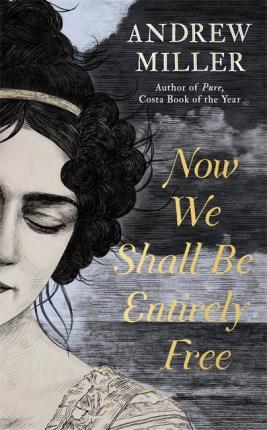
Now We Shall Be Entirely Free by Andrew Miller

It’s 1809 and a wounded man is being carried into his home in Somerset. His name is Captain John Lacroix and he has just returned from Spain, where he has been fighting in the Peninsular War. Injured, exhausted and haunted by his experiences, he seems close to death, but with the help of his housekeeper, Nell, he slowly regains his strength. Unable to contemplate returning to the war, he sets off for Scotland instead – first to Glasgow, then to the Hebrides, in search of some peace and redemption.

Meanwhile, in Spain, a British soldier called Calley is providing evidence to a military inquiry regarding atrocities carried out in the Spanish village of Los Morales during the retreat of the British army. He says he can identify the man responsible for this war crime, the man who was in command of the troops as they raped and murdered. To satisfy the Spanish that justice has been done, Calley is sent to hunt down and punish the perpetrator of the crime, accompanied by a Spanish officer, Medina, who will act as a witness.

Due to the alternating of the two narratives, it very quickly becomes obvious to the reader that the man accused by Calley is John Lacroix…but can it be true? Can the quiet, decent, sensitive man we have been getting to know on his journey to Scotland really have carried out these appalling deeds? Either there is more to the story than meets the eye or we don’t know John Lacroix as well as we think we do. There’s plenty of suspense as we wonder when we will find out exactly what happened that day in Los Morales and what sort of man John Lacroix really is.

As we wait to see whether Calley and Medina will catch up with their target, Lacroix arrives on a remote Hebridean island where he meets Emily Frend and her siblings, Jane and Cornelius. Together with their absent leader, the mysterious Thorpe, they are the last remaining members of a small community who have made the island their home. Intrigued by their lifestyle, Lacroix compliments Emily on her freedom, only for her to explain to him that she does not consider herself to be free at all: “Is it because I take off my stockings to paddle in the sea?” she asks. “That I have let you see me do it? Is that my freedom?”

Now We Shall Be Entirely Free is a beautifully written novel and although there were one or two aspects of the plot that I found unconvincing and although I was disappointed in the Hebridean setting, which I would have expected to have a much stronger sense of place, I could overlook these things because there was so much else that I liked. Andrew Miller has a lot to say about so many things: guilt and blame, the atrocities of war, independence, redemption and love. This is only the second book of his that I’ve read – the first was Pure, a dark and fascinating novel about the destruction of a cemetery in Paris. I enjoyed both but preferred this one because the characters are stronger and because it left me with more to think about at the end. I’m sure I’ll be reading more of his books; I like the sound of Ingenious Pain, so maybe I’ll try that one next.

Thanks to Hodder & Stoughton for providing a copy of this book for review via NetGalley.

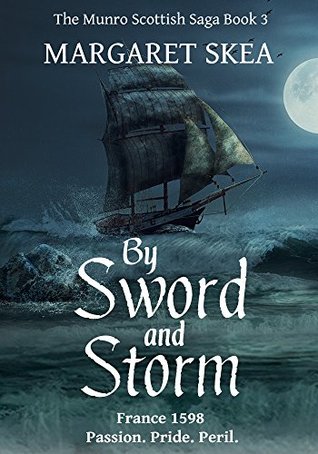
By Sword and Storm by Margaret Skea

This is the third novel in Margaret Skea’s Munro Scottish Saga set in 16th century Scotland and France and based on the history of a clan feud known as the Ayrshire Vendetta. I haven’t read the first two, Turn of the Tide and A House Divided, but that didn’t affect my enjoyment of this third book.

The novel opens in 1598 with Adam Munro, a colonel in the Scots Gardes, living in France with his wife Kate, who has skills as a healer, and their three children, Robbie, Maggie and Ellie. One of the functions of Adam’s regiment is to provide protection to Henri IV of France and when Adam saves the king’s life while risking his own in the process, the Munro family are rewarded with an invitation to come and live at the French court.

In Scotland, meanwhile, the feud between the Cunninghames and Montgomeries is supposedly at an end and the Scottish king, James VI, has banned unauthorised duelling. Most of the family members are trying to keep the peace, but two of them – Hugh Montgomerie and William Cunninghame – are still not prepared to let things rest. The Scottish storyline and the French one alternate throughout the book, eventually coming together as the novel heads towards its conclusion.

By Sword and Storm is a mixture of fact and fiction; many of the characters are real historical figures while others come from the author’s imagination – if you want to know who really existed and who didn’t, there’s a character list at the beginning of the book. Apart from the storylines involving the fictional characters, the novel is grounded in historical fact and has obviously been well researched. I loved the portrayal of life at the court of France, where Kate gets to know the king’s mistress, Gabrielle d’Estrées, and I sympathised with Maggie, who longs to study medicine and despite being given opportunities in France that would not have been open to her in Scotland, still faces obstacles because of her sex.

The political and religious situation in France at that time also plays a part in the story. At the beginning of the novel we see Henri IV issuing the Edict of Nantes, bringing the French Wars of Religion to an end and giving the Huguenots more freedom. However, it is still not safe for people in Paris to worship as they wish, as Kate and Adam’s son, Robbie, discovers when he becomes romantically involved with a Huguenot girl. I think Margaret Skea does a good job of showing the many dangers of 16th century life, not only where religion was concerned, but also for pregnant women before and during childbirth, patients with the sort of illness or injury that could be easily treated today, and anyone who had to travel by ship. It’s a period I love to read about but would not have liked to have lived through!

I really enjoyed By Sword and Storm. I liked the characters and even though I hadn’t been with them from the beginning, I found it easy enough to jump into their story and follow what was happening. Although this was meant to be the third in a trilogy, at the end of the novel I felt that there was still scope for more, so I was pleased to find that Margaret Skea has said she may return to this story again in the future.

Thanks to the publisher Corazon Books for providing a copy of this book for review.

The Story Keeper by Anna Mazzola

This is Anna Mazzola’s second novel, following her debut, The Unseeing, which I read last year. There are some similarities between the two – they are both set in the 19th century and they are both inspired by true crimes – but the stories are very different and, of the two, I found this new one much more enjoyable.

It’s 1857 and Audrey Hart is desperate to get away from London following a traumatic experience at the orphanage where she has been volunteering. Audrey’s mother, who disappeared while out walking many years earlier, had an interest in folklore, so when Audrey sees a job advertised for a collector of folk tales on the Isle of Skye, she applies at once. After arriving on the island and meeting her new employer, Miss Buchanan, she becomes aware that her task is going to be much more difficult than she had expected…

During the recent Highland Clearances, many of the crofters have been forced to leave Skye, taking their stories with them, and those who remain are reluctant to speak to Audrey. Some of this reluctance could simply be due to the fact that Audrey is from England and therefore an outsider, but she senses that there is more to it than that – the islanders seem to be afraid to share their stories and to have them written down. Then Audrey finds the body of a girl washed up on the beach – and when another girl also goes missing, she begins to wonder whether the people of Skye are right to be afraid.

The Story Keeper is a wonderfully atmospheric novel set in a small, remote Scottish community where people’s daily lives are influenced by the old superstitions and traditions in which they still believe. Throughout the novel, as one strange occurrence follows another, we are kept wondering whether there are supernatural forces at work on Skye or whether there is another explanation for what is happening. It all feels quite sinister, and genuinely eerie in places. Some of the superstitions and beliefs Audrey encounters are dark, disturbing and even dangerous. The novel reminded me in that respect of The Good People by Hannah Kent.

As well as the mystery unfolding on the Isle of Skye, there are also hints of other mysteries in Audrey’s past. Why did she leave her home in London without telling her father and stepmother where she was going? What really happened while she was visiting the orphanage? And what was the true story behind her mother’s disappearance, all those years ago? These things are all explained, but the truth only emerges very slowly, meaning that there is plenty of suspense from the beginning of the book until the end.

If I have a criticism, it is that some of the developments towards the end of the book, especially where one particular character is concerned, feel a bit too dramatic and far-fetched. I liked the final twist, though, as it was something I hadn’t worked out for myself. I also enjoyed the fairy tale extracts at the start of some of the chapters and the lines from the poem Kilmeny by James Hogg, which I had to look up and read in its entirety after finishing the book.

Although I couldn’t help thinking The Story Keeper would have been better suited to a cold, dark winter’s night, I still enjoyed reading it during our current summer heatwave and I’m looking forward to whatever Anna Mazzola writes next.

Thanks to Headline for providing a copy of this book for review.

This is book 5/20 of my 20 Books of Summer. I am doing slightly better with this than it seems – I just need to catch up with writing my reviews!

The Queen’s Mary by Sarah Gristwood

Sarah Gristwood is an author of both historical fiction and non-fiction. I have read one of her non-fiction books – Blood Sisters, a biography of several of the women involved in the Wars of the Roses – but this is the first of her novels that I’ve read. It’s set in the 16th century and the queen of the title is Mary, Queen of Scots. Mary is known to have had four ladies-in-waiting, young women her own age who were also all called Mary. They were the daughters of Scottish nobility – Mary Fleming, Mary Livingston, Mary Beaton and Mary Seton. Gristwood’s novel is written from the perspective of Mary Seton.

We first meet the four Marys as children of five or six years old. It’s 1548 and they are embarking on a voyage to France where the young queen will grow up and eventually marry the Dauphin, the heir to the French throne. This forms the novel’s brief prologue and we hear very little about what actually happened in France, except when Seton looks back on the period later in her life:

Seton could tell tales of Diane’s banquets where the white wine was made cool with snow, of music in the pavilions by the river; a tennis court where the king played dressed in white silk. Of a park where special deer wore silver collars and ornamental canals were filled with fish; and of how, when the royal children came to stay, muzzled mastiffs and even a bear were brought into the nursery.

We join the Marys again in 1561 as they return to Scotland following the death of the queen’s husband. They have now grown into young women, all with very different personalities: Fleming pretty and regal, Livingston down to earth and flirtatious, Beaton quietly passionate, and Seton herself sensible and thoughtful. However, it would have been nice if, rather than the author just telling us what the Marys were like (by comparing them to the four elements, earth, fire, water and air, for example) she had done more to convey their personalities through their speech and actions instead.

The rest of the novel takes us through the years of Mary’s reign, a troubled time of religious conflict, disastrous marriages and controversial love affairs. It can’t have been easy for a young woman returning after a long absence in France to rule over a country she barely remembered:

It was as if the queen were groping to understand what to her – Seton thought with a chill – seemed almost to be an alien country.

The queen is lucky to have such loyal companions as the Marys to help her through these difficult years, but even they are unable to prevent her from making mistakes. She rarely confides in them or asks their advice, remaining a very lonely and isolated figure. Seen only through the eyes of Mary Seton, she never fully comes to life on the page and we never really know what she is thinking or feeling, but maybe that was intentional, to show the distance between the queen and her ladies, even after so many years together.

The story of Mary, Queen of Scots is fascinating but has been written about many times before; the stories of Mary Seton, Beaton, Livingston and Fleming are much less well known and the hope of finding out more about them was what drew me to this novel. I can appreciate that there will not be a lot of information available on the lives of these four women, but I think Sarah Gristwood did a good job of working with what we do know to flesh out each character a little bit. I do wonder, though, whether the story might have been more compelling if it had been written in the first person rather than the third, or if each Mary had been given a chance to take a turn at narrating rather than just Seton.

I did have a lot of sympathy for Mary Seton; she is the one who remains in the queen’s service as the other three gradually marry and find freedom (or if not freedom exactly, at least a form of escape) away from court. Seton’s whole life has been devoted to the queen and she gradually becomes torn between loyalty to her mistress, frustration at her lack of influence and a longing to break the bond and live her own life at last.

Although there was too much distance in this novel for me to say that I really enjoyed it (distance between one character and another, as well as distance between the characters and the reader) it was still good to have an opportunity to meet the Four Marys and to add to my knowledge of this period of history.

Thanks to Endeavour Press for providing a copy of this book for review via NetGalley.

Lament for a Maker by Michael Innes

After reading Hamlet, Revenge! recently, I have been wanting to read more by Michael Innes, so I was pleased to find his next Inspector Appleby mystery, Lament for a Maker, available through NetGalley. Having read the previous book in the series I thought I knew what to expect from this one, but I was wrong – this book has a very different feel and structure and despite being published in 1938, it’s not a typical Golden Age mystery novel at all.

The title is taken from a 16th century Scottish poem by William Dunbar (the word maker, also spelled makar, means a poet or court poet). The Latin refrain Timor mortis conturbat me – fear of death disturbs me – is repeated throughout the poem and sets the tone for Innes’ novel.

This is such a complex, convoluted mystery it’s difficult to know where to begin, but the best place to start is probably with the crime itself – assuming that a crime has actually been committed, of course! Ranald Guthrie, the miserly laird of Erchany Castle has been killed falling from the ramparts of his own tower on a cold winter night, but was he pushed, was it an accident or could it have been a suicide attempt? If it was murder, then the culprit seems obvious: Neil Lindsay, the young man who wants to marry Ranald’s niece and whose family have been feuding with the Guthries for generations. There is much more to the situation than meets the eye, however, and as the story unfolds more suspects and possible scenarios begin to emerge.

The novel is written from the perspectives of five different characters who each take it in turns to narrate their part of the story. My favourite was the first, Ewan Bell, a shoemaker who lives in Kinkeig in Scotland. It is Ewan who sets the scene, introduces us to the other main characters in the novel and describes the events leading up to Guthrie’s death – all in his own distinctive voice, complete with plenty of Scots dialect!

“If an unco silence had fallen upon nature with the snow those weeks there were plenty of human tongues in Kinkeig to make good the deficiency. The less work always the more gossip, and there must have been even more claiking than usual about the meikle house.”

The second narrator is Noel Gylby, a young Englishman who appeared in Hamlet, Revenge! He is visiting Erchany Castle with his American girlfriend and immediately his narration (which takes the form of letters) has a very different feel from Ewan Bell’s:

“Diana darling: Leaves – as Queen Victoria said – from the Journal of my Life in the Highlands. Or possibly of my Death in the Lowlands. For I don’t at all know if I’m going to survive and I don’t know – I’m kind of guessing, as my girl-friend here says – where I am.”

And there are several more! Lots of authors have written books with multiple narrators but I haven’t come across many (apart from Wilkie Collins) who actually succeed in giving each narrator a unique voice of their own. This is one of the best attempts I’ve read for a while. It’s not just the style and structure which make this such an enjoyable novel, though; the mystery itself is also a good one, with twist following upon twist as the end of the book approaches.

As for Inspector Appleby himself, he doesn’t appear until two thirds of the way through the book when the mystery is already half solved and theories have been suggested. Although the novel is clearly set in the 1930s, there are times when both the story and the book itself feel as though they belong to a much earlier period (it reminded me very strongly of The Master of Ballantrae by Robert Louis Stevenson and it seems I’m not the only one to make that connection). This makes me wonder whether Innes may really have wanted to write a historical mystery but couldn’t as he needed to make it part of the Appleby series. That would explain why Appleby makes such a late appearance, almost as an afterthought.

Anyway, I loved this one. Thanks to Ipso Books for the review copy.

Rum Affair by Dorothy Dunnett – #1968Club

I am, after all, the only really photogenic coloratura soprano alive. My only problem, just about then, was in staying alive.

It’s been a while since I read my first of Dorothy Dunnett’s Johnson Johnson mysteries and this week’s 1968 Club (hosted by Simon and Karen) seemed the perfect opportunity to read another one. Rum Affair – originally titled Dolly and the Singing Bird and then The Photogenic Soprano – was the first in the series to be published (in 1968 obviously), although Tropical Issue, the other one I’ve read, was the first chronologically.

Dunnett is better known for her historical novels, some of which have recently been reissued, but the seven books in her mystery series have contemporary settings. They are each narrated by a different young woman and all feature the portrait painter Johnson Johnson and his yacht Dolly.

Rum Affair opens with Tina Rossi, a Polish-Italian opera singer, arriving in Scotland where she is due to give two performances at the Edinburgh Festival. During a break in her schedule, she has arranged to meet her lover, Kenneth Holmes, at his friend’s Rose Street flat. However, there’s no sign of Kenneth – just a card with the three handwritten words, “Darling, I’m sorry”. Searching for clues to explain his absence, Tina opens a wardrobe door to reveal the body of a man, a stranger, who has been shot in the chest. When the police unexpectedly arrive, making enquiries about a robbery in the neighbourhood, she quickly makes the decision to conceal what has happened – to try to save her own reputation, she tells us, and Kenneth’s.

Instinct is a marvellous thing, I dare say; but I prefer to use my good sense. You, perhaps, with a strange man lying dead at your feet would have welcomed the police with an exhibition of nervous relief. I, on the other hand, kept my head.

On the same night, Tina’s path crosses for the first time with that of Johnson, who is staying nearby. Tina is immediately intrigued by Johnson, a mysterious man who wears bifocals and introduces himself as “thirty-eight. Painter. London. On holiday.” When Johnson invites her to join him on a yacht race to the Isle of Rum, she is quick to accept. Rum is where Kenneth is currently based, working on a highly sensitive project for his employers, although she doesn’t admit this to Johnson. However, it seems that Johnson has a reason of his own for wanting Tina to sail with him on board Dolly – and it’s not just so that he can paint her portrait!

I won’t go into any more detail regarding the plot because I wouldn’t like to inadvertently give too much away and spoil the mystery – and I don’t want to say much more about Tina Rossi either as I’m finding that part of the fun of reading the Johnson novels is in getting to know the woman who is narrating the story. What I will say is that Tina is very different from Rita Geddes of Tropical Issue and that their narrative voices reflect their different personalities and backgrounds (while I liked Rita immediately, I never connected with Tina at all, but I suppose you can’t like every character in every book). As for Johnson himself, even though I have now read two books in this series, he is still very much an enigma to me. Of course, we only see him through the eyes of the narrators so we only know what they choose to tell us and are reliant on their observations and interpretations of his character, which may not always be correct or true.

I also found the setting interesting; the race in which Johnson and Tina are participating takes them around the west coast of Scotland, visiting several islands of the Inner Hebrides, of which Rum is one.

In the summer night, the Inner Hebrides lay all about us, black on the indigo sea. Above us, the uninterrupted sky stretched, a light, dense ultramarine, its ghostly clouds and small, sharp white stars suspended over the bright winking lights, near and far, of a constellation of lighthouses, and the grey, dimly voyaging waves here below.

I particularly enjoyed the scenes set at Fingal’s Cave on the island of Staffa!

Although I don’t think these books come close to the brilliance of Dunnett’s Lymond or Niccolò series, or King Hereafter, they are still quite enjoyable in a different way. I am looking forward to reading the rest and meeting the other five narrators.