Gemini by Dorothy Dunnett

Gemini In June last year, having finished the final book of the Lymond Chronicles in April, I picked up Niccolò Rising and embarked on Dorothy Dunnett’s second historical series, the House of Niccolò. And now here I am, seven months and eight books later, at the end of Gemini and finding it hard to believe that there are no more adventures of either Lymond or Nicholas left for me to discover. There will be re-reads, of course, but it does make me sad that I can’t read any of these books for the first time again.

*Spoilers follow for both the House of Niccolo and the Lymond Chronicles*

Geographically, unlike the last few Niccolò books where the action switched between a variety of different settings, Gemini is focused mainly on one location: Scotland. After causing damage to the Scottish economy in the course of his long-running contest with his wife, Gelis, Nicholas has returned to try to make amends. Soon after his arrival in Scotland, Nicholas finds himself having to contend with a possible inherited illness (porphyria?) afflicting the royal family, trying to handle the King’s wild and unpredictable younger brother, John of Mar, and attempting to thwart a rebellion by the King’s other brother, the Duke of Albany. With Nicholas’s two biggest enemies, his grandfather, Jordan de St Pol of Kilmirren, and his former trading rival, Davie Simpson, also in Scotland, Gelis stays behind for a while in the relative safety of Bruges with their son, Jordan. But it’s not long before she and Jordan are in Edinburgh too and the eighth and final volume of the House of Niccolò starts to head towards its conclusion.

I did love Gemini overall, but I confess to getting a little bit bored with the political aspects of the novel. It’s not that I don’t find this period of history interesting and important, because I do – it’s just that at this late stage in the series, and especially as I began to reach the end of the book, I was too impatient to slow down and concentrate on all the details. I’m sure on a future re-read I’ll be able to appreciate this side of the novel more, but on this first read I was desperate to see how Nicholas’s personal story would be resolved and to have some of my questions answered.

I found Simon’s and Henry’s deaths particularly moving, though not so much for their sakes as for Nicholas’s, though I did feel slightly cheated when I realised that Simon was never going to acknowledge Nicholas as his son, and that neither Simon nor Henry were ever going to find out the truth about Henry’s parentage – I think I had expected there to be a big confrontation at the end of the book where everything would be revealed. I suppose it’s not the first time in a Dunnett novel that things haven’t turned out the way I had been anticipating! I was also a bit disappointed that a true reconciliation between Henry and Nicholas never happened, despite there seeming to be some steps in that direction earlier in the book.

I get the impression that opinion is divided over the Epilogue with some readers finding it unnecessary, but personally I liked it and was pleased to see that some of the links with the Lymond Chronicles were explained at last. Although I’ve been doing my best to avoid spoilers while reading this series I must have picked up somewhere that Rankin was Lymond’s father because I had that at the back of my mind, but I was completely confused as to how Rankin of Berecrofts could possibly be the same person as Francis Crawford, 1st Baron Culter. As for Sybilla’s parents, I had guessed that Jordan was probably her father, though I had no idea about the identity of her mother. I had been coming up with various theories about the significance of Bel of Cuthilgurdy, but not the right one.

Now for one of the most shocking revelations of the novel: Julius. I didn’t like him and had started to suspect there might be more to him than met the eye, but even though his mother’s name was there in the family tree at the front of the book, it had never occurred to me that there was any connection and when it was revealed it took me completely by surprise. When I get around to reading this series again I will certainly be looking for clues about Julius and paying more attention to everything he says and does in the earlier novels!

*End of spoilers*

I’ve really enjoyed working my way through this series, but the House of Niccolò hasn’t had quite the same effect on me as the Lymond Chronicles, mainly because Nicholas himself, to me, is a less appealing character than Lymond – though I know others will disagree. While I was reading the Lymond Chronicles (and sometimes even now, a year later) I was thinking and worrying about Lymond all the time, even when I was away from the books, but I never really connected with Nicholas on the same level. Still, I did love the series as a whole and am looking forward to reading all the books again and looking out for some of the things I know I missed during the first read. I’ve also bought a copy of King Hereafter and will be reading that at some point, but first I’m spending some time catching up on all the non-Dunnett books I’ve been neglecting over the last year!
The Private Memoirs and Confessions of a Justified Sinner by James Hogg

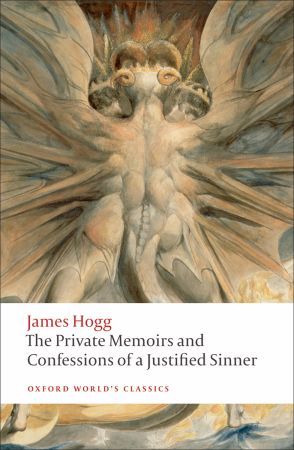
The Private Memoirs and Confessions of a Justified Sinner My sister gave me a copy of this book saying it was one of the weirdest books she’d ever read and she thought I would love it. I’m not sure what that says about my reading tastes, but she was right anyway because I did love it!

The Private Memoirs and Confessions of a Justified Sinner, published in 1824, was written by the Scottish poet and novelist James Hogg. I had never come across Hogg and his work until now and was interested to learn that he was a shepherd who taught himself to read and write and became a friend of Sir Walter Scott. This, his most famous novel, is part horror story, part murder mystery and part gothic fiction, but it also incorporates elements of religion, Scottish folklore, the supernatural and even some humour and satire.

Robert Wringhim, the ‘justified sinner’ of the title, is a young man who has been raised by his adoptive father, a Calvinist, to believe he is one of the chosen few, destined for a place in Heaven regardless of the sins he commits in life. One day he meets a mysterious stranger who calls himself Gil-Martin and who seems able to change his appearance at will. Wringhim allows the stranger to convince him that it’s his duty to “cut sinners off with the sword” and that he doesn’t need to worry about committing murder as in this case it’s the right thing to do and he is sure to be saved by God anyway. In his Private Memoirs and Confessions, he describes how he falls under the spell of the sinister Gil-Martin and how, when he begins to have doubts about his new friend, he starts to descend into madness and desperation.

Robert Wringhim’s Confession is presented as an authentic document that has been discovered under unusual circumstances a century later. It is introduced by a Narrative written by a fictitious editor which gives a supposedly factual account of Wringhim’s life and the crimes he is involved in. The Editor’s Narrative also forms the third and final section of the novel and attempts to explain how the Confession was found and what it might mean. But instead of helping to clarify the story, the Editor actually makes things more confusing and sometimes even contradicts what Wringhim has said. Neither narrative seems to be very reliable and at the end of the novel, we have to decide for ourselves what really happened. For example, it’s not clear whether Gil-Martin is a product of Wringhim’s imagination or whether he is a real person or even the Devil.

This book kept me gripped from the first page, but it was quite a challenging story to read. There was a lot of Scottish dialect and while that’s not something I usually have a problem with, many of the words used here were unfamiliar to me and I was constantly turning to the glossary at the back of the book. There were also a large number of Biblical references on almost every page and again, I found that I kept needing to refer to the notes. It wasn’t completely essential to recognise or understand all of these references, but it was important to know how the various characters were interpreting them. Finally, there are no chapter breaks – the middle section, the Confession, forms one continuous chunk of over 100 pages, making it hard to find a place to stop reading.

However, it was definitely worth having to make a bit of extra effort; this is one of the most fascinating and original classics I’ve read and I can’t believe it isn’t better known. I thought it was much better than Robert Louis Stevenson’s Dr Jekyll and Mr Hyde, which is the book it reminded me of most. I’m also surprised that, as far as I’m aware, it has never been adapted for film or television. Some parts of the novel are very visual – the atmosphere of the dark wynds and closes of Edinburgh; the description of the rainbow seen by Robert Wringhim’s brother, George; and some of the scenes where Wringhim finds himself hounded and tormented by fiends and demons. I loved this book and am very grateful to my sister for recommending it!

To Lie with Lions by Dorothy Dunnett

To Lie with Lions To Lie with Lions is the sixth volume in the House of Niccolò series and although I loved it, this is not the place to start if you’re new to Niccolò. To be able to fully appreciate this book, you really need to have read the series from the beginning and, in particular, you need to read the fifth book, The Unicorn Hunt, before this one. To Lie with Lions picks up a lot of the threads from The Unicorn Hunt and in some ways I thought they almost felt like two halves of the same novel, so please be aware that if you haven’t read all of the previous five books yet you will encounter spoilers in the rest of this post.

***

In To Lie with Lions, Nicholas de Fleury returns to Scotland with his wife, Gelis, and son, Jodi. On the surface it may appear that he and Gelis have been reconciled; in reality, the mysterious ‘game’ they are playing is about to enter its final stages. Meanwhile, as Nicholas continues to make himself indispensable to the young King James III of Scotland and his court, he also becomes embroiled in the conflict in Europe between the King of France and the Duke of Burgundy – but which, if either, is he really working for?

Previous books have dealt with the trade of alum, silks, sugar, gold and slaves; this book looks at the trade of another commodity: stockfish (dried, unsalted fish). To find these supplies of fish, Nicholas must embark on a sea voyage to Ultima Thule – Iceland and the Westmann Islands. As usual, he has more than one reason for this trip, and to make things even more interesting, the Bank of Niccolò’s rivals, the Vatachino and Anselm Adorne, as well as Paúel Benecke of the Hanseatic League, are also on their way to Iceland. There were a lot of dramatic scenes and set pieces in this book – a walk through the ducal château of Hesdin where traps and practical jokes lie around every corner; a game of Florentine football on the castle walls in Edinburgh; skating on the frozen Nor’ Loch – but it was this excursion to Iceland in the middle of the novel that I found the most memorable. There’s some beautiful descriptive writing in this section of the book, bringing to life all of Iceland’s distinctive natural features – the glaciers, geysers, hot springs and volcanoes – and the wildlife – the eagles, ‘white bears’ and ptarmigans. The descriptions of the volcanic eruptions are stunning and made me think how much more frightening and awe-inspiring such phenomena must have been in Nicholas’s time.

“The Mouth of Hell opened when they were a long way out to sea, and the glacier over Katla lifted its city of ice into the sky…Now, you could no longer diminish what was happening by translating it into human dimensions. This was not a play. This was the hurling into the sky of thousand-ton blocks of ice, glinting and roseate in the thundering night. This was the discharge of millions of gallons of boiling water, plunging down from the mountain in a wild dashing glitter, outrunning the billows of its own pink-flushed steam.”

As with all of Dunnett’s novels, there are things that seem confusing at the beginning but have taken on new meaning by the end of the book. Among other things, we finally discover, after endless hints about ‘the game’ Nicholas and Gelis were playing, what it was all about and what each of them was hoping to achieve; we learn why Godscalc had been so determined to keep Nicholas from returning to Scotland; and the reason for Nicholas’s reaction to the Nativity Play he had worked so hard on and received so much praise for. After disliking Nicholas throughout most of The Unicorn Hunt, I found him more likeable again in this book, rather like Tobie, who returns to Nicholas’s side filled with hope that perhaps he is not beyond redemption after all. Tobie, with his ever-changing opinion of Nicholas, is someone I can definitely identify with! We do see some evidence of Nicholas’s warmer, more human side again in the relationships he forms with Kathi Sersanders and Robin of Berecrofts (two of my favourite characters) in Iceland and in the effort he makes to bond with Jodi.

It seems, though, that Nicholas often gets so carried away with the intricacies of his elaborate machinations that he forgets, or ignores, the fact that his schemes are affecting real people’s lives. And after feeling so much more sympathetic towards him during this book than I did during the last one, the revelations in the final chapters caused me, like many of his friends and colleagues, to become disillusioned with him again. Still, I was pleased that the contest between Nicholas and Gelis had finally come to an end and I was left with the feeling that one episode is over and a new one is about to begin.

The Unicorn Hunt by Dorothy Dunnett

The Unicorn Hunt is the fifth book in the eight-volume House of Niccolò series which follows the adventures of former dyer’s apprentice Nicholas de Fleury (also known as Nicholas vander Poele or Niccolò) now a successful banker and merchant. I loved all of the previous four books – although it took me a while to really get into the first one, possibly because I read it too soon after finishing the Lymond Chronicles and couldn’t avoid making comparisons – but I think this one has just become my favourite of the series so far, surpassing even the brilliant Scales of Gold.

A warning before I go any further: as followers of my blog will know, I usually make an effort to avoid spoilers in my posts, but I think it’s going to be almost impossible to discuss the fifth book in a series without spoiling anything. Unless you’ve already read the first four instalments, I would suggest starting at the beginning with Niccolò Rising and not reading the rest of this post until you’ve caught up.

In The Unicorn Hunt Nicholas is searching for two things: the gold which was stolen from his ship in the previous book and a child that may or may not be his. The search for both will send Nicholas and his companions on a journey across Europe and North Africa – but before the hunt begins, we are taken to Scotland where Nicholas is setting some elaborate schemes in motion.

Scotland, I suppose, may be a less exotic setting than the Black Sea port of Trebizond, the island of Cyprus or the African city of Timbuktu – but much as I’ve enjoyed learning about the places Nicholas and his entourage have visited in the previous books, it was good to be back on more familiar territory and in one of the few Dunnett locations I have actually visited many times! Later in the book the action returns to Bruges and Venice, incorporating trips to Cairo and Alexandria, the mountains of the Tyrol, and another brief visit to Cyprus, though for once I think I would have preferred the whole book to have been set in one place – after leaving Scotland I thought the story suffered slightly from the lack of geographical focus. There also seemed to be less focus on trade and business in this book than in the others; instead, the driving force of the plot is the conflict between Nicholas and his wife, Gelis.

I think this is the only series I’ve ever read where I feel I’m understanding the main character less with every book rather than more! The warmth and sense of fun he often displayed in the earlier novels is almost completely gone now, which is understandable considering some of the things he has gone through, but even so Dunnett really made me dislike Nicholas in this book, especially in the first half. I couldn’t help comparing his behaviour to Lymond’s in The Ringed Castle – both of them seem to deal with their pain by cutting themselves off emotionally from the people around them and the way Nicholas’s men were trying to keep him away from Scotland reminded me of the way Lymond’s friends were reluctant to let him return to Russia. Anyway, I’m fortunately not a reader who needs to like the characters to be able to enjoy a book – and Nicholas is still as complex and fascinating as ever, even if not very likeable at the moment, so we’ll see how I feel about him in the next book, To Lie with Lions.

Dunnett really excels at writing exciting set pieces and there were some great ones in The Unicorn Hunt, including a dramatic fight at the salt-pans in Scotland and a confrontation during an ascent of Mount Sinai (there were lots of ascents and descents of various types in this book, I noticed). But as usual, in what is otherwise a very dark book, the drama is balanced by some delightfully funny scenes – one involving a parrot, a mirror and a hat, and another with a gum-covered kite and a priest’s beard. The introduction of Anselm Adorne’s niece, Katelijne Sersanders (Kathi), also helps to lighten the mood and I think she’s part of the reason I enjoyed this book so much.

I did have one small problem with this book and that was the fact that we are asked to believe that Nicholas is now a diviner and has the ability to find people and objects by divining. I’m still not sure how I feel about this; I don’t really mind Dunnett adding a paranormal angle to the story (the Dame de Doubtance and her prophecies in the Lymond Chronicles didn’t bother me too much, for example) but I do prefer to see Nicholas solving problems using his own intelligence and powers of logic and reasoning, rather than using what appear to be magical abilities. It just seemed a bit too convenient that he suddenly discovers he is able to use divination to find things in a book where ‘finding things’ is the central plot point.

And hunting, as the title suggests, is a major theme of this book. The dowsing and divining are linked to this, but there are also lots of other ways in which hunting is incorporated into the story: hunting with hounds in Scotland, hunting chamois in the Tyrol, hunting for the stolen gold, and of course, hunting for the baby. The unicorn of the title and who or what it refers to could also be interpreted in several different ways. Like the unicorn, which is a mythical beast, for most of the novel we are never quite sure whether or not the existence of the child is also a myth and I thought it was wonderful that Dunnett was able to keep the reader in suspense so masterfully right until the very end of the book.

For a very different view of The Unicorn Hunt, see Leander’s post from a few weeks ago. I think it’s interesting that each individual reader can have different favourites and least favourites while still agreeing on the overall quality of the series.

Thoughts on finishing the Lymond Chronicles

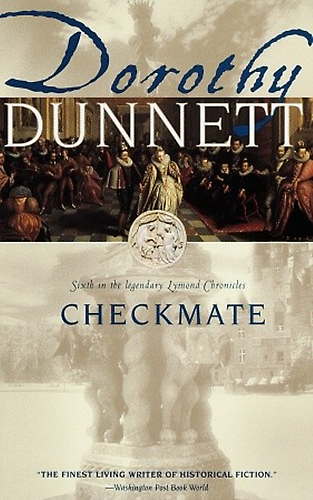
I apologise for abandoning my blog this week – I’ve been very busy both at work and at home, and any spare time I did have was devoted to finishing Dorothy Dunnett’s Lymond Chronicles. Because I read the final two books, The Ringed Castle and Checkmate so close together, rather than posting separate ‘reviews’ I decided to combine both books into the same post, along with some comments on the series as a whole.

Let’s start with the fifth book in the series, The Ringed Castle. After all the praise I’ve bestowed on the first four books it’s difficult to find new words to describe how I felt about this one, so suffice to say that it was as wonderful as the others. Russia is one of my favourite settings for historical fiction so I liked that aspect of the book, though I was equally interested in the chapters set at the Tudor court.

As with the previous novels, there’s a lot of history in this book – in the Russian sections we learn about Ivan IV, the Cossacks and the Crimean Tartars, and in the English sections we find ourselves at the centre of the conspiracies and political intrigue surrounding Queen Mary I and the future Elizabeth I. We also meet John Dee, the famous astrologer and mathematician, who is always interesting to read about, as well as another historical figure I knew nothing about: the explorer Richard Chancellor. Chancellor’s work with the Muscovy Company and as a navigator form quite a big part of the plot and I’m glad I’ve been able to learn something about his life and career. The final voyage of the Edward Bonaventure was so sad and one of the most memorable parts of the book for me.

Oh, and I loved the scene in the Hall of Revels, which finally led to the ‘Anvil Moment’ Aarti has been telling me about. And yes, it was worth waiting for!

When I started Checkmate, it was with a mixture of excitement at finding out how Lymond’s story would end and also sadness at the thought of reaching the end of the series. I was hoping to make the final book last as long as possible, but of course I couldn’t and it actually took less time to read than any of the others. In a series of unputdownable books, I found this one the most unputdownable of them all! I admit to having to cheat once or twice and flip forward a few pages, which is something I usually try not to do, but knowing from the previous books that Dorothy Dunnett had no qualms about killing off major characters, sometimes the suspense was just too much to bear.

Having said that, this wasn’t my favourite of the six books. There were parts that I loved – the chase through the streets of Lyon, the hilarious Hotel de Ville banquet, as well as finally learning the truth about Lymond’s birth – but overall I enjoyed some of the earlier books more. Still, I thought Checkmate was a great conclusion to the series and it was good to see so many of the characters from the previous books brought together in this one, including the return of Jerott, Marthe and one of my favourites, Archie Abernethy. And after The Ringed Castle, in which Lymond becomes more isolated than ever from his family, I was glad that Sybilla and Richard played such a big role in this book (it’s been fascinating to follow all the ups and downs of the relationship between Richard and Francis).

I’d like to finish by saying that I agree with all the Dorothy Dunnett readers who have been commenting on my previous Lymond posts – this is the best series of historical fiction novels I’ve ever read and I can see why so many of you have been re-reading them for decades because I’m sure I’ll be doing the same. And for anyone who has yet to read these books, I can promise you that although they’re not the easiest of reads, it’s definitely worth making the effort and getting to know Francis Crawford of Lymond, one of the most complex, charismatic, fascinating characters you’re ever likely to meet in literature. Working through the six books of the Lymond Chronicles has been one of the greatest experiences in my lifetime of reading.

The Disorderly Knights by Dorothy Dunnett

The Disorderly Knights is the third of Dorothy Dunnett’s Lymond Chronicles. In this instalment, Francis Crawford of Lymond goes to Malta to help the Knights Hospitallers of St John protect the island from invasion. It soon becomes obvious that not only is Malta under threat from the Turks, but the Order of St John itself is in danger of being torn apart by feuding factions among the knights. And as the action moves first to Tripoli and then back home to Scotland Lymond himself becomes entangled in the schemes of a very clever and subtle enemy.

I loved the first two books in this series, The Game of Kings and Queens’ Play, but this one is my favourite so far. It’s been a long time since I’ve been so completely immersed in a book – I had to tear myself away from it to go to work or to sleep and still couldn’t stop thinking about the story or the characters even when I wasn’t reading.

As with the first two books I found I had to keep turning back to remind myself of what had happened in earlier sections and was constantly changing my mind about what I thought was going on. Although I knew who the villain was (even if most of the characters in the book didn’t) I wasn’t sure what his motives were, what he was hoping to achieve or how long ago he had started to put his plans into motion, so there was still plenty of mystery to keep me guessing throughout the story.

I have never read anything set in either Malta or Tripoli, but both locations were brought to life for me through the vivid descriptions we were given. After I’d finished the book I looked up some of the historical events covered in the story such as the Siege of Tripoli and I was so impressed at how cleverly Dorothy Dunnett had woven fact and fiction together. The same applies to some of the novel’s later events set in Scotland – the feud between the Scotts and the Kerrs, for example, and even the deaths of some of the characters.

This was such an emotional book too – there were various points in the story where my blood was boiling, my heart was pounding or I had tears in my eyes – yet I think the fact that it caused such strong emotions proves what a powerful book this was. And I appreciated the moments of humour that the author injected into what would otherwise have been a very dark story. The scene with the eight hundred sheep was one of my favourites!

I couldn’t put this book down throughout the last 100 pages and was so glad I had Pawn in Frankincense ready to pick up as soon as I finished! You can expect to see my thoughts on that one soon.

The Game of Kings by Dorothy Dunnett

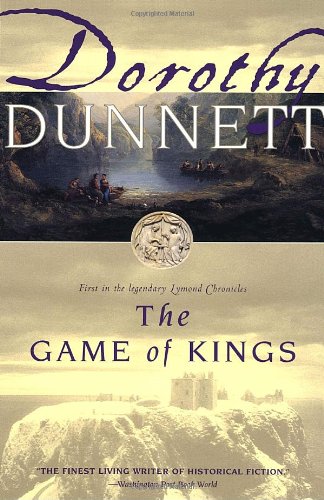
The Game of Kings is the first of the Lymond Chronicles, a series of historical fiction novels by Dorothy Dunnett originally published in the 1960s and 70s. I’m actually quite surprised and disappointed that I had never come across these books before, especially as historical fiction is my favourite genre and for a few years was pretty much all I read. Anyway, I’ve discovered them now, which is the most important thing!

It’s 1547 and Francis Crawford of Lymond, accused of treason five years earlier, has returned to his home country of Scotland. As the leader of a band of outlaws he begins a search for the three men he believes might be able to clear his name. Lymond’s personal quest is played out during an important period in Scotland’s history: the English are hoping to marry the 4 year old Mary, Queen of Scots to 9 year old King Edward VI of England and unite the two countries – but the Scots are equally determined to prevent this from happening.

I really can’t tell you much more about the plot without spoiling the story, but I can promise you that this was one of the most gripping historical novels I’ve read for a long time – I was never bored for a minute. There are sad scenes, funny scenes, exciting scenes and moving scenes, not to mention the most thrilling sword fight I’ve ever read! I finished reading the book last weekend and since then have been trying to think of what I could possibly say about it that would do it justice…there were just so many things I loved: the wonderful plot, filled with twists and turns, surprises and revelations; the strong, memorable characters; the clever dialogue; and the accurate and well-researched historical setting. Most of all, of course, I loved Francis Crawford of Lymond, brilliant, charismatic and witty, but also very flawed and troubled. He is now high on my list of favourite fictional characters!

In fact, all of the characters in the book are incredibly well drawn. There’s so much I could say about Christian, Will, Sybilla, Kate, Richard, Mariotta and the others, but I won’t because it would be so much more fun for you to get to know these characters for yourself. They all felt like fully formed people rather than just words on a page and they lived on in my mind even when I wasn’t reading, which I always think is a sign of a good book. And I haven’t even mentioned yet the amazing sense of time and place Dorothy Dunnett creates. The amount of detail she goes into in building Lymond’s world is so impressive and everything feels completely accurate.

But much as I loved it, this was not the easiest of books to get into. There are a lot of characters to keep track of and some of them are referred to by more than one name or title, so the character list at the front of the book was very helpful! The novel also has a very, very complex plot and you really need to concentrate because the tiniest detail can turn out to be important later on. Lymond has a very good reason for almost everything he does but many of those reasons are not immediately obvious. Things that initially don’t make any sense suddenly take on new meaning a few chapters later and I found I had to keep re-reading previous sections so I could grasp what had happened.

I should also point out that Lymond’s dialogue is filled with quotes and references from history, literature, myth, nature, philosophy, nursery rhymes, songs and riddles (some of which are in French, Spanish, Latin or other languages, which are not translated for us). I soon realised there was no way I was going to understand all of the references, as unfortunately my education is sadly lacking in comparison to Lymond’s! Some of the things he says seem to mean nothing at all unless you recognise the context they are from, which in most cases I didn’t.

I know there are two Dorothy Dunnett Companions and other guides to the series that you can buy, but I think trying to read those along with The Game of Kings would have been too much for me on a first read! I decided just to enjoy the story and when I re-read the book, as I’m sure I will, I can look up the unfamiliar words and phrases then. In the meantime, there was always Google when I was desperate to know what something meant.

So, if you’re looking for a light, easy read The Game of Kings probably isn’t for you, but if you enjoy complex, well-written historical fiction then I hope you’ll give it a try. Although it could be challenging at times it was so rewarding and definitely worth the effort. I’ve already started reading the second in the series, Queen’s Play – I’m nearly 100 pages into it and loving it so far!