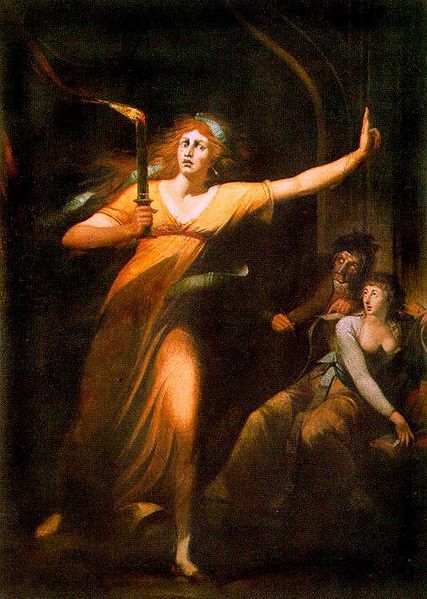
Double, Double, Toil and Trouble!

Earlier this year I re-read Macbeth as part of a Shakespeare reading challenge, but never got round to actually posting about it. And so, in honour of Halloween I decided to share ten of my favourite quotes from the play. Enjoy!

***

“Tis safer to be that which we destroy, Than by destruction dwell in doubtful joy”

***


“I have no spur
To prick the sides of my intent, but only
Vaulting ambition, which o’erleaps itself
And falls on the other.”

***

“Stars, hide your fires; Let not light see my black and deep desires.”

***

“Tomorrow, and tomorrow, and tomorrow
Creeps in this petty pace from day to day
To the last syllable of recorded time;
And all our yesterdays have lighted fools
The way to dusty death. Out, out, brief candle!
Life’s but a walking shadow, a poor player
That struts and frets his hour upon the stage,
And then is heard no more. It is a tale
Told by an idiot, full of sound and fury,
Signifying nothing.”

***

“Give sorrow words; the grief that does not speak whispers the o’er-fraught heart, and bids it break.”

***


“Come, you spirits
That tend on mortal thoughts! Unsex me here,
And fill me from the crown to the toe top full
Of direst cruelty; make thick my blood,
Stop up the access and passage to remorse,
That no compunctious visitings of nature
Shake my fell purpose, nor keep peace between
The effect and it!”

***

“By the pricking of my thumbs, Something wicked this way comes.”

***

“Away, and mock the time with fairest show:
False face must hide what the false heart doth know.”

***

“Come what come may, time and the hour run through the roughest day.”

***

“Double, double, toil and trouble;
Fire burn and cauldron bubble!”

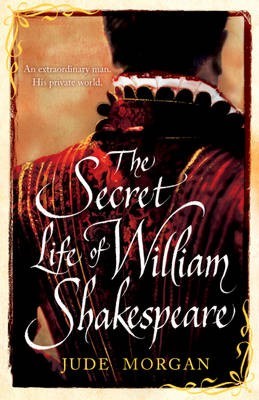
The Secret Life of William Shakespeare by Jude Morgan

I loved Jude Morgan’s books about the Brontës (The Taste of Sorrow) and the Romantic poets (Passion) so was very excited about reading this new novel on the life of William Shakespeare – and I’m pleased to say that it did live up to my expectations. Before I go any further I should point out that this book and the other two I’ve mentioned are fiction, although they do stick quite closely to the known facts about the lives of their subjects (as far as I can tell, not being an expert on any of them!)

The Secret Life of William Shakespeare opens in 1582 when we first meet Shakespeare as a glovemaker’s son from Stratford. At the age of eighteen he marries Anne Hathaway and they have three children together, but we soon learn that Will wants more out of life. He dreams of going to London and becoming an actor – and despite his father’s disapproval he sets out to turn his dream into reality.

It’s really not necessary to know anything about Shakespeare before beginning this novel and you could easily enjoy it without being familiar with any of his work. Some of his plays are mentioned, of course, but the plays are not the focus of this book. As the title suggests, the book is not just about Shakespeare the playwright but also about Shakespeare the man – his emotions, his hopes and fears, his relationships with the people around him, the things he might have said and done. Obviously we don’t know exactly what the real Shakespeare was like, but the way Jude Morgan portrays him here is believable and realistic.

Shakespeare’s relationship with his wife Anne Hathaway forms a very big part of this novel – in fact, a large proportion of the story is told from Anne’s perspective and a lot of what we learn about Shakespeare is seen through her eyes. For much of the novel Anne’s life is very separate from her husband’s – while he is in London, she stays behind in Stratford with their children. Although she understands that Will’s career is important to him, there is a sense that she has been left behind, that the ties between them are not as strong as they once were – and so there’s a sadness surrounding Anne and I did have sympathy for her. Anne’s character is very well-developed and I was interested in reading her story because I was interested in Anne herself, not just because she was William Shakespeare’s wife.

Other important characters include Shakespeare’s fellow playwrights, Ben Jonson and Christopher Marlowe, and we see the ways in which they affect and influence each other’s lives. But there’s also a large cast of other characters who appear in the novel: Will and Anne’s children, Susanna, Judith and Hamnet; the men Will meets in the theatre world; family members such as Anne’s brother Bartholomew, Shakespeare’s parents and siblings; and their friends in Stratford. By fleshing out the characters surrounding Will, we are given a better idea of the type of person Will might have been – and some of these characters also have fascinating stories of their own.

Something that is often a problem in historical fiction is dialogue – but I think the author gets the balance right in this book; the language is modern enough to be easily understandable without feeling too modern. Jude Morgan does have quite an unusual, distinctive writing style though, so if you’re new to his work it might take a few chapters to get used to it – having read a couple of Morgan’s other books in the past, I already knew that I like the way he writes. Overall I preferred the novels on the Brontës and the Romantic poets, but that’s purely because they interest me personally more than Shakespeare does. The Secret Life of William Shakespeare is a fascinating historical fiction novel with all the depth and attention to detail I’ve come to expect from Jude Morgan. I finished this book feeling that I had learned something, as well as being entertained by an interesting and compelling story.

I received a copy of this book from Headline for review

A Midsummer Night’s Dream by William Shakespeare

This year I’m taking part in a reading project hosted by Risa with the aim of reading twelve of Shakespeare’s plays, one every month during 2012. I have not actually studied Shakespeare since I was at school and although I’ve read a few of his plays since then I’m not sure I completely understood them so this seemed like a good reading challenge for me to participate in.

A Midsummer Night’s Dream was January’s play. This is not the first time I’ve read this play; the last time was two years ago in 2010 when I read it as part of my own personal Shakespeare challenge (which was a complete failure, by the way, as I never actually got around to reading any more of his plays that year!) but I liked the idea of reading it at the same time as other people, so I was happy to read it again. This post is an updated version of my original post from 2010, with some new opinions and observations as I picked up on different things this time round than I did on my previous read.

A Midsummer Night’s Dream is thought to have been written around 1594-1596 and is classed as a comedy. There are three separate storylines woven into the plot. The first involves the upcoming wedding of Theseus, the Duke of Athens, and Hippolyta, Queen of the Amazons. A group of craftsmen (known as ‘mechanicals’) are rehearsing the story of Pyramus and Thisbe, a play they are planning to perform at the wedding.

In the second thread we meet Oberon and Titania, King and Queen of the fairies. Titania has a new little servant boy and Oberon is jealous. He and the fairy, Puck, come up with a plot to distract Titania while Oberon takes the boy away from her.

The third storyline follows Hermia (who is in love with Lysander), Helena (who is in love with Demetrius), and Demetrius and Lysander (who are both in love with Hermia). Confusing? Yes – and it gets even more complicated when the four of them get mixed up in Puck and Oberon’s scheming!

In Act I Scene 1, Lysander tells us “the course of true love never did run smooth” (one of those quotes you might have heard without even having read the play; Puck’s line, “Lord, what fools these mortals be!” is another) – and one of the central themes of the play is love and its difficulties. Here is one of my favourite quotes on the subject of love, spoken by Helena:

Love looks not with the eyes, but with the mind;
And therefore is winged Cupid painted blind:
Nor hath Love’s mind of any judgement taste;
Wings and no eyes figure unheedy haste:
And therefore is Love said to be a child,
Because in choice he is so oft beguiled.

The play begins and ends in Athens but the majority of the play is set in the nearby woods, a place free from Athenian law where anything can happen. There are a lot of allusions to the moon, fantasy and dreams which help to create a magical, dream-like atmosphere for the play and hint that the action that follows may be taking place in a fantasy world, rather than in reality. The references to the moon also suggest that the important events of the play are going to happen at night by the light of the moon (I love the way Hippolyta describes the moon as ‘like to a silver bow, new bent in heaven’).

With some of Shakespeare’s plays I find it difficult to get a real sense of the time and place, but with this one I have no problem picturing the characters running through the moonlit woods on a warm midsummer’s night while the fairies dance around them weaving their magic. The dreamlike mood is enhanced by the way much of the action takes place while various characters are sleeping. Here Oberon describes the bank where Titania sleeps. Isn’t the language beautiful?

I know a bank where the wild thyme blows,
Where oxlips and the nodding violet grows,
Quite over-canopied with luscious woodbine,
With sweet musk-roses and with eglantine.
There sleeps Titania sometime of the night,
Lulled in these flowers with dances and delight;

As in several of Shakespeare’s plays there’s also a theme of doubling and symmetry with Theseus and Hippolyta mirroring Oberon and Titania, and the two men Lysander and Demetrius being balanced by the two women Hermia and Helena. The conflict is caused by the fact that although Hermia and Lysander are in love, Demetrius also loves Hermia, leaving Helena on her own. The balance needs to be restored by Demetrius falling in love with Helena before the story can come to its conclusion. But as this is a comedy rather than a tragedy like Romeo and Juliet, it’s all very lighthearted and after all the misunderstandings have been cleared up, Shakespeare ends with the play-within-a-play (Bottom and his friends’ performance of Pyramus and Thisbe) and finally, these words from Puck…

If we shadows have offended,
Think but this, and all is mended,
That you have but slumbered here
While these visions did appear.
And this weak and idle theme,
No more yielding but a dream,
Gentles, do not reprehend:
if you pardon, we will mend:
And, as I am an honest Puck,
If we have unearned luck
Now to ‘scape the serpent’s tongue,
We will make amends ere long;
Else the Puck a liar call;
So, good night unto you all.
Give me your hands, if we be friends,
And Robin shall restore amends.

I enjoyed my re-read of A Midsummer Night’s Dream and will be reading Macbeth later this month.
Shakespeare’s Mistress by Karen Harper

It’s a well-known fact that William Shakespeare married Anne Hathaway in November 1582. What fewer people know, however, is that just days earlier a marriage licence had been issued to William Shakespeare and Anne Whateley of the village of Temple Grafton. Historians are divided over whether Shakespeare was actually involved with two separate women or whether the first entry in the parish register was a simple clerical error. In Shakespeare’s Mistress Karen Harper takes this as a starting point to explore Anne Whateley’s life and the influence she may have had on Shakespeare’s work. Anne is portrayed as the woman Shakespeare truly loved while the other Anne, Anne Hathaway, is the one who is recognised as his legal wife.

The novel is narrated by Anne Whateley and divided into five ‘Acts’, like one of Shakespeare’s plays, and it really is a fascinating, entertaining story. As well as following the turbulent romance between Anne and Will (as he is referred to throughout the book) we also meet a host of other figures from the Elizabethan period including Queen Elizabeth I, Christopher Marlowe, Henry Wriothesley, John Dee, Richard Burbage, Sir Walter Raleigh and Lord Strange. The story is played out against a backdrop of historical events: an outbreak of the plague, Christopher Marlowe’s death, the defeat of the Spanish Armada, the funeral of Elizabeth I and the building of the Globe Theatre.

The book appears to have been very well-researched and I appreciated the author’s notes at the end as it’s always helpful to have an idea of which parts of a novel are based on historical fact and which are completely fictional. I enjoyed reading all the scenes in which Will and Anne are going through the creative process of writing and staging his famous plays – a knowledge of Shakespeare and his writing is not essential, by the way, but would probably help. Karen Harper has also done a good job of attempting to show how Anne could have been the inspiration behind some of Shakespeare’s work but I was less convinced by the way the characters were constantly dropping lines from Shakespeare’s plays and sonnets into their conversations. It seemed forced and unnatural, particularly when Anne and Will kept speaking to each other in rhyming couplets!

The dialogue, in general, has a modern feel, though it’s interspersed with words like ’twas and ’tis, in an attempt to make it more authentic. The language wasn’t always quite right but it didn’t feel ridiculous (which is always a danger with dialogue in historical novels) and I didn’t have a problem with it.

I did enjoy both this book and also Karen Harper’s The Queen’s Governess, which I read a couple of months ago. I really like the fact that with both novels she has found a way to approach the Tudor period from a fresh and unusual perspective. I think I would put her books on the same level as Philippa Gregory’s, so if you like Gregory’s historical fiction I would recommend trying Harper’s too.

For anyone interested in learning more about Anne Whateley, this website discusses the various arguments for and against her existence.

Note: This book has previously been published in the US under the title Mistress Shakespeare

Thoughts on A Midsummer Night’s Dream by William Shakespeare

A few months ago I mentioned that I would like to revisit a few of Shakespeare’s plays, but for one reason or another I haven’t had time to do that until now. I thought this would be an appropriate time of year (unless you live in the southern hemisphere, of course) to look at A Midsummer Night’s Dream. As I’m not a Shakespearean scholar and haven’t actually tried to write about one of his plays since I was at school, this is not going to be an in-depth analysis. As the title of this post suggests, I am just going to give some of my thoughts on rereading the play.

A Midsummer Night’s Dream is widely performed on stage, making it one of Shakespeare’s most popular plays. The play is thought to have been written around 1594-1596 and is classed as a comedy.

There are three separate storylines woven into the plot. The first involves the upcoming wedding of Theseus, the Duke of Athens, and Hippolyta, Queen of the Amazons. A group of craftsmen (known as ‘mechanicals’) are rehearsing the story of Pyramus and Thisbe, a play they are planning to perform at the wedding. In the second thread we meet Oberon and Titania, King and Queen of the fairies. Titania has a new page boy and Oberon is jealous. He and his servant, the mischievous fairy Puck, come up with a plot to distract Titania while Oberon takes the boy away from her. The third storyline follows Hermia (who is in love with Lysander), Helena (who is in love with Demetrius), and Demetrius and Lysander (who are both in love with Hermia). Confusing? Yes – and it gets even more complicated when the four of them get mixed up in Puck and Oberon’s scheming!

In Act I Scene 1, Lysander tells us “the course of true love never did run smooth” – and the central theme of the play is love and its difficulties. Here is one of my favourite quotes on the subject of love:

Love looks not with the eyes, but with the mind;
And therefore is wing’d Cupid painted blind:
Nor hath Love’s mind of any judgement taste;
Wings and no eyes figure unheedy haste:
And therefore is Love said to be a child,
Because in choice he is so oft beguiled.

The play begins and ends in Athens but the majority of the play is set in the nearby woods, a place free from Athenian law. With some of Shakespeare’s plays I find it difficult to get a real sense of the time and place, but with this one I have no problem picturing the characters running through the moonlit woods on a warm midsummer’s night while the fairies dance around them weaving their magic. The dreamlike mood is enhanced by the way much of the action takes place while various characters are sleeping. Here Oberon describes the bank where Titania sleeps:

I know a bank where the wild thyme blows,
Where oxlips and the nodding violet grows,
Quite over-canopied with luscious woodbine,
With sweet musk-roses and with eglantine.
There sleeps Titania sometime of the night,
Lulled in these flowers with dances and delight;

As in several of Shakespeare’s plays there’s also a theme of doubling and symmetry with Theseus and Hippolyta mirroring Oberon and Titania, and the two men Lysander and Demetrius being balanced by the two women Hermia and Helena. The conflict is caused by the fact that although Hermia and Lysander are in love, Demetrius also loves Hermia, leaving Helena on her own. Only when the balance is restored by Demetrius falling in love with Helena can the story come to its conclusion.

If you’d like to read the play online you can do so here. In the meantime, I’ll leave you with a few words from Puck…

If we shadows have offended,
Think but this, and all is mended,
That you have but slumbered here
While these visions did appear.

*The picture at the top of this post shows “The Quarrel of Oberon and Titania” by Sir Joseph Noel Paton, c. 1849 (in the public domain)