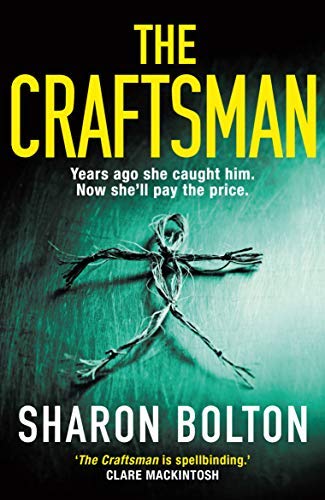
 I love Sharon Bolton’s books; I don’t read contemporary crime very often these days, but she is an author I always look forward to reading. Her latest novel, The Craftsman, marks a move to a different publisher and is apparently the first in a trilogy.
The Craftsman opens in 1999 with Florence Lovelady, an Assistant Commissioner of Police, attending the funeral of Larry Glassbrook in the Lancashire town of Sabden. Larry has spent the last thirty years in prison – and it was Florence who helped to put him there. His crime? The murder of three teenagers, all buried alive in the graveyards of Sabden. After the funeral, Florence visits Larry’s house where she had been a lodger at the time of the crimes, and here she finds something which makes her begin to question what really happened all those years ago.
About half of the novel is set in 1969, taking us through the events leading up to the murders and the police investigation which follows. As a young female police constable, Florence is the target of prejudice and bullying – and her suggestions that witchcraft could be involved in the murders make her even less popular. But high above Sabden looms Pendle Hill, a place associated with witchcraft since the Pendle Witch Trials of the 17th century. Florence is sure they are dealing with no ordinary crime and no ordinary criminal…but how can she make her colleagues take her theories seriously?
Sharon Bolton’s novels are always dark and eerie, but this one even more so than usual. After all, what can be more terrifying than being buried alive? The setting – an area steeped in superstition and with a history of magic and witchcraft – adds to the atmosphere; it’s more than just a backdrop because a coven of witches and even Pendle Hill itself eventually begin to play an important role in the story.
I loved the way the novel was split between the 1960s and 1990s, showing the contrast in attitudes between the two. In 1969, Florence is a young woman fresh from university doing what many consider to be ‘a man’s job’. The men she works with belittle her achievements constantly, try to give her the less dangerous tasks to carry out, and resent her for thinking of things they hadn’t thought of themselves. And it’s not just the men – Florence observes that some of the worst sexism she encounters actually comes from other women. Florence is also a southerner, so even when she’s not at work, she still feels like an outsider amongst the people of Sabden, most of whom were born and bred in the North West of England. Following Florence’s ordeals as she tries to win the trust of her neighbours and the respect of her fellow police officers interested me almost as much as the mystery itself.
And there is a mystery to be solved here, although it doesn’t seem that way at first. We are told in the very first chapter that it was Larry Glassbrook who was found guilty of the murders, but even knowing that, there are still plenty of twists and turns to the plot and plenty of tension, building and building as we move towards the end of the book. The ending, when it comes is…unexpected, to say the least, and probably something readers will either love or hate. I would have preferred something more conventional – and it does make me wonder what direction things are going to take in the second book in the trilogy. Apart from that, though, I really enjoyed The Craftsman and will look forward to meeting Florence Lovelady again.
This is my sixth book read for the R.I.P. XIII challenge (category: mystery/horror).





 She Reads Novels