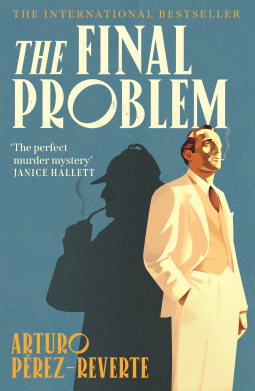
The Final Problem by Arturo Pérez-Reverte – #ReadIndies

Translated by Frances Riddle

It’s June 1960 and actor Ormond Basil has found himself trapped on the small island of Utakos, near Corfu. He has been invited to join a film director on his yacht to discuss a new project, but stormy weather means they are unable to leave the island until conditions improve. Luckily, there’s a hotel on Utakos where they and a small group of other guests and staff can take shelter until the storm has passed. However, there are no police on the island, so when one of the guests, British tourist Edith Manders, is found dead under suspicious circumstances, it’s up to the others to investigate until help can arrive.

Because Ormond Basil famously played the part of Sherlock Holmes on screen many times, he’s nominated to lead the investigation. No matter how much he explains that he’s only an actor and not really the great detective, everyone else insists that he must know more about solving mysteries than they do. And despite his protests, he does seem to know what he’s doing. With one of the other guests, Spanish crime author Paco Foxá, as his Watson, Basil begins to look for clues and question the suspects – but can he find the killer before another death takes place?

You may have guessed that Ormond Basil is closely based on the real life actor Basil Rathbone, who is for many people the quintessential Sherlock Holmes. I’ve talked before about not liking the current trend for using real people as detectives, but this is slightly different as the character is semi-fictional which gives Pérez-Reverte more scope to have him say and do things that the real Basil may not have done. He’s so obviously supposed to be Basil Rathbone, though, that it seems a bit pointless to pretend that he’s not. Either just calling him Rathbone or creating a completely fictional character would have worked better for me.

The novel is well plotted and the locked room mystery has a solution which is clever without being overly complex. With only a small number of suspects due to the setting, I thought I had guessed who the murderer was, but I was wrong and there was a nice twist towards the end that I hadn’t seen coming. For all Basil’s insistence that he’s not the real Sherlock Holmes, he does turn out to be an excellent detective, with powers of observation and deduction almost as good as the character he played for all those years!

However, I felt that there was far too much name-dropping of other famous actors and directors Basil had worked with, and too many long discussions between Basil and Foxá on the subject of Sherlock Holmes, in which both of them quote constantly from the books and adaptations. This all became a bit tedious and detracted from the mystery. I had a similar problem with the other Pérez-Reverte novel I’ve read, The Dumas Club, in which we’re bombarded with references to Alexandre Dumas’ books, so maybe this is just the way he writes.

I’m not sure if The Final Problem is going to be left as a standalone or if it’s intended as the start of a series; I don’t know if I would want to read any further adventures for Ormond Basil, but I did enjoy this one overall because of the interesting murder mystery. This edition of the novel is available from Atlantic Books, translated into English from the original Spanish by Frances Riddle. As Atlantic Books is an independent publisher, I’m counting this towards Read Indies, hosted this month by Karen of Kaggsy’s Bookish Ramblings.

A Monstrous Regiment of Women by Laurie R. King

A Monstrous Regiment of Women This is the second in Laurie R. King’s series of novels featuring Mary Russell and Sherlock Holmes. It’s been almost exactly two years since I read the first in the series, The Beekeeper’s Apprentice, and I really didn’t mean to leave it so long before reading the next one. However, when I picked this book up and started reading a few days ago, I was pleased to find that I’d inadvertently chosen the perfect time to read it because the story is set during the Christmas and New Year period of 1920/1921 – although it’s not a typical festive read as Mary makes it clear in the first chapter that she sees Christmas as something to be survived rather than enjoyed!

At the beginning of the book, Mary is awaiting her twenty-first birthday when she will receive her inheritance and her freedom from her aunt. She is also struggling with her feelings for her friend, the detective Sherlock Holmes. While she’s trying to avoid Holmes, she meets another old friend who introduces her to Margery Childe, the charismatic feminist leader of The New Temple of God. Mary herself is a student of theology at Oxford and is instantly drawn to Margery, fascinated by her interpretations of the Bible and impressed by the work she and her church are doing to help women in need. But at the same time, Mary feels uneasy and when she discovers that several young women from the Temple have recently died under suspicious circumstances, she decides to investigate.

Before beginning this book I had been curious to see how the relationship between Mary Russell and Sherlock Holmes was going to develop. I don’t have a problem with the thirty-nine year age difference (they are both adults and Mary has matured a lot since she first met Holmes as a teenager in the previous book) and I love all of their interactions and conversations. My favourite scenes are the ones in which they are both together, so I was disappointed that there weren’t more of them in this book – although I do understand the reasons why they are working separately for such long periods of the story. The focus is on Mary and her personal development as well as on the development of her romance with Holmes.

The actual mystery seemed to take a long time to get started and I didn’t find the plot very exciting until the second half of the book, but it was still interesting to read about 1920s society and the way life had been affected by the end of the Great War, the changing roles of women as a result of the war and the suffrage movement, and the work of Margery’s church. The title of the novel refers to a 16th century pamphlet by John Knox, The First Blast of the Trumpet Against the Monstruous Regiment of Women, an attack on the rule of female monarchs (specifically Mary of Guise, the Queen Dowager of Scotland, and Mary I of England) and the subjects of feminism and religion both form part of the story.

I did enjoy this book, but not as much as The Beekeeper’s Apprentice, which I loved. I’m looking forward to reading the next one in the series – and will try not to wait another two years!

The Beekeeper’s Apprentice by Laurie R. King

This was the first book I finished in 2012 (the other books I’ve been posting about over the last few days were all reads from the end of 2011) and what a great book it was to start a new year with!

The Beekeeper’s Apprentice begins when fifteen-year-old Mary Russell, living with an aunt in England following the deaths of both her parents in America, is out walking one day and almost steps on a man who is sitting on a hill watching bees. This man happens to be the famous detective Sherlock Holmes, who has retired to the Sussex countryside. In Mary, Holmes finds a mind as intelligent and observant as his own, and the two soon become friends, with Holmes teaching Mary everything he knows about detection. Soon Mary finds herself working with the detective on what will be the first of many cases they’ll solve together and even after Mary leaves home to study theology at Oxford University, their friendship remains as strong as ever.

A lot of time in the first half of this book is spent introducing us to the characters and relating a few of Mary and Holmes’ earliest cases (one involving a woman whose husband is suffering from a mysterious illness and another involving an American senator’s kidnapped daughter). These two cases, and the third main one, appear to be unrelated at first but they do all add to the bigger picture. There was a section in the middle of the book where Mary and Holmes go to Palestine which didn’t seem to have much relevance to the plot, though I’ve since learned that we find out more about that in a later book in the series.

There were so many things to enjoy about this book: great characters, some intriguing mysteries to solve, a setting that I loved (the early 20th century, during and following World War I). I also liked the way the book began with Laurie R. King telling us that she had nothing to do with the book and had simply received a mysterious box of manuscripts written by Mary Russell herself. The Beekeeper’s Apprentice is therefore presented as if it was the first instalment of Mary’s memoirs, with her older self looking back on her younger days and the beginning of her relationship with Sherlock Holmes.

Most of all, I loved Mary Russell’s witty and engaging narrative voice. Her friendship with Holmes feels so natural and there’s some great dialogue between the two of them. The huge age difference (39 years, I think) is slightly disturbing when you think about it, considering Mary is only fifteen at the beginning, but it didn’t come across that way at all in the novel. Despite the differences in their ages and backgrounds, Mary and Holmes have a lot in common and Mary is Holmes’ equal when it comes to spotting clues and making deductions. I loved the portrayal of Sherlock Holmes too; he felt much more human and likeable than the Holmes I remember. And as they spend more time together, both characters change with Mary maturing into a confident young woman and Holmes eventually coming to accept her as his partner.

You might be wondering if it’s necessary to have read Arthur Conan Doyle’s Sherlock Holmes books first, but no, I don’t think it’s necessary at all (there are some references to people and events from the original books, but nothing that would prevent you from understanding this book). I have read Conan Doyle’s books, but it was a long time ago and I wasn’t really a huge fan, which I think might have actually made it easier for me to accept this depiction of Holmes and the other characters.

I can’t believe it’s taken me so long to discover these books (The Beekeeper’s Apprentice was published in 1994). The one advantage of coming to the series so late is that there are now another ten books to read without having to wait for each one to be published. I can’t wait to spend more time with Mary Russell and Sherlock Holmes and hopefully I’ll have many happy hours of reading ahead!