 I’ve included this book on my R.I.P. list every year since I read We Have Always Lived in the Castle in 2011, but this is the first year I’ve actually found time to read it, thanks to a readalong hosted by the Estella Society. They have posted some discussion questions for us today, which I didn’t see until I had already written my post…though I think I’ve said everything here that I want to say anyway. I’ll look forward to reading what everyone else thought of it!
The Haunting of Hill House is a 1959 novel by Shirley Jackson. Dr John Montague, an anthropologist and psychic investigator, is renting Hill House for the summer in the hope of studying the supernatural phenomena and ghostly manifestations that he believes take place there. After assembling a list of people who have had previous paranormal experiences he invites them to stay in the house with him as his assistants, but there are only two who accept the invitation: Eleanor Vance, a shy, lonely woman of thirty-two, and the confident, outgoing Theodora. Accompanied by Luke Sanderson, whose aunt is the owner of Hill House, Dr Montague and his guests arrive at the house one by one and wait for something to happen.
Things do soon begin to happen but I can’t tell you too much about those happenings because as with all books of this type it’s best if you know as little as possible before you start. All I will say is that the story is told from Eleanor’s perspective…and Eleanor is not always entirely reliable. The supernatural element of the novel is quite subtle and you can never be completely sure what is going on. Because we spend so much time inside the head of a character who is unstable and insecure it’s difficult to tell exactly what is real and what isn’t.
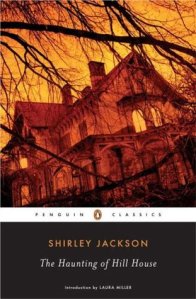 I didn’t find this book as frightening as I’d expected, but that could just be because I deliberately avoided reading it late at night (I’m a coward when it comes to books like this). There are certainly some very creepy moments, though – without having to resort to graphic horror, Jackson is still able to unsettle the reader and convey the feeling that something isn’t quite right. I loved the descriptions of Hill House – it has all the characteristics you would expect a haunted house to have, including a tragic history – but there are very few physical manifestations of ghostly activity. The creepiness of the story comes mainly from the fact that we don’t know how much of the ‘haunting’ is caused by Hill House itself and how much is the product of Eleanor’s disturbed mind.
I had been looking forward to reading The Haunting of Hill House because of its status as a classic American haunted house story and because I loved the other Shirley Jackson book I read. I really wanted to love this one too, but I have to be honest and say that I didn’t. It was good, but not as good as We Have Always Lived in the Castle. However, if you’re new to Shirley Jackson, I would recommend either of these two books as a perfect read for this time of year.

 She Reads Novels