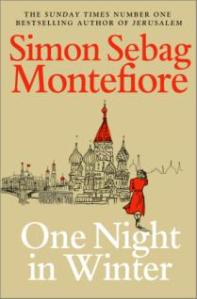
 This is the third in Simon Sebag Montefiore’s Moscow trilogy. I have read the second one, One Night in Winter, but not the first, Sashenka; the books are only loosely connected and it’s not essential to read all three in order. Montefiore is better known as a historian and writer of non-fiction, but these three books are fictional – although based on real events from Russian history.
Red Sky at Noon tells the story of Benya Golden, a Jewish writer and former teacher who, in 1940, is given the death sentence for “terrorism, conspiracy to murder Comrades Stalin, Molotov, Kaganovich and Satinov, and membership of a counter-revolutionary Trotskyite group”. At the last minute Benya is given a reprieve and instead of being executed he is exiled to the Gulag of Kolyma and sentenced to ten years’ hard labour in the gold mines. Life in the camp is harsh and miserable, so when a chance comes two years later to join a penal battalion (a shtrafbat) formed to fight the Germans, Benya is quick to volunteer. The reward will be the opportunity to win redemption by the shedding of blood – either his own or the enemy’s.
The rest of the novel follows the adventures of Benya, his beloved horse Silver Socks and the assorted group of murderers, Cossack gangsters and fellow political prisoners who fight alongside him in the Soviet cavalry. Together they undertake dangerous missions behind enemy lines, facing death, capture or betrayal – or all three – and for Benya, there is also a romance when he meets a widowed Italian nurse, Fabiana. Of course, with Russia and Italy on opposite sides of the war, it’s clear from the beginning that their love affair is unlikely to run smoothly.
With so much happening and with such an action-packed plot and interesting historical setting, this could have been a wonderful novel, filled with drama, romance and excitement. However, I think Montefiore is probably a better historian than he is a novelist; although I have no doubts that he knows his Russian history, he never quite managed to bring the characters and events in this novel to life. The dialogue didn’t feel entirely convincing and there were only a few moments in the whole book when I felt any real emotional connection to Benya or the other characters, despite the horrors of war that were being described. I remember having similar thoughts about One Night in Winter, which was a more enjoyable novel in my opinion, but another one which made little emotional impact.
I haven’t mentioned yet that there is another thread to the novel, involving Svetlana Stalina. As Stalin’s daughter, sixteen-year-old Svetlana is a lonely and isolated figure, who has experienced little in the way of love and friendship as people are afraid to get too close because of who her father is. Svetlana’s story doesn’t really have anything to do with Benya’s, but it offers insights into life in the Stalin household and does add another layer to the novel.
I’m not sure if I would want to read more of Montefiore’s fiction – although Sashenka does still sound tempting – but I’m curious to know what his non-fiction is like. Has anyone read any of it?
 She Reads Novels