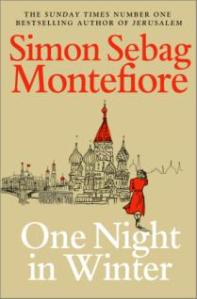
 It’s Moscow, June 1945 and a Victory Parade is taking place to celebrate the defeat of Nazi Germany. A group of teenagers, all members of a secret literary society called the Fatal Romantics’ Club, meet on a bridge during the parade to re-enact a duel scene from the poet Pushkin’s Eugene Onegin. It’s supposed to be a game, but something goes tragically wrong and two of them are shot dead.
The secret police begin to investigate at the orders of Stalin himself, but it’s not clear whether the deaths were the result of an accident, a suicide pact or a murder. Because the teenagers involved in the incident are the children of some of the Soviet Union’s highest-ranking officials, they find themselves suspected of conspiring to overthrow the government. When the children are arrested and questioned they discover that the answers they give could incriminate their families and that innocent people could suffer.
More and more people are gradually drawn into the investigation and taken to Moscow’s Lubianka Prison where they are interrogated. As well as the members of the Fatal Romantics’ Club themselves (including eighteen-year-olds Serafima Romashkina, the daughter of a famous actress, and Andrei Kurbsky, son of an ‘Enemy of the People’), questions are also asked of their school teachers, parents and even two younger children aged just ten and six.
One Night in Winter is based on a real incident that occurred in 1943 and as you would expect, some parts of the book are quite harrowing, especially the descriptions of frightened children being made to testify against their own families, knowing that if they say the wrong thing they could be condemning a parent to death. Some of the parents, such as Hercules Satinov, have to continue working with and obeying Stalin even while knowing that he is responsible for the imprisonment of their children.
But this is also a book about love – in many different forms, whether it’s the romantic love between a man and a woman or the special bond between a parent and a child. Almost everyone in the novel seems to be in love with someone else and some of them are involved in secret romances. Over the course of the novel we see how far our characters are prepared to go to protect the ones they love. The secret police believe that a mysterious lover of Serafima’s could hold the key to the whole mystery. And the idea behind the Fatal Romantics’ Club is that “if we cannot live with love, we choose death”.
Simon Sebag Montefiore is a historian and the author of several historical non-fiction books which include a biography of Stalin. It’s obvious that he has an excellent knowledge of the period and its historical figures (Stalin himself has an important role to play in the novel) and his portrayal of life in Stalinist Moscow feels thoroughly researched and authentic. The settings include School 801, the exclusive school attended by all of the children in the story, the interior of Lubianka Prison, the dirty communal apartment where Andrei and his mother live and the luxurious homes of the Bolshevik leaders.
The only thing that was lacking in this novel was emotional impact and I do think this could have been improved if the author had chosen to focus on the viewpoint of just one or two characters, rather than switching between so many different characters. There are such a lot of people to keep track of that I found the character list at the front of the book absolutely essential and while I can understand the reasons for telling the story from different perspectives, it meant I struggled to form any strong emotional connections.
Simon Sebag Montefiore is a new author for me, but I am now interested in reading his other Russian novel, Sashenka.
I received a copy of this book from the publisher for review
 She Reads Novels