The Creation of Eve by Lynn Cullen

I think most people have probably heard of famous Renaissance artists such as Michelangelo and Leonardo da Vinci. But what about Sofonisba Anguissola? In The Creation of Eve, Lynn Cullen introduces us to this talented female artist who was prevented from reaching her full potential simply because she was a woman. Sofonisba, who spent many years in the Spanish court, was not allowed to sign her paintings with her own initials and some of her works were even credited to other people.

At the beginning of the book, Sofonisba is studying in Rome with Michelangelo. She leaves Rome following an affair with another student and travels to Spain where she joins the royal court as lady-in-waiting and art instructor to the fourteen-year-old Queen, Elizabeth of Valois. Here she becomes caught up in a scandal involving the Queen and the King’s half brother, Don Juan.

This book was not quite what I had thought it would be. I was expecting it to focus on the story of Sofonisba Anguissola and was looking forward to learning about her training as an artist and the challenges she faced as a woman working in a male-dominated field. As it turned out though, the book was as much about the relationship between King Felipe II and his young French wife, Elizabeth, as it was about Sofonisba. For much of the book Sofonisba is little more than a passive observer, a witness to the events that are unfolding in the Spanish court.

I thought The Creation of Eve was an interesting and entertaining read but it lacked any real emotional impact for me. Looking at other reviews of this book (as I usually do after writing my own) opinion seems to be overwhelmingly positive, so if you like reading historical fiction revolving around intrigue in royal courts there’s a good chance that you’ll love this book. The novel does appear to be very well-researched. Cullen manages to incorporate a large amount of historical detail, but this never gets in the way of the plot. I appreciated the author’s note at the end of the book which tells us which parts of the book are historical fact and which are fiction.

I actually won this book in last year’s Readathon (April 2010) and am glad I’ve finally read and enjoyed it, as I was starting to feel very guilty about not reading it sooner!

Some examples of Sofonisba Anguissola’s paintings can be seen on her Wikipedia page.
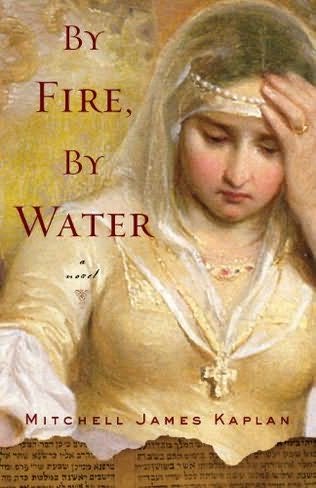
By Fire, By Water by Mitchell James Kaplan

By Fire, By Water tells the story of an important period in the history of Spain. A time of progress and discovery, as Christopher Columbus prepares to set out on his legendary voyage to the Indies and seeks funding from the Spanish court. But also a time of fear and suffering with Tomas de Torquemada’s New Inquisition designed to root out heresy.

Luis de Santángel, the King’s chancellor, is a converso – his family has recently converted from Judaism to Christianity – and his Jewish heritage means that even he, in his position of great wealth and power, is under suspicion. Santángel wants to understand the differences between the Jewish and Christian faiths but attempting to gain this knowledge could put his life in danger.

Intertwined with Santángel’s story is the story of Judith Migdal, who lives with her nephew and his grandfather in a Jewish community in Muslim-ruled Granada. Following the deaths of her brother and his wife, Judith decides to become a silversmith so that she can take over her brother’s silver workshop and support her family. Eventually Luis and Judith’s paths meet, but can there be any happiness for them?

By Fire, By Water was not a light or easy read and I found I had to really concentrate to follow everything that was going on. However, it was worth the effort because I felt that I really learned a lot from this book. I thought it was an excellent portrayal of what it must have felt like to live during the Inquisition, not being sure who could and couldn’t be trusted, knowing that even your own friends and family could betray you at any moment. This book really opened my eyes to the suffering and persecution the Jews faced in Spain. The images of thousands of Jews being driven from their homes and forced to leave the country are unforgettable.

I was also interested in the inclusion of Cristóbal Colón (Christopher Columbus) in the plot. Most people are aware of his quest to find the Indies and his subsequent arrival in America, but this book looks at the struggles he faced to obtain the funding he needed for the voyage and to get people to take his ideas seriously.

The author’s attention to detail is incredible, from the colours and fabrics of the clothes people wore, to the sights and sounds of the marketplace. You could never forget that you were in 15th century Spain and I was very impressed with the amount of research that must have gone into this book. Everything felt very realistic and believable.

I read most of this book in one day because I was so desperate to find out what would happen to Santángel, Judith and the other characters. The ending was not what I expected at all, but again, it was probably a realistic outcome. By Fire, By Water should be enjoyed by anyone who appreciates well-written historical fiction or is interested in learning more about 15th century Spain.

I received a review copy of this book from the author.

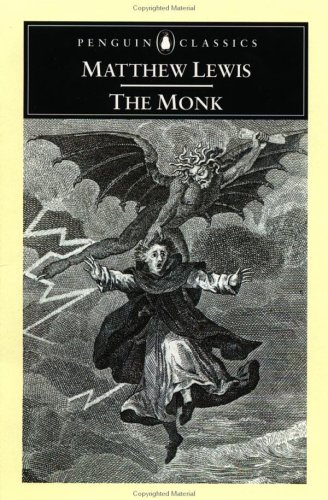
Review: The Monk by Matthew Lewis

The Monk, published in 1796, is an early gothic novel by Matthew Gregory Lewis, which completely dispels the notion that classics are dull and boring! While I wouldn’t say this was an easy read (due to the 18th century writing style and language you do need to concentrate) it was a real pageturner. I actually started to write this review when I was only halfway through the book and I was going to say that although I was enjoying it, I didn’t think it was a great book. Then, as I continued to read, I changed my mind. It is a great book and the best gothic novel I’ve read so far!

The book cover shown above is the Penguin Classics edition of the book. However, my copy of this novel is actually part of a four books-in-one anthology called Four Gothic Novels, which also includes The Castle of Otranto by Horace Walpole, Vathek by William Beckford and Frankenstein by Mary Shelley. I’ve been reading the novels in the order that they appear in the book, but The Monk was the one that I had really been looking forward to reading.

The novel is set in a monastery in Spain, during the time of the Spanish Inquisition. The plot is very complex, but basically there are three main storylines.

The first storyline revolves around Ambrosio, the Monk of the title, who is highly respected within the monastery and attracts large crowds to his sermons. Ambrosio is regarded almost as a saint yet when a beautiful young woman called Matilda tries to seduce him, he is tempted into breaking his vows. After succumbing to this first temptation, Ambrosio goes on to commit one crime after another, each worse than the one before.

We are also given a long account of the adventures of the young Marquis de las Cisternas. When the Marquis rescues a baroness from a gang of bandits, he is invited to accompany her to the Castle Lindenberg in Germany where he meets and falls in love with her niece, Agnes – and learns the legend of the Bleeding Nun. Finally we follow a friend of the Marquis, Lorenzo de Medina, who also happens to be the brother of Agnes. When a young girl from Murcia named Antonia arrives in Madrid, she and Lorenzo fall in love – but things don’t go smoothly for the pair and Antonia soon finds herself in serious danger.

At first it seemed that Agnes and Antonia’s storylines were unrelated to the Ambrosio and Matilda plot, but I soon began to see how cleverly Lewis was weaving the threads of the story together. Ambrosio is a complex character and his downfall was fascinating to read about. Some of my favourite passages were those which gave us an insight into the different facets of his personality.

He pronounced the most severe sentences upon Offenders, which, the moment after, Compassion induced him to mitigate: He undertook the most daring enterprizes, which the fear of their consequences soon obliged him to abandon: His inborn genius darted a brilliant light upon subjects the most obscure; and almost instantaneously his Superstition replunged them in darkness more profound than that from which they had just been rescued…The fact was, that the different sentiments with which Education and Nature had inspired him were combating in his bosom: It remained for his passions, which as yet no opportunity had called into play, to decide the victory.

Some parts of the book are quite gruesome and disturbing, and the passages which describe the sufferings of Agnes and Antonia are horrifying. I thought the final chapter of the book was stunning. There were several different ways the story could have ended, but the ending Lewis chose was absolutely perfect.

This book has almost every element of the gothic novel that you can think of: ghostly apparitions, haunted castles, ancient monasteries, bad weather, fortune telling gypsies, an evil prioress, dark dungeons and shadowy crypts, witchcraft, magic and pacts with the devil. It’s also very daring for the 18th century; with themes of murder, rape, incest, violence and torture, I can see exactly why it was so controversial in its day.

So don’t let the fact that the book was written in the 1700s prevent you from picking it up!

Recommended

If you enjoy this book you might also like The Italian by Ann Radcliffe which I read a few years ago. It’s very similar to this one in both the setting and the atmosphere (and anyone who was put off Radcliffe by the long scenic descriptions in The Mysteries of Udolpho will be pleased to know there are a lot less of those in The Italian).