The Household by Stacey Halls

Urania Cottage in Shepherd’s Bush, London, was a home for ‘fallen women’ founded in 1846 by Charles Dickens and Angela Burdett-Coutts. Their vision was to provide a safe place for young women to rehabilitate after serving prison sentences or working on the streets as prostitutes. At Urania Cottage they would receive an education and the opportunity to train as domestic servants, enabling them to start new, more respectable lives overseas. In her latest novel, The Household, Stacey Halls imagines the stories of some of these women.

During the period covered in the novel, there are many young women staying at Urania Cottage, but Halls chooses to focus on two of them. One is Martha who, while trying to rebuild her own life at the cottage, is also worrying about her sister, Emily, who has disappeared. As Martha grows more desperate about Emily, she is driven to make a decision she may later regret. The other is Josephine, who had expected a close friend to accompany her to Urania Cottage. When the friend never arrives, Josephine must decide whether to continue participating in the scheme or leave in search of happiness elsewhere.

Dickens himself is mentioned now and then but always stays in the background, never becoming an actual character in the novel. Angela Burdett-Coutts, on the other hand, has a much larger role. We meet Angela as a woman in her early thirties who several years earlier inherited a fortune from her banker grandfather, making her one of England’s wealthiest people. She is becoming known as a philanthropist and Urania Cottage is one of her first big projects.

Angela’s privileged lifestyle means she struggles to truly understand the needs of the women at the cottage, but she and Dickens both enter into the project with the best intentions. However, despite Angela’s wealth and position she still has problems of her own to deal with – such as being stalked by Richard Dunn. She had thought she was safe from Dunn when he was sent to prison for four years, but now he’s been released early and is on her trail again. As I read, I wondered whether this was a fictitious storyline, but I looked it up and found that, yes, Richard Dunn was a real person and did obsessively pursue Angela Burdett-Coutts as described in the book. It seems that other parts of the novel I had assumed were invented were also based on historical fact; after finishing the book I was interested to learn that many of the incidents described as happening at Urania Cottage were taken from Dickens’ letters to Angela and even inspired his own David Copperfield.

The Household is fascinating in many ways, yet it’s probably my least favourite of Stacey Halls’ books. The separate stories of Angela, Josephine and Martha never quite blend together properly and give the novel a disjointed feel. I found the first half very slow and although there’s a twist towards the end that I hadn’t seen coming, it happens too late to really change the way I felt about the book overall. Still, I’m pleased to have had the opportunity to learn about life at Urania Cottage and will look forward to whatever Stacey Halls writes next.

Thanks to Manilla Press for providing a copy of this book for review via NetGalley.

Book 16/50 for the Historical Fiction Reading Challenge 2024

Mrs England by Stacey Halls

Mrs England is one of the books longlisted for the 2022 Walter Scott Prize for Historical Fiction. Although I hadn’t even heard of a lot of the titles on this year’s longlist, this particular book is one that I had been planning to read anyway. I enjoyed both of Stacey Halls’ previous novels, The Foundling and The Familiars, and was just waiting for the right moment to start reading this one.

The novel opens in 1904 with Ruby May, a trained children’s nurse from the prestigious Norland College, discovering that the family she works for are preparing to emigrate. Ruby is invited to accompany them, but turns down the opportunity, saying that she can’t be too far away from her younger sister and brothers. Instead, she finds a new position looking after the four children of Charles and Lilian England, a wealthy couple who own a cotton mill in the West Riding of Yorkshire.

On arriving at the Englands’ home, Hardcastle House, Ruby quickly senses that something is not right. Although Mr England is charming and friendly, Mrs England seems distant and withdrawn, showing very little interest in her children’s lives and leaving the running of the household to her husband. The other servants also make Ruby feel unwelcome, but she finds the four England children delightful and immerses herself in her work. As the days and weeks go by, Ruby becomes increasingly aware of the dark undercurrents within the household and wishes there was something she could do to help. However, there are mysteries lurking in Ruby’s own past and she has problems of her own to deal with. Why does she refuse to open letters from her father? Why is she so afraid of having her photograph taken? And what is the real reason for her reluctance to leave the country?

I think this is my favourite of the three books I’ve read by Stacey Halls. Although it’s quite a slow-paced novel, with most of the drama and revelations coming near the end, I was drawn completely into Ruby’s story from the beginning. As the novel’s narrator, Ruby is a genuinely nice person and I liked her immediately. It takes a long time for her back story to unfold and in the meantime I’d formed a few theories about what must have happened with her father – however, I wasn’t quite right! In her author’s note, Stacey Halls states that she based Ruby May’s story on a real person and incident that occurred in the late 19th century, but don’t be tempted to look at this until you’ve finished the book. The story that unfolds within the walls of Hardcastle House is even more intriguing and, again, I thought I knew what was going on only to find that, although I did guess some of it correctly, I was still missing some parts of the overall picture.

The descriptions of the Yorkshire scenery are very well done, particularly the parts of the book set in the Hardcastle Crags, as are the descriptions of the Englands’ cotton mill, the blacksmith’s forge and all the other locations Ruby and the children visit throughout the story. I also found it interesting to read about the Norland Nurses – the kind of training they received and the standards they were expected to conform to.

I enjoyed this book very much, but to be honest, I’m surprised it’s on the Walter Scott Prize longlist as it doesn’t seem quite as ‘literary’ as the books the judges usually go for. I hope it progresses to the shortlist next month, but we’ll have to wait and see.

This is book 14/50 read for the Historical Fiction Reading Challenge 2022.

The Familiars by Stacey Halls

After enjoying Stacey Halls’ The Foundling earlier this year, I decided to read her previous book, The Familiars. It didn’t sound as original as The FoundlingThe Familiars is about the Pendle Witch Trials and I’ve read quite a few other books about witches – but I hoped it would still be interesting.

The novel is set in 1612, in Lancashire in the northwest of England, and is narrated by Fleetwood Shuttleworth, mistress of Gawthorpe Hall. Fleetwood is seventeen years old, in love with her husband, Richard, and pregnant with his child; this should be a happy time for her, but instead Fleetwood is filled with dread. This is her fourth pregnancy and all of her previous three have ended in a miscarriage – and, more worrying still, she has discovered that Richard has been hiding a letter from a doctor warning that if his wife became pregnant again neither she nor the baby would survive.

A chance meeting in the woods one day with Alice Gray, a young midwife, gives Fleetwood new hope. Alice seems to know a lot about herbs and remedies and what is needed to bring about a healthy birth, so Fleetwood asks her to join the household at Gawthorpe Hall until the child is born. Just having Alice around makes her feel better and she is sure that this time she will give birth to the son and heir Richard so desperately wants. 1612, however, is a dangerous time for women who are seen as ‘different’ in any way, and when a group of suspected witches are arrested Alice is one of those accused. Fleetwood vows to do whatever she can to help her friend, but will she be able to save her before it’s too late?

I think The Foundling is the better of Stacey Halls’ two novels, but I did still enjoy this one. As I’ve said, I’ve read other books on similar subjects – for example, Beth Underdown’s The Witchfinder’s Sister, Katherine Howe’s The Lost Book of Salem and Helen Steadman’s Widdershins – but this is the first one I’ve read specifically focusing on the Pendle Witch Trials. I was interested to learn that most of the characters in the book are based on real people, including Fleetwood Shuttleworth herself, the ‘witches’ and the men responsible for arresting them and arranging the trials. In her author’s note at the end, Stacey Halls explains which parts of the story stick to the historical facts and which are fictional.

Although the witches are obviously an important element of the novel, we don’t see as much of them as I had expected. Because the story is written entirely from Fleetwood’s perspective, a lot of the action – including the so-called acts of witchcraft, the arrest of the witches and the trials – takes place elsewhere and Fleetwood hears about these things from other people rather than witnessing them for herself. That’s one of the limitations of a first person narrative, I suppose, and it wasn’t really a problem as I found Fleetwood’s personal story quite engaging anyway. I liked her from the beginning and could really feel her fear and anxiety over her pregnancy and her frustration at not being able to do more to help Alice and the other witches.

I’ll be looking out for any future novels from Stacey Halls, but if you have any other books to recommend on the Pendle witches, please let me know which ones.

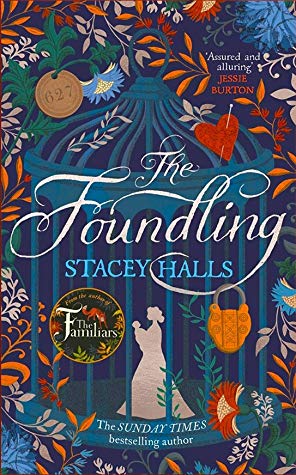
The Foundling by Stacey Halls

Stacey Halls’ new novel, The Foundling, begins on a cold November evening in 1747 with Bess Bright about to make a very difficult decision, one no new mother should ever have to face. She has brought her illegitimate baby daughter, Clara – less than a day old – to London’s Foundling Hospital and is planning to leave her there. Aware that, as an impoverished shrimp seller, she has little to offer her daughter but hunger and hardship, she is sure Clara will have a happier childhood at the Foundling, where at least she will be fed, clothed and educated. As she walks away from the hospital, leaving her baby behind, Bess consoles herself with the knowledge that it needn’t be forever; she has left a token – half of a heart made from whalebone – as proof of identity if she is ever in a position to bring Clara home again.

After six years of working hard and saving every penny she can, Bess returns to the hospital to collect her child, dreading being told that Clara has died of some childhood illness. Nothing can prepare her for the shock she receives when she enters the Foundling and is informed that her daughter has already been claimed – by someone who gave her name as Bess Bright and knew about the whalebone token. Bess is horrified. What has happened to Clara? Who has taken her little girl and what have they done with her?

I was very impressed with The Foundling, my first Stacey Halls novel. Although there wasn’t as much mystery as I would have liked and some of my biggest questions were answered a lot earlier than I’d expected, I was still kept in suspense wondering whether there would be a happy ending for Bess and her daughter or whether fate would have something else in store. I liked Bess and loved the descriptions of the London in which she lived and worked, from her lodgings in Black and White Court, where the alleys are ‘choked by coal smoke’, to the lively fish markets of Billingsgate where she and her father sell their shrimps.

However, this is not just Bess Bright’s story. It’s also the story of another woman, Alexandra Callard, a widow who is leading a very different sort of life in another part of London. Apart from attending church, Alexandra hasn’t left her elegant townhouse for years and neither has her little girl, Charlotte. Just the thought of going outside and walking along the street fills her with fear and she’s convinced that her child will be safer indoors too. Then one day, a friend persuades her to employ a nursemaid to help with Charlotte and the arrival of a new face in the household poses a threat to the secure little bubble Alexandra has built around herself.

I didn’t like Alexandra as much as Bess, but bringing a second narrator into the story – especially one who lived in such a different world – added variety and the chance to see things from another perspective. Unlike Bess, Alexandra doesn’t have to worry about money and has everything she needs within the four walls of her luxurious home, but due to her mental health problems her life is still not very happy. We eventually find out what has caused her agoraphobia and I did have a lot of sympathy, but I still found her a cold and rather selfish person.

As well as the two contrasting views of Georgian London, The Foundling explores several other interesting issues, particularly what it means to be a mother and what sort of environment is the most suitable in which to raise a happy, healthy child. The way the book ended was probably the best outcome, but I think there were at least two other possible endings and either could have been used to make a valid point. Having enjoyed this so much, I will have to read Stacey Halls’ previous book, The Familiars, about the Pendle Witch Trials.