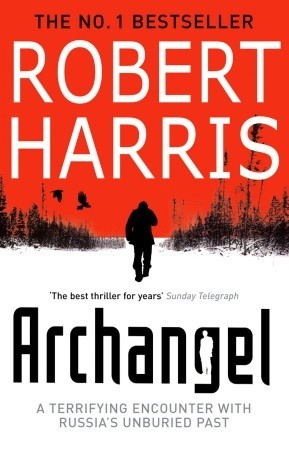
 After reading Conclave recently and reminding myself of how much I love Robert Harris, I was pleased to find a copy of Archangel at the library. Although this was not one that sounded particularly appealing to me and I suspected it wasn’t going to be a favourite, I still wanted to read it – the other Harris novels I’ve read have been his newer ones and I was curious to see what his earlier books were like (Archangel was published in 1998).
The story is set in Russia in the 1990s, during the Boris Yeltsin years just after the dissolution of the Soviet Union. British historian Christopher Kelso – better known as ‘Fluke’, for reasons which are explained within the novel – is attending a conference in Moscow at which the recent opening of the Soviet archives will be discussed. During the conference, Fluke is approached by Papu Rapava, an elderly man who claims that he was present at the death of Joseph Stalin in 1953 and that he witnessed the theft of a black notebook which belonged to Stalin and was believed to be his secret diary.
This diary, if it really exists, could be the academic breakthrough Fluke needs to revive his career, but it will also be dangerous if it falls into the wrong hands. Choosing to believe that Rapava is telling the truth, Fluke begins a search for the notebook – but what he finds is not quite what he had expected. Following a trail of clues leading north to the remote city of Archangel, he makes a discovery that could affect not only his own future but Russia’s future as well.
The first thing to say is that this book, being more of a conventional thriller, is quite different from the other five Robert Harris books I’ve read. It’s also my least favourite so far, but I’d had a feeling that would be the case, so at least my expectations weren’t too high! I did find things to enjoy and at times I was completely gripped, but there were too many other aspects of the book that were a problem for me.
First of all, the characters: because of the nature of the story, most of the characters are very unlikeable – a mixture of ambitious politicians, unscrupulous journalists and people with dangerous ideas. As for Fluke Kelso, our hero, I found him bland and uninteresting, especially when compared with the protagonists of other Harris novels; he certainly lacked the depth and complexity of Cardinal Lomeli in my most recent Harris read, Conclave. The character who was potentially most engaging, Rapava’s daughter Zinaida, had an important role but we didn’t see as much of her as I would have liked.
In terms of plot, the novel gets off to a promising start, with Fluke learning about the night of Stalin’s death and then following clues which he hopes will lead him to the mysterious black notebook. However, the big revelation, when it comes, is something so far-fetched I just couldn’t believe in it, and the scenes which follow feel over the top and implausible too, which was a shame after so much care had been put into building the tension and creating a sense of mystery.
The descriptions of 1990s Moscow and snowbound Archangel are very well done and, as I’ve said, the book is quite a pageturner at times, so I still think it’s worth reading – particularly if you are more interested in Soviet history than I am. Apparently there was a BBC adaptation in 2005 starring Daniel Craig. Has anyone seen it?
 She Reads Novels