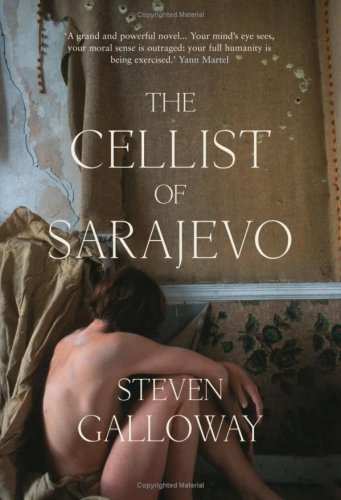
Sarajevo is a city under siege. On 27th May 1992, twenty two people are killed by a mortar shell as they wait outside to buy bread. In memory of those who died, a cellist sits in the street on twenty two consecutive afternoons and plays Albinoni’s Adagio in G Minor on his cello.
The cellist, however, is not the main character in this book – although he is there in the background throughout the story, playing his music as a message of hope and inspiration. Instead, Galloway has chosen to focus on three different characters, who are each coping in their different ways with the changes war has brought to their lives.
One of these is Arrow, a young woman who was once the star of the university target shooting team. Now she’s been recruited as an army counter-sniper and given the responsibility of protecting the cellist from attack. Then there’s Kenan, a man in his forties for whom the simple task of going to collect water for his family means putting his life in danger. And finally there’s Dragan, an older man who sent his wife and son out of Sarajevo before the siege began, and is now slowly making his way across the war-torn city to the bakery where he works.
I was only 11 years old when the Bosnian War started so probably wasn’t paying a lot of attention to news reports about it – I’m ashamed to admit that I know very little about what happened and before I read this book was only vaguely aware that Sarajevo had been under siege. However, if you’re looking for a book that will teach you the facts about the war, you’ll need to look elsewhere as this book does very little to educate the reader about the war itself. We are never even told the nationality of any of the characters. The snipers surrounding the city are referred to as simply ‘the men on the hill’; those defending Sarajevo are ‘the men in the city’.
This vagueness was very effective because in a way, Steven Galloway was saying that it doesn’t matter who’s fighting who, it doesn’t matter why a war began, because people everywhere are the same, have the same feelings and emotions, and are similarly affected by the pain and suffering of war. The author could have taken any war or any siege as the basis for this book and the overall mood he created would have been the same.
I can’t say that I enjoyed this book because ‘enjoyed’ isn’t the right word. Neither is ‘loved’. But it was an incredibly powerful book and I’m glad I finally found time to read it. I think some readers would probably dislike the structure of the book with its alternating chapters from the viewpoints of each of the three characters, but it worked for me. Arrow’s storyline was the most compelling and could have been a whole book on its own, but I also found it interesting to follow Dragan and Kenan as they dodged the snipers and negotiated hazardous bridges and ruined buildings on their dangerous journeys through the city.
The Cellist of Sarajevo doesn’t tell us how the war started, the reasons for the war or even who the war was between. What it does attempt to tell us is the effects the war had on individual people, how they felt and how they tried to survive.
Highly Recommended
 She Reads Novels