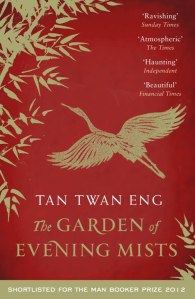
 I loved Tan Twan Eng’s The Garden of Evening Mists but his latest novel, The House of Doors, sounded less appealing and I only decided to read it when I saw it had been longlisted (and then shortlisted) for this year’s Walter Scott Prize. Now that I’ve read it, I have mixed feelings about it; there was a lot to like and admire, but it definitely didn’t captivate me the way The Garden of Evening Mists did.
The House of Doors weaves the fictional story of Lesley and Robert Hamlyn around a real life visit in 1921 by the author William Somerset Maugham to Penang, Malaysia – or Malaya, as it was still known at the time. Lesley has spent her whole life in Malaya, while her husband Robert was born in Britain and moved to Penang as an adult. Maugham, referred to as Willie throughout the novel, is an old friend of Robert’s and has come to stay with them at their home, Cassowary House. Leaving his wife behind in England, he is accompanied by Gerald, his lover and secretary.
At first Lesley is not very happy about having visitors and it takes her a while to warm to Willie, but she eventually finds herself confiding in him and sharing with him stories about her past. She tells him about her involvement with Sun Yat Sen, the Chinese revolutionary who came to Penang to raise funds, and about her friend, Ethel Proudlock, who was charged with the murder of a man. Some of the things Willie hears and experiences during his time with the Hamlyns will later find their way into his fiction.
The book is beautifully written, which I had expected from my previous experience of Tan’s work, and the descriptions of Penang itself are particularly lovely and evocative. I can only think of one or two other novels I’ve read set in Malaysia, but it’s a setting I love and I enjoyed revisiting it through Tan’s descriptive writing. The book deals almost entirely with British characters and we learn a lot about the colonial lifestyles and attitudes of the time, but although Tan Twan Eng himself is a Malaysian author, if you’re hoping for a Malaysian perspective you won’t really find that here. Through the Sun Yat Sen storyline, we are given a little bit of insight into Chinese revolutionary politics, but again we see this from Lesley’s point of view, through her interactions with Sun Yat Sen and his associates.
The plot moves quite slowly, maybe because so much of the story is told in the form of flashbacks. At times I was bored, but one part of the book that I did find gripping was the Ethel Proudlock storyline. It’s based on a real murder case which I knew nothing about before reading this novel, so I had no idea what the outcome was going to be. Maugham used the case as the inspiration for his 1927 play The Letter, which was made into a film starring Bette Davis. There are references to other Maugham stories, novels and plays throughout the book as well, but they meant very little to me because I haven’t read any of his work apart from The Painted Veil. I think if I’d had more familiarity with Maugham’s writing it’s possible that I would have been able to get more out of this book. I had similar experiences with Colm Tóibín’s The Magician and Damon Galgut’s Arctic Summer, novels about Thomas Mann and E.M. Forster respectively (I haven’t read much of their work either and was left with the feeling that I’d missed something).
The House of Doors wasn’t a huge success with me, then, but the setting and the beautiful writing made it worth reading. The Walter Scott Prize winner is due to be announced later this week and of the shortlisted titles I’ve read so far, My Father’s House by Joseph O’Connor is still my favourite with this one second above Kevin Jared Hosein’s Hungry Ghosts. Maybe the winner will be one of the three I still haven’t read!

Book 21/50 for the Historical Fiction Reading Challenge 2024

 She Reads Novels