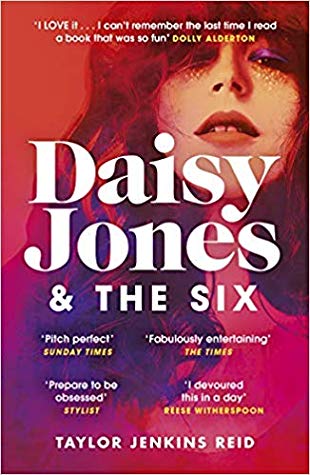
 When I first heard about Daisy Jones & The Six, I dismissed it as not for me. The subject – a fictional 1970s rock band – didn’t appeal to me and it sounded as though the book was written in the sort of experimental style I usually dislike. Then I started to see some very positive reviews from people who often have similar taste in books to me, so when I came across it at the library just before Christmas, I decided to give it a try after all – and am very glad that I did.
The best way to describe Daisy Jones & The Six is like this: Imagine someone has carried out hours of interviews with the members of a rock band and then pieced them all together – a few lines from one member, followed by a short quote from another and then a brief recollection by a third – to form a cohesive narrative telling the complete story of that band, from their early days to their rise to fame and subsequent break-up. The overall effect is like watching a television documentary; it’s a brave and imaginative way to write a novel and could probably have gone badly wrong, but I’m pleased to say that Taylor Jenkins Reid gets it exactly right. In fact, I could easily have believed that Daisy Jones & The Six really existed and that this book really was a documentary transcribed onto the page.
There’s not a lot I can say about the plot of the novel, if you can really call it a ‘plot’. Taylor Jenkins Reid has said that she loosely based Daisy Jones & The Six on Stevie Nicks and Fleetwood Mac, as well as other bands such as The Eagles, so you probably know the sort of things you can expect: rivalries between band members; drink, drugs and wild parties; the stories behind song lyrics; lots of tours and rehearsals and recording sessions. The characters are brought to life both through their own words and through the observations of others, and while some of the band members are very forgettable, a few are much more strongly drawn.
Daisy Jones herself is a bit of a mystery; she’s eccentric, quirky, and a real individual who does as she pleases and doesn’t care what people think of her. She comes across as selfish and reckless, but also tragic and vulnerable, and because she spends so much of the book under the influence of drugs, I felt that I never truly knew or understood the real Daisy Jones. Daisy’s relationship with Billy Dunne, the lead singer of The Six with whom she writes some of the band’s biggest hits, forms an important part of the novel. Billy faces his own problems with addiction early in his career, but unlike Daisy he doesn’t face them alone – he is sustained by the love of the strong, supportive and endlessly patient Camila, whom he meets near the beginning of the book and who ended up being one of my favourite characters.
I also liked Karen Karen, the keyboardist with the Six and, until the arrival of Daisy, the only woman in the band, but the other members, as I’ve said, are much less memorable to the point where I kept confusing Eddie, Pete and Warren and couldn’t tell you which instruments they played. Thinking about it, that was probably the point: most well-known bands do have one or two members who get all the attention while others are kept in the background. This is clearly a source of resentment for some of the lesser members of The Six and, when added to Daisy’s drug problems and the tensions between Karen and Billy’s brother, lead guitarist Graham, the break-up of the band seemed inevitable. However, I had been given the impression from the book’s blurb – which states that “no one knows the reason behind the group’s split on the night of their final concert at Chicago Stadium on July 12, 1979 . . . until now” – that something dramatic was going to happen to bring things to a head and I was disappointed that the eventual reason was much less shocking.
There are one or two twists near the end which I liked, especially as one of them made me think differently about everything that had come before. Really, though, it’s not the story that I will remember about this book and probably not the characters either – it’s the overall atmosphere of the book, the documentary style, the recreation of the 1970s music scene and the effort the author has gone to in order to make Daisy Jones & The Six feel like a real band, right down to including a collection of their song lyrics at the end of the book. I didn’t love this book quite as much as most other people seem to have done, but I’m still glad I decided to take a chance on something different from my usual reads as I enjoyed it a lot more than I expected to!
 She Reads Novels