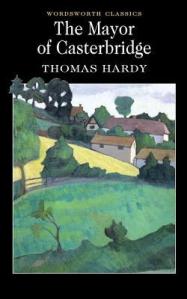
The Mayor of Casterbridge by Thomas Hardy

The Mayor of Casterbridge - Thomas Hardy This book was chosen for me in the recent Classics Club Spin. My strategy with spin books is to pick it up and start reading as soon as possible after the number is announced – that way I don’t put it off until the last minute and end up not wanting to read it. This worked well with my last two spin books, A Tale of Two Cities and Can You Forgive Her? and it worked again with this one – once I started reading The Mayor of Casterbridge I didn’t want to put it down, though that wasn’t entirely surprising as I’ve loved everything else I’ve read by Thomas Hardy and fully expected to love this one too.

The Mayor of Casterbridge is the story of Michael Henchard, whom we first meet as a young man, out of work and walking from town to town in search of employment as a hay-trusser. On arriving in a small village near the town of Casterbridge and discovering that a country fair is taking place, Michael proceeds to get drunk and sells his wife, Susan, and baby daughter Elizabeth-Jane to a sailor for five guineas. In the morning he regrets what he has done, but Susan, Elizabeth-Jane and their new owner have already disappeared without trace. After swearing not to touch another drop of alcohol for twenty-one years – the length of time he has been alive – Henchard begins to rebuild his life.

Almost twenty years later, we rejoin Susan and her daughter as they return to Casterbridge. The sailor, Mr Newson, has been lost at sea and having only recently learned that her second ‘marriage’ was not legally binding, Susan is hoping that she and Elizabeth-Jane can find and be reconciled with Michael Henchard. Things have changed in the intervening years and Henchard has transformed himself into the sober and respectable Mayor of Casterbridge. How will he react to having his wife and daughter back in his life? With the arrival of two more newcomers – Lucetta, a pretty young woman from Jersey, and Donald Farfrae, a Scottish traveller – Henchard’s fortunes begin to change yet again and in typical Thomas Hardy fashion a series of mistakes and misunderstandings follow, sometimes with tragic consequences.

I loved this book as much as I expected to and enjoyed being back in Hardy’s Wessex (now that I’ve read quite a few of his books it’s fun to be able to notice the occasional references to characters and places from previous novels). There are some lovely descriptions of Casterbridge with its Roman ruins, and the beautiful countryside surrounding it. However, this is a less pastoral book than most of the others I’ve read – the action takes place in and around the market town of Casterbridge itself, which gives this book a slightly different feel to the more rural, farm-based ones such as Far From the Madding Crowd.

The plot is a great one, with lots of twists and turns and plenty of drama; I was never bored once. There are lots of scenes and images that I’m sure will stay with me from this novel – the ‘furmity tent’ at the fair, the goldfinch in its cage, the noise of the ‘skimmington ride’ – but the main focus of the story is on Michael Henchard and his rise and downfall. There is no doubt that what Henchard does in the first chapter of this book is cruel and shocking, but he’s not just a two-dimensional villain; he is much more complex than that and his character is not written completely without any sympathy. It’s up to the reader to decide whether they can find any forgiveness for him or whether they think he deserves everything he gets. Personally, although I thought the way he behaved was terrible at times, I still found his story very sad, particularly as so much of his misery was self-inflicted and a result of his own flaws and impulsive decisions. And of course, as with many of Hardy’s novels, there is a sense of impending tragedy that hangs over everything and you know from the beginning that there is unlikely to be a happy ending.

I’m now looking forward to reading the other Thomas Hardy novels on my Classics Club list. I think The Return of the Native will probably be the next one I read.

Far from the Madding Crowd by Thomas Hardy

Far from the Madding Crowd Far from the Madding Crowd is set in Thomas Hardy’s fictional Wessex and tells the story of Bathsheba Everdene and her relationships with three very different men. Near the beginning of the book, Bathsheba inherits her uncle’s farm and, being confident in her ability to make a success of the business, decides to run it herself. This is not a conventional thing for a woman to do in Victorian England and it’s not suprising that Bathsheba attracts a lot of attention.

Soon she has two men in love with her: the first is the shepherd, Gabriel Oak, who had already proposed to Bathsheba before she inherited the farm and had been turned down. Despite being rejected, Gabriel remains quietly devoted to Bathsheba and as time goes by she comes to rely on him more than she realises. Her second suitor, Mr Boldwood, is a well-respected neighbouring farmer. When Bathsheba sends him a valentine saying “Marry me”, Farmer Boldwood becomes determined to make her his wife, unaware that the valentine was intended as a joke. But neither Gabriel nor Boldwood can hope to compete with the handsome but untrustworthy Sergeant Troy who seems set to succeed where they have both failed.

I loved Far from the Madding Crowd. Thomas Hardy is one of my favourite Victorian authors and having read five of his books now, none of them have disappointed me. I read the beautiful Penguin English Library edition of this book which I won in a giveaway from Heavenali last year, and I would like to say how much I appreciated the fact that the ‘introduction’ is at the back of the book instead of the front! I wish all publishers would do that, as it would reduce the risk of an unsuspecting reader having the story spoiled for them (I have never understood why it’s apparently considered acceptable to give away the entire plot of a novel in the introduction or on the back cover just because the book is a classic).

Hardy is often criticised for being too depressing, but this one isn’t really a tragic, heartbreaking book like Tess of the d’Urbervilles or Jude the Obscure – although it does still have its moments of sadness. Things do go wrong, bad things happen and not every character gets a happy ending. However, it also has some humour, which is maybe not something usually associated with Hardy. Most of this is provided by the wonderful collection of secondary characters – the eccentric villagers and rustic farm workers who gather at the Buck’s Head Inn in the evenings to discuss the day’s news. Their conversations are so funny and give some relief from the darker parts of the central storyline.

I found Bathsheba very frustrating, although it’s her flaws – her vanity and her impulsive nature – that make her such a fascinating character. There’s a lot to admire about her, such as her desire to run the farm and be successful at it, despite farm management still being very much a man’s world, but after seeming to be such a strong, independent person at the start of the book, she begins to make one mistake after another. Gabriel Oak, though, I loved. I loved him for his patience and devotion, for the way he coped with rejection, and the fact that he didn’t judge too harshly. Like the oak tree his name suggests, he is a constant, reassuring presence throughout the story and certainly my favourite character in any of the Hardy novels I’ve read so far.

Of all the Hardy novels that I’ve read, with the possible exception of Under the Greenwood Tree, this is the most pastoral, with lots of beautiful descriptions of the countryside and lots of information on farming and agriculture. I should now be able to shear sheep, hive bees, forecast the weather by watching the movements of slugs and toads, and deal with a fire in a hayrick! (Well, maybe not.)

I need to choose my next Thomas Hardy book now so any recommendations are welcome. I’ve already read Tess of the d’Urbervilles, Jude the Obscure, Under the Greenwood Tree and A Pair of Blue Eyes.

Thomas Hardy by Jane Drake (Wessex Books)

Wessex Books are a publishing house based in Wiltshire who specialise in books about the history, mysteries and legends of the Wessex region of South West England. I was unaware of Wessex Books until they contacted me before Christmas to offer me a review copy of one of their titles, Thomas Hardy by Jane Drake, and as Hardy is one of my favourite authors I was very happy to receive this beautiful 32 page guide to his life and work.

Thomas Hardy, as you probably know if you’ve read any of his books, set most of his work in a fictional Wessex and Jane Drake’s book begins with a useful fold-out map and a list of the place names found in his writing. The pages that follow give some basic biographical information about Hardy with a focus on how his life related to his work. There are also some beautiful illustrations and photographs (many of them in colour) showing some of the places that were important to Hardy, including his birthplace at Higher Bockhampton, near Dorchester. And interspersed throughout the books are some of Hardy’s poems: Tess’s Lament, The Ghost of the Past, After the Last Breath, and a few others.

With all the poems, extracts from his novels, quotations, photos and captions taking up so much space, there’s not a huge amount of original text to read in this book. It’s not a comprehensive biography and at only 32 pages it’s obviously not intended to be. However, the book is lovely to look at and I’m sure it would make a nice gift either for someone who is interested in Hardy’s work or who is planning a visit to that part of the country.

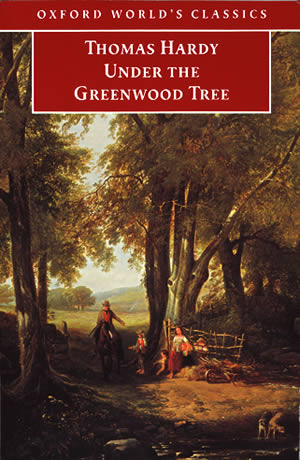
Under the Greenwood Tree by Thomas Hardy

Under the Greenwood Tree, set in the small village of Mellstock in Thomas Hardy’s fictional Wessex, is both a love story and a nostalgic study into the disappearance of old traditions and a move towards a more modern way of life. The book is divided into five sections, one for each of the four seasons of the year plus a final concluding section. The story begins in the winter, when we meet a group of villagers who play stringed instruments in the church choir. There’s a new vicar in Mellstock, the Reverend Maybold, and he has plans to replace the traditional choir with a new mechanical church organ. The organ will be played by another newcomer to the village, a pretty young schoolteacher whose name is Fancy Day.

The musicians are upset when they learn that they are going to be replaced, but one of them, Dick Dewy, finds himself falling in love with Fancy Day. However, unknown to Dick he has several rivals for Fancy’s love, including a rich local farmer and even the Reverend Maybold himself. The story of Dick and Fancy’s romance is played out over the course of a year, against a backdrop of the changing seasons and the changing landscape of Mellstock.

Hardy’s novels have a reputation for being bleak and depressing, but I can promise you that this one is neither. It’s actually quite an uplifting, optimistic story with an (almost) happy ending – very different from the other three Hardy books I’ve read (Tess of the d’Urbervilles, Jude the Obscure and A Pair of Blue Eyes). It doesn’t have the depth and complexity of Tess or Jude and to be honest, I do personally prefer Hardy’s tragedies, but I enjoyed this one too and it did make a nice change from the darker books I’ve been reading recently. The strengths of Under the Greenwood Tree are its gentle humour and its portrayal of life in 19th century rural England. As usual with Hardy, his pastoral descriptions are beautifully written and I love the way he paints four different portraits of country life appropriate to each season of the year, from singing carols and making cider in the winter to gathering nuts and collecting honey from beehives in the autumn.

Where the book was less successful, in my opinion, was with the characters of Dick Dewy and Fancy Day, because they just weren’t strong enough or interesting enough for me to really care about their romance. Fancy was actually quite an advanced and ‘modern’ character for the time and place, being well-educated and independent. However, she’s depicted here as being very silly and shallow and I felt that we never got to understand her properly. Dick was easier to like but his character wasn’t given a lot of depth either. I do think Hardy captured the naiveté of their relationship perfectly, but I would have preferred to have read more about the rest of the village community, with the love story pushed further into the background. Apparently Hardy had originally wanted to call the book “The Mellstock Quire” and it did seem to me that he was maybe more comfortable with that aspect of the book.

Although I’ve only read a few of Thomas Hardy’s novels he’s quickly becoming one of my favourite Victorian authors. I hope to read all of his books eventually, but I wish I’d left Under the Greenwood Tree until later as it’s turned out to be the first one I haven’t loved. There were a lot of things I liked about it, but it didn’t have the same emotional impact on me that the others had and it’s not a book I would want to read again and again.

Jude the Obscure by Thomas Hardy

Thomas Hardy really seems to be an author people either love or hate and Jude the Obscure must be the book that divides opinion more than any of his others. This is the third Hardy book I’ve read, the first two being Tess of the d’Urbervilles and A Pair of Blue Eyes and although this one didn’t have quite the same emotional impact on me that Tess did, I was still moved to tears in places.

Jude Fawley is eleven years old when he sees his schoolmaster, Mr Phillotson, leave the hamlet of Marygreen to go and study in the great city of Christminster. As a working-class boy it’s unlikely that Jude will ever be able to do the same. His only chance is to spend the next few years teaching himself Greek and Latin from books every night after going out to work through the day. Jude hopes that hard work, determination and a desire for knowledge will be enough to enable him to fulfil his dream of going to university in Christminster.

“It is a city of light,” he said to himself.

“The tree of knowledge grows there,” he added a few steps further on.

“It is a place that teachers of men spring from and go to.”

“It is what you may call a castle, manned by scholarship and religion.”

After this figure he was silent a long while, till he added:

“It would just suit me.”

What makes this so sad is that we, as readers, can see almost from the beginning that Jude is going to be disappointed. The class system in Victorian England meant it was almost impossible for someone in Jude’s position to go to university. The hopelessness of his situation becomes clear when the head of one of the Christminster colleges advises him that as a working man he should ‘remain in his own sphere and stick to his trade’. Jude’s response is to write on the college wall with a piece of chalk: “_I have understanding as well as you; I am not inferior to you: yea, who knoweth not such things as these?_”–Job xii. 3. That scene was one of many that made my heart break for Jude.

But education is not the only problem Jude faces. Following a disastrous marriage to a pig farmer’s daughter, he falls in love with his cousin, Sue Bridehead, who has also been unhappily married. Disillusioned with marriage, Jude and Sue decide to live together without marrying, but this unconventional arrangement could have tragic consequences.

I can see why this book was so controversial at the time of its publication (1895) as there are a few aspects of the story that must have been quite shocking for Victorian readers, particularly the way it challenges the way we think about Christianity and marriage. Hardy places Jude and Sue into a situation which he could use to explore England’s marriage and divorce laws as well as the problems that faced two unmarried people living together and how they could (or couldn’t) reconcile this with their religious and moral beliefs.

All of this eventually leads to a devastating tragedy which takes place towards the end of the book – anyone who has read it will know what I’m referring to and for those of you who haven’t, I can tell you it’s one of the saddest scenes you’re ever likely to read. A couple of pages before it happened I guessed (knowing Hardy) what was going to occur and yet I still wasn’t really prepared for it. One of the reasons people give for not liking Hardy is that he’s too depressing and while I can’t deny that this book is relentlessly tragic and heartbreaking, I still felt compelled to keep reading, to find out what happened next, to see what further ordeals Jude would have to face.

I can’t recommend Jude the Obscure highly enough, unless you really just don’t like this type of book. Now I need to decide which of his books I should read next…

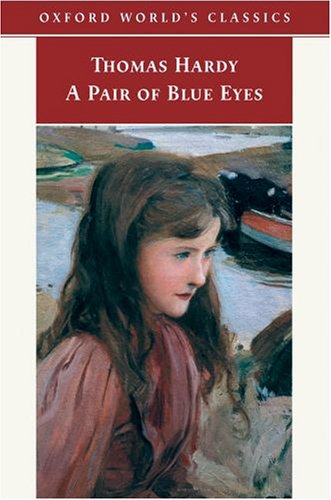
Review: A Pair of Blue Eyes by Thomas Hardy

These eyes were blue; blue as autumn distance – blue as the blue we see between the retreating mouldings of hills and woody slopes on a sunny September morning. A misty and shady blue, that had no beginning or surface, and was looked into rather than at.

I’m loving Thomas Hardy more and more with every book of his that I read. A Pair of Blue Eyes was one of his earliest books, originally serialised in Tinsley’s Magazine from September 1872 to July 1873. Although this is not generally noted as being one of his better novels and is certainly one of his least well known, there was something about it that appealed to me – and I would even say that of all the classics I’ve read so far this year, this might be my favourite.

A Pair of Blue Eyes is the story of Elfride Swancourt, a vicar’s daughter living in a remote corner of England, who is forced to choose between two very different men. One of these, Stephen Smith, is a young architect whom she meets when he is sent by his employer to survey the church buildings. At first, the vicar approves of Stephen and encourages his daughter to spend time with him. It soon emerges, however, that Stephen has been hiding an important secret from the Swancourts; something that could put his relationship with Elfride in jeopardy. Later in the book, another man arrives at Endelstow Vicarage – Henry Knight, an essayist and reviewer from London – and Elfride has to make a difficult decision.

As you might expect with this being a Hardy book, nothing goes smoothly for any of the characters. I would describe A Pair of Blue Eyes as being similar in some ways to the later Tess of the d’Urbervilles, though not as dark and bleak – and not quite as tragic either. Although I didn’t find Elfride particularly likeable, I thought she was an interesting character. Her lonely, secluded life gives her a childlike innocence and vulnerability and at one point Hardy draws a comparison with Miranda from Shakespeare’s The Tempest – both characters have little knowledge of men and a male visitor is a big event (and Elfride even plays chess with Stephen Smith and Henry Knight as Miranda did with Ferdinand in The Tempest). Of the two men, Stephen was the only one I had any real sympathy for. Knight, although another interesting character, annoyed me almost as much as Angel Clare in Tess annoyed me.

The descriptions of scenery in this book are stunningly beautiful and bring the setting vividly to life. If you’re familiar with Hardy you’ll know that he sets most of his works in the fictional region of Wessex in the southwest of England. This story actually takes place in Off-Wessex or Lyonesse, which equates to Cornwall. I had no problem at all in picturing the lonely vicarage, the windswept hills, and the dark cliffs towering over the sea below. Speaking of cliffs, it is thought that the term ‘cliffhanger’ originates from a scene in this book, though I’m not going to say any more about it than that!

Another interesting aspect of this book is that it’s loosely based on Hardy’s relationship with his first wife, Emma Gifford. Unfortunately I don’t know enough about Hardy to have picked up on all the allusions and references to events in his own life. I would like to eventually read a biography as I think it would help my understanding of both this book and his work as a whole.

I found A Pair of Blue Eyes very easy to read. I thought the pacing and flow of the story were perfect and the pages flew by in a weekend. It’s so sad that this book has been ignored and underrated to the point where, until not long ago, I hadn’t even heard of it. Maybe it won’t appeal to everyone and it might not be the best introduction to his work, but I loved it and would highly recommend it to all Hardy fans.

Review: Tess of the D’Urbervilles by Thomas Hardy

Tess Durbeyfield’s life changes forever when her father learns that he is descended from the noble D’Urbervilles. After discovering that he has some wealthy D’Urberville relatives living nearby, Tess is sent to visit them in an attempt to improve the family’s fortunes. While there she is taken advantage of by Alec D’Urberville and returns to her parents pregnant. A few years later when she falls in love with Angel Clare, the parson’s son, she is forced to decide whether to trust Angel with the truth about her past…

It seems that people either love or hate Tess of the D’Urbervilles. Among those who hate it the main reasons for disliking it appear to be that the book was too dark and depressing, or that Tess was too passive and weak. Although I can understand these complaints, I personally fall into the group of readers who loved the book. I don’t have a problem with a story being tragic, melodramatic or depressing as long as it’s well-written. And Hardy’s writing is beautiful. With other books I am often tempted to skim through pages of descriptions of trees, fields, sunrises etc, but Hardy’s portrayal of nature and the English countryside is so poetic I wanted to read every word. Be prepared, though – you will learn more than you ever wanted to know about milking cows, threshing wheat and slicing turnips!

It’s true that Tess doesn’t stand up for herself enough – there were plenty of times when I wanted to scream at her – but I mostly felt sorry for her. She was young (sixteen I think at the start of the book), innocent, naive, and didn’t have the best family life, with a father who was often drunk.  It seemed that everything that could go wrong for her did go wrong. More than poor Tess, it was Alec d’Urberville and Angel Clare who both really infuriated me – and I actually thought Angel was worse than Alec in some respects.

The injustice of a society with different sets of rules for men and women, Christianity vs pagan symbolism, the Industrial Revolution, and the class system of Victorian England are some of the interesting topics this book covers. The only thing I didn’t like about the book was the ending – the final chapters just didn’t seem to fit with the rest of the novel.

So, if you haven’t read this book yet give it a try – you might hate it…but you might just love it like I did.

Highly Recommended

Genre: Classics/Pages: 464/Published:BBC Books (Random House)/Year: 2008 (originally published 1891)/Source: Library book