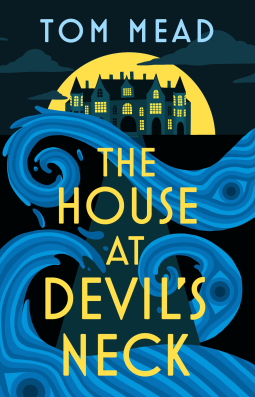
The House at Devil’s Neck by Tom Mead

This is the fourth book in Tom Mead’s Joseph Spector mystery series, but if you haven’t read any of them, don’t worry – they all stand alone and if you wanted to start here, that wouldn’t be a problem. The books are set in the 1930s and are written in the style of Golden Age ‘locked room’ or ‘impossible crime’ novels, with the influence of John Dickson Carr being particularly strong. The series features two detectives: a professional one – Inspector Flint of Scotland Yard – and an amateur one – Joseph Spector, a retired magician.

The House at Devil’s Neck begins in August 1939 with a group of people boarding a coach, ready for a trip to Devil’s Neck, a supposedly haunted house. The house, which can be reached by a causeway at low tide, has a long and dramatic history, but was most recently used as a convalescent home for wounded soldiers during the Great War. The current owner has now opened up the house to tourists and the first party is about to arrive. The guests include Madame la Motte, a medium, and her companion Imogen; a ‘ghost hunter’, Francis Tulp; and a magician – Joseph Spector. No sooner have they reached Devil’s Neck and settled into their rooms, however, than one of the party is found dead.

Back in London meanwhile, Inspector Flint is investigating what appears to be a suicide. The victim is Rodney Edgecomb, a man who, many years earlier, was involved in a high-profile inheritance dispute following the sinking of the Titanic. The circumstances of his death lead Flint to believe this is murder rather than suicide. When he eventually discovers links between Edgecomb and the house at Devil’s Neck, Flint and Spector are able to team up once again to solve the mystery.

I won’t go into the plot in any more detail because it’s such a complex one with so many twists I’m impressed that Tom Mead managed to keep track of it all himself! The murder methods are also very complicated, but the solutions do make sense once Spector explains them. As with his other books, Mead inserts a brief chapter towards the end to warn us that the solution is coming in case we want a chance to try to solve the mystery for ourselves. I think the average reader would find that very difficult – I certainly had no chance at all of solving it! – but the clues are all there and there are references at the end linking back to where you can find them in the text.

What interested me more than the mystery itself was the setting. The descriptions of the house at Devil’s Neck – ‘a hulking shape, a creature waiting at the valley’s nadir’ – are very atmospheric, as the guests arrive in pouring rain and the house quickly becomes cut off from the mainland by the rising water. The house’s history is also fascinating and allows Mead to explore the fate of wounded soldiers and how those left with permanent disabilities struggled to integrate back into society. Spiritualism, the tricks used by mediums and methods of ghost hunting are also subjects touched on in the book.

I loved most of this novel, until I started to feel lost near the end as it became more and more complex! I think the first and third books – Death and the Conjuror and Cabaret Macabre – are still my favourites.

Thanks to Head of Zeus for providing a copy of this book for review via NetGalley.

Book 17/20 for 20 Books of Summer 2025.
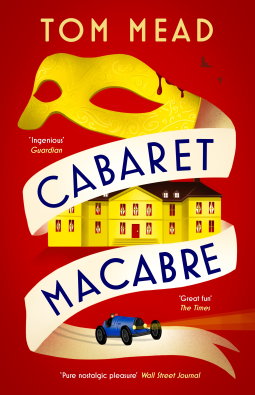
Cabaret Macabre by Tom Mead

After enjoying the first two books in Tom Mead’s Joseph Spector mystery series, Death and the Conjuror and The Murder Wheel, I was pleased to see that he had written a third one. I think this might even be my favourite of the three! If you haven’t read any of them, you could start here if you wanted to; although there are some references to Spector’s earlier cases, there are no spoilers and all three mysteries work perfectly as separate standalones.

It’s December 1938 and retired magician Joseph Spector has been approached by the wife of Sir Giles Drury, a prominent judge, who wants him to identify the sender of some threatening letters. She believes the culprit may be Victor Silvius, who attacked her husband nine years earlier and has been confined in a private sanatorium ever since. Having noted Spector’s involvement in solving the recent Dean case (described in The Murder Wheel), she hopes he will be able to find out who is behind the letters.

Coincidentally, Spector’s friend Inspector Flint of Scotland Yard has had a visit from Caroline Silvius, sister of Victor Silvius. Caroline believes someone is trying to murder her brother and she’s convinced that person is Sir Giles Drury. With Spector and Flint both investigating the same situation from opposite sides, it’s inevitable that their paths will cross. Arriving at Marchbanks, the Drurys’ country estate, during a period of heavy snow, both men are baffled when a member of the family is found dead under very unusual circumstances. Can they solve the mystery before another murder takes place?

I really enjoyed Cabaret Macabre. It’s very cleverly plotted, with not one but two locked room style murders for Flint and Spector to investigate, but unlike the previous book, which I found too complicated, this one was easier for me to follow. That doesn’t mean it was easy to solve, however, because it certainly wasn’t! I had no idea how the murders were carried out or who was responsible for them, even though the clues were all there in the text. Tom Mead really is a master of this type of mystery and it’s easy to see the influence authors like John Dickson Carr and Agatha Christie have had on his work.

The book has a large number of suspects (and also potential victims) including Sir Giles, his wife and their four sons and stepsons, Victor and Caroline Silvius and an assortment of servants at Marchbanks. There’s also another murder case – or was it suicide? – from nine years earlier (the source of the animosity between Victor and Sir Giles), which could provide the key to what’s happening in the present. It’s impressive that Mead manages to pull all of this together without leaving any obvious holes in the plot. What I particularly love about this series, though, is the idea of a former magician becoming an amateur detective and using his special knowledge of illusions and deceptions to solve crimes and assist the police. Although Spector is still something of a mystery himself and reveals very little of his past or his private life, I think he’s a great character and the perfect partner for the more practical, less imaginative Inspector Flint.

If you haven’t tried a Joseph Spector book yet and are a fan of Golden Age mysteries, I do recommend them; this one and the first one, in particular, have quite an authentic 1930s feel, as well as being fun and entertaining. I’m hoping there’ll be more!

Thanks to Head of Zeus for providing a copy of this book for review via NetGalley.

Book 39/50 for the Historical Fiction Reading Challenge 2024

This is book 20/20 of my 20 Books of Summer 2024.

Yes, I have completed my 20 Books of Summer list with nearly a week to go! I’ll be looking back at my 20 books and my experience with this year’s challenge in a special post at the end of the month.

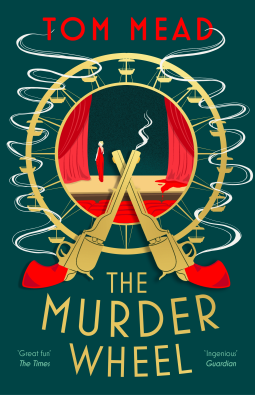
The Murder Wheel by Tom Mead

This is the second book in Tom Mead’s Joseph Spector mystery series, following last year’s wonderful Death and the Conjuror. If you haven’t read the first book yet and want to start with this one it won’t be a problem as the two deal with standalone mysteries.

The Murder Wheel begins in London in 1938 with lawyer Edmund Ibbs visiting a client, Carla Dean, in Holloway Prison. Carla is awaiting trial for the murder of her husband while they were riding on a Ferris Wheel together at the fair. As the only other person in the carriage when a shot was fired at close range – and with her fingerprints all over the alleged murder weapon – suspicion has naturally fallen on Carla. Ibbs’ job is to prove that she is innocent, but it’s going to be a difficult task!

When he’s not investigating crimes, Edmund Ibbs is pursuing a secondary career as an amateur magician and has just received a copy of a highly controversial new book, The Master of Manipulation, which promises to give away all the secrets of the art of magic. After his visit to Carla in prison, Ibbs heads for the Pomegranate Theatre to watch a performance by the great illusionist, Professor Paolini. When another suspicious death occurs during the magic show, Ibbs finds himself in the wrong place at the wrong time and discovers that he is now a suspect in another murder case! Are the crimes connected? Luckily, retired magician Joseph Spector is on hand to solve the mystery.

The Murder Wheel is another entertaining novel, but I didn’t enjoy it quite as much as the first book, mainly because I found it so complicated. There are eventually three separate seemingly impossible crimes to solve and I struggled to keep track of all the different threads of the story. There’s a lot of focus on the murder methods and the intricacies of how each one was committed, and although the solutions do all make sense, I could never have worked them out; I completely failed Mead’s ‘challenge to the reader’ near the end of the book, even though we’re told that the clues have all been provided in the text (and when the solutions are finally revealed, there are footnotes linking back to where each clue first appears).

I do love the partnership between Joseph Spector and Inspector Flint of Scotland Yard; they work together so well because one of them is using traditional methods of detecting such as questioning suspects and searching for evidence, while the other is more concerned with how his knowledge of illusions and sleight of hand can show how the crime was carried out. Magic plays a bigger part in this book than it did in the first one and I enjoyed that aspect of the story; it was interesting to get some insights into the backstage preparations for a magic show and how some of the tricks are performed, although I can see why some of the characters were unhappy with the author of The Master of Manipulation revealing all their secrets!

Tom Mead is a fan of Golden Age detective novels, particularly of the ‘locked room’ or ‘impossible crime’ types, and I think he does a good job overall of capturing the feel of a 1930s mystery – although with this book, I never felt that I really was reading a 1930s mystery, the way I did with the first one. I’m not sure exactly what was different, but that’s another reason why I preferred Death and the Conjuror. Still, I will probably read the third book in this series, assuming there’s going to be one!

Thanks to Head of Zeus for providing a copy of this book for review via NetGalley.

This is book 48/50 for the 2023 Historical Fiction Reading Challenge.

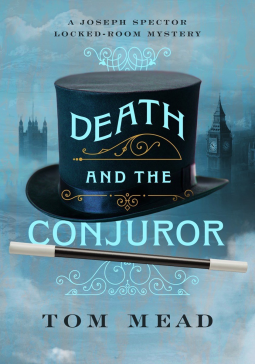
Death and the Conjuror by Tom Mead

Death and the Conjuror is a homage to the great locked room mysteries of the Golden Age and a clever and entertaining novel in its own right. I’m hoping it’s the first in a series as I would love to see more books like this from Tom Mead.

The novel is set in London in the 1930s where the renowned psychiatrist Anselm Rees has been found dead in his study. The door is locked, there’s no sign of a murder weapon and there’s no way for the killer to have escaped without being seen. Inspector Flint of Scotland Yard is baffled by this seemingly impossible murder and calls on retired magician Joseph Spector in the hope that he can use his knowledge of illusions and deceptions to help solve the mystery.

As the detective and the magician begin their investigations, they uncover another intriguing crime – an equally impossible theft – which seems to have links to Dr Rees’ death. Could one of the psychiatrist’s patients be responsible for one or both of these crimes? And can Flint and Spector catch the culprit before another murder takes place?

As with any good mystery novel, there are plenty of suspects, an assortment of clues and lots of red herrings! Suspicion falls not only on the doctor’s own household – including his daughter and her fiancé – but also on three of his patients, celebrities who are referred to as Patients A, B and C, to protect their identities. Each patient has been seeing Dr Rees for help with a specific problem, which we learn more about as the story unfolds. The psychiatric element of the plot is fascinating and reminded me very much of Helen McCloy’s Dr Basil Willing mysteries. It came as no surprise to me, then, to learn that McCloy is one of many classic crime novelists Tom Mead has named as an influence on his writing – along with John Dickson Carr, Ellery Queen, Nicholas Blake and others.

I loved the idea of a magician working alongside the police; Spector has lots of specialist knowledge when it comes to the sort of tricks a murderer or a thief might use to create confusion and cover their tracks. As a locked room mystery it was very satisfying and although I didn’t manage to solve it myself, I enjoyed following the progress of the investigations and was happy for Spector to explain it all for me at the end. As a tribute to the Golden Age mystery I thought it was equally successful. I could almost have believed I really was reading a book from the 1930s, as the author seemed to have made an effort to avoid inappropriately modern language and modern sensibilities. The characters in the book even discuss and reference some of the detective novels of the time, but in such a way that the plots of those books aren’t spoiled for those of us who haven’t read them yet.

This was a great read and I will be hoping for another mystery for Joseph Spector to solve soon.

Thanks to Penzler Publishers, Mysterious Press for providing a copy of this book for review via NetGalley.

This is book 34/50 read for the Historical Fiction Reading Challenge 2022.