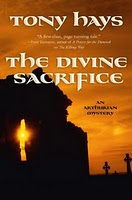
Today I’d like to welcome Tony Hays for an author interview. Tony’s latest book The Divine Sacrifice will be published on March 30th 2010. You can see my review here.

Hi Tony! The Divine Sacrifice is your second historical mystery set in the days of King Arthur. How did your interest in the Arthurian age begin?
I grew up, of course, seeing Sword in the Stone and A Connecticut Yankee. But I have always been fascinated by the debate over Arthur’s historical existence. I believe that fascination was first sparked by reports of the South Cadbury excavations of the late 1960s. Over the years, I’ve kept up with developments. As luck would have it, the secretary of the Camelot Research Committee, which sponsored the digs, was Geoffrey Ashe, who is now among the most renowned of Arthurian scholars and a good friend of mine.
In The Divine Sacrifice we meet characters who are familiar to us from Arthurian legends e.g. Arthur, Guinevere and Merlin. When you created the character of Malgwyn was he inspired by any legendary or historical figure or is he entirely fictional?
Actually, no. I wanted a narrator who was not enamored with Arthur, one who didn’t really like Arthur all that much, although he shares Arthur’s belief in justice. I also wanted a character who would not only solve the mystery, but gain something himself. I couldn’t bring myself to use any of the familiar characters, so Malgwyn was born.
I read on your website that you like to visit some of the places mentioned in your books. How important do you think it is for an author to visit the places they are writing about and how does this help you with your research?
My first published novel was set in 1602 London, onstage at the Globe Theatre. Going to London wouldn’t have helped me at all. Too much has changed. But I could not write the new series without spending a great deal of time in the west country. While some things have certainly changed, many have not. I lived just south of Glastonbury in 2008 for six months, hiking everyday in the Somerset Levels. I can write about sunrise over Glastonbury Tor, how the air smells, because I have been there. I use Cadbury Castle in South Cadbury as the location for Arthur’s headquarters. I used to go up there and sit and plan out the town layout and, with a nod to my acting friends, “block out” the scenes. So, the short answer is, some books demand reconnoitering the locations. Some don’t.
There must be very little historical information available about life in the 5th century. Did this make your task of writing the novel easier or harder?
Both. I had to do hours of research in what sources are available to make certain that I did nothing to conflict with those. But, the lack of primary source material gave me a free hand to invents bits myself. I have read literally dozens of archaeological reports on digs from that time period (I’m also a huge Time Team fan) and I have used actual artifacts found in the books, sometimes suggesting ways that they could have ended up where archaeologists found them years later. The historical Arthur (and I believe that there was a leader named Arthur who had a tremendous impact on his world) would have had to worry about things like economics, trade, the Church. So, I’ve tried to immerse myself in what we know about those aspects of the Dark Ages as well. My Arthur concerns himself with where the resources will come from to continue fortifying specific sites, with exploiting the natural resources like tin. But in case people worry that Arthur is too grounded in reality, as the series progresses, Malgwyn and Arthur will also encounter, and deal with, things that cannot be explained – call it the supernatural or paranormal. There are things in this world that we do not understand, and there were back then too.
What type of books do you like to read yourself? Are there any authors you’ve found particularly influential?
I like history, obviously, even in fiction. I particularly like modern novels with a historical basis. George Macdonald Fraser’s Flashman series and John Maddox Roberts’ SPQR series about the last years of the Republic are great. I cut my teeth as a youngster on the Revolutionary War novels of Kenneth Roberts and Louis L’amour’s westerns. For the Arthur series, Geoffrey Ashe’s work, the historical studies of Christopher Snyder, and the Celtic books of Peter Beresford Ellis have been my mainstays.
If you could go back in time and meet one historical figure, who would it be? In your case, would it be Arthur or someone else entirely?
At this point, I think it would be Arthur. Here’s a figure from 1500 years ago, from one of the least documented time periods in any culture’s history, and yet his impact is felt even today. That’s a person I’d love to meet. I might be disappointed with the reality, but I don’t think so.
Finally, can we look forward to more books in the Malgwyn series?
Absolutely! The Divine Sacrifce will be followed first by The Beloved Dead (April 2011) and then The Stolen Bride (2012). Given good sales, my editor and I plan to keep exploring Dark Ages Britain with Malgwyn for years to come.
Thanks for your time, Tony!
You can find out more about Tony Hays and his books here:
 She Reads Novels