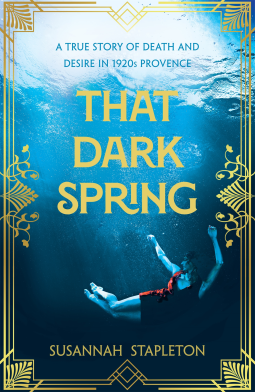
That Dark Spring by Susannah Stapleton

One of my resolutions for 2025 was to read more non-fiction books, so I’m ashamed to say this is only my second one this year. Oh, well – I still have more than seven months to add a few more to that total. I would also like to widen the range of topics I normally choose to read about and try something different, but for now, with That Dark Spring, I have stayed within one of my usual areas for non-fiction – true crime.

The crime in question is the murder – or could it be suicide? – of Olive Branson, an Englishwoman in her forties found dead at her farmhouse in a village in Provence. This happens in April 1929, when she is discovered submerged in a water tank outside the house, a bullet wound between her eyes and a revolver nearby. The local policeman and doctor conclude that Olive shot herself, but not everyone is happy with this verdict. Back in England, Olive’s wealthy, influential cousin demands that the case be reopened, so one of France’s top detectives, Alexandre Guibbal, is summoned from Marseille to investigate.

It’s an intriguing mystery! Could Olive really have lifted the heavy cistern lid, lowered herself in and shot herself – with her left hand, despite evidence suggesting that she was right-handed? Guibbal doesn’t think so and quickly turns his attentions to François Pinet, believed to be a lover of Olive’s for whom she had changed her will to leave him the Monte Carlo Hotel, which she had recently purchased. As evidence mounts up against Pinet, he insists that he is innocent and is defended by many of the villagers who are keen to support ‘one of their own’. There’s eventually a trial, but even then a lot of questions are left unanswered. Susannah Stapleton can’t – and doesn’t – give us those answers, leaving us to draw our own conclusions and try to decide what really happened.

I enjoyed That Dark Spring overall, although it took me a while to get into it due to the amount of background information provided in the first half of the book: a history of the village of Les Baux and the Baussenc people; an account of Olive’s early life and her career as an artist; detailed descriptions of the two rival hotels in Les Baux; and a long and (as far as I could tell) irrelevant biography of the poet Frédéric Mistral. Some padding is to be expected in books of this type, of course, but I found that I only became fully engaged with the story when it returned to the central crime. There are some points that wouldn’t be out of place in a detective novel, such as where Guibbal consults an astronomer in an attempt to decide exactly when darkness fell on the night of the crime or where Pinet tries to use the sighting of a car as an alibi and becomes entangled in his own lies.

It’s frustrating that we still don’t know the truth behind Olive’s death and probably never will. If Pinet was innocent and we assume that suicide was unlikely, that must mean someone else got away with murder – but who was it? Stapleton doesn’t really steer us into one way of thinking or another; she just provides the facts and some possible theories for us to consider. She suggests that the police may have been so determined just to pin the blame on somebody that they ignored or failed to collect important evidence, leaving Pinet’s fate up to the lawyers and the jury.

Stapleton has drawn on a number of primary sources and includes excerpts from Olive Branson’s diaries and letters throughout the text, giving it a more personal touch. There are also notes at the end, a bibliography and a list of Olive’s exhibited artworks. I had never heard of Olive until now, so it’s good to have learned a little bit about her. I’ll have to go back and read Susannah Stapleton’s other book – The Adventures of Maud West, Lady Detective.

Thanks to Picador for providing a copy of this book for review via NetGalley.
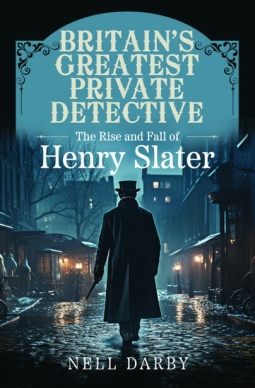
Britain’s Greatest Private Detective by Nell Darby

As someone who enjoys detective novels, I was naturally drawn to this non-fiction book about a real life private detective who achieved fame and success in the late Victorian era. His name (at least the one by which he was best known) was Henry Slater and he was the owner of Britain’s leading detective agency. This new book by Nell Darby explores Henry Slater’s life and career and looks at the world of the early private detective in general – the backgrounds they came from, the type of cases they dealt with, the methods they used and the problems that could arise from those methods.

The Matrimonial Causes Act 1857 is one of the key factors that gave rise to the private detective in the second half of the 19th century. This made it possible for people to request a divorce through the law courts (rather than through a private Act of Parliament as previously) as long as they could prove their spouse had committed adultery. Women would also need to prove one other offence, such as desertion or cruelty. But how could people obtain evidence to show that their partner had been unfaithful? By employing a private detective, of course, and asking them to shadow their husband or wife and look for proof of infidelities. And what do you think happened if the detective couldn’t find any proof – and their client was paying them to deliver results?

Slater’s Detective Agency, who operated from offices in London’s Basinghall Street, advertised all sorts of detective work, but most of their business relied on divorce cases. It was one case in particular that brought about their downfall. Having been hired on behalf of a Mrs Kate Pollard to help her divorce her husband, the agency resorted to underhand methods to get the evidence they needed and were betrayed by a former employee with a personal grudge against Henry Slater. This led to a trial which damaged Slater’s business and exposed his true identity. The Pollard case and the trial which followed form a large part of the book, although Darby moves back and forth between that story, a personal biography of Henry Slater himself and a general history of private detective agencies.

This is a fascinating book and has clearly been very well researched (there’s a long bibliography and an extensive section of notes), but it wasn’t quite what I expected. I thought there would be details of more of Slater’s cases than just the Pollard one and more discussion of the other types of work the agency carried out as well as divorces, but maybe there just wasn’t enough information available to do that. I can’t agree with other reviews saying the book reads like a detective novel as there’s very little actual ‘detecting’ being done and certainly not much similarity between Henry Slater and Sherlock Holmes, whose adventures were appearing in print during the same period that Slater was operating. The jumping around from one topic to another also disrupts the flow of the book and meant I couldn’t become as immersed in it as I would have liked.

Still, I enjoyed learning about Henry Slater and how he established his agency, how he found work first through advertising and then through the strength of his fame and reputation, and how he faced challenges from rival companies. It seems that although Slater can be admired for what he achieved in building his business up from nothing and reaching the very top in his chosen profession, he was less skilled in handling his personal relationships with friends and employees – and this, together with his determination to keep his perfect record in winning divorce cases, is what led to his demise.

I was intrigued by the occasional mentions of the women detectives Slater employed, particularly the ones described as ‘cyclist detectives’ who followed their suspects by bicycle. I’ve discovered that Nell Darby has written another book, Sister Sleuths: Female Detectives in Britain, which sounds like a good companion to this one and I’m sure it would be an interesting read as well.

Thanks to Pen & Sword for providing a copy of this book for review via NetGalley.
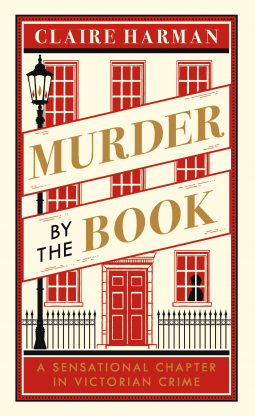
Murder by the Book by Claire Harman

I don’t read a lot of non-fiction, but I’ve been reading more of it than usual over the last few weeks in preparation for Nonfiction November. Murder by the Book, an account of a true crime which took place in Victorian London, sounded appealing to me because it promised to explore the possible links between the crime and some of the bestselling novels of the day.

The book begins by describing the events of 6th May 1840, when Lord William Russell’s housemaid found her master in bed with his throat slit. Suicide was suspected at first, but with his head almost severed from his body, this theory was dismissed and a murder investigation began. Russell, an elderly widower, had been leading a quiet, unremarkable life, living alone (apart from his servants) in a respectable Mayfair street. Who could possibly have wanted him dead – and why?

The murder sent shockwaves throughout London, with everyone – including Queen Victoria herself – following the news and voicing their opinions. What made this particular case so shocking was that when the culprit was identified and questioned, it was found that before committing the murder he had been reading Jack Sheppard, a well-known novel by William Harrison Ainsworth. Based on the story of a real life 18th century criminal, Jack Sheppard had been published as a serial in Bentley’s Miscellany from January 1839 until February 1840. With plots involving murder, theft and violence, crime novels of this type had become known as ‘Newgate Novels’ (a reference to the Newgate Prison), and were hugely popular with the public, partly due to the rise in literacy levels during the first half of the 19th century. Following the Russell murder, a debate began regarding the suitability of this sort of reading material.

I enjoyed Murder by the Book, but I didn’t find the true crime element particularly interesting. There didn’t seem to be a lot of mystery surrounding Russell’s death and the murderer was arrested quite quickly. Although Claire Harman did manage to flesh the story out, on its own it wouldn’t have been enough to form a compelling book. The parts where she discussed Jack Sheppard and other popular novels of the time were of much more interest to me. I haven’t read Jack Sheppard, or anything else by William Harrison Ainsworth, and I’d had no idea that it had been so successful in its time. The book was adapted for stage many times, including some musical versions, so even if people hadn’t read it they were likely to have seen it performed.

The reactions of other authors were interesting; Charles Dickens had apparently been a friend of Ainsworth’s, but distanced himself from him after the Russell incident, doing all he could to defend the reputation of his own Oliver Twist, which covered similar themes. Both Dickens and William Makepeace Thackeray followed the outcome of the murder trial and attended the hanging of the culprit and some of their thoughts on this are given in the book.

Anyway, the social aspects of the book were fascinating, even if the true crime parts weren’t – although I was surprised that Claire Harman didn’t draw more parallels between the Jack Sheppard controversy and the perceived influence of modern television, music and video games on violent behaviour. The book reminded me of Kate Summerscale’s The Wicked Boy and I think if you enjoy one you might enjoy the other.

Thanks to Viking for providing a copy of this book for review via NetGalley.
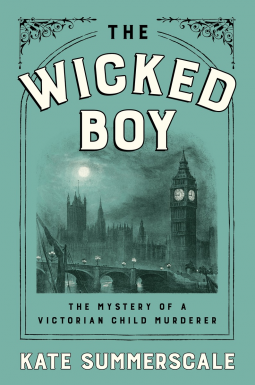
The Wicked Boy by Kate Summerscale

The Wicked Boy It’s July 1895 and Robert and Nattie Coombes could be any two young boys enjoying the hot summer weather. They go to see a cricket match, they play in the park, they take a trip to the seaside and they go fishing. Their father, a ship’s steward, is at sea and the boys tell anyone who asks that their mother is visiting her sister in Liverpool and that a family friend, John Fox, is staying with them while she’s away. However, there is more to the situation than meets the eye and it’s not long before the neighbours grow concerned. Why did Emily Coombes not mention to anyone that she was going away – and what is that horrible smell drifting down from the bedroom upstairs?

When the police are eventually called to the house at 35 Cave Road, they make a shocking discovery: it seems that Emily Coombes has been there all the time, her dead body decomposing in the summer heat. Her eldest son, Robert, immediately confesses to stabbing his mother to death ten days earlier. In the trial which follows, the court attempts to make sense of this terrible crime. Robert is only thirteen years old (one year older than his brother, Nattie); what would make a boy of this age commit such a cruel and cold-blooded act?

This may sound like the plot of a crime novel, but it’s not – it’s actually a true story and the events I’ve been describing above really did take place in London’s East End in 1895. In The Wicked Boy, Kate Summerscale gives an account of the murder, the inquest and the trial, exploring some of the factors which may have led to Robert’s actions before going on to look at what happened to him after he was found guilty.

This is the third book I’ve read (or attempted to read) by Summerscale. I loved The Suspicions of Mr Whicher, which was also based on a true crime, but I found Mrs Robinson’s Disgrace, about a Victorian divorce scandal, difficult to get into and I abandoned it after a few chapters. I’m pleased to report that I liked The Wicked Boy much more than Mrs Robinson, though not as much as Mr Whicher, which had a stronger mystery element. There’s really no mystery at all about the Robert Coombes case; we know almost from the beginning what the crime is and who is responsible for it. Of course, this doesn’t mean there are no more questions to be asked. The official verdict was that Robert was “guilty but insane” and no clear motive was ever identified, but Summerscale does devote a large portion of the book to discussing Robert’s childhood and family background in an attempt to understand what could drive a thirteen-year-old boy to kill his mother.

Where the murder and the trial themselves are concerned, Summerscale sticks to the facts and doesn’t resort to too much speculation or personal opinion. However, she also spends a lot of time looking at what life was like in general for working-class Londoners towards the end of the Victorian era. Robert and Nattie Coombes would have been among the first generations to be educated at the new Board Schools which were established after the Elementary Education Act of 1870, but there were many people who believed that making education available to everyone was a bad idea. It meant that more children were able to read and therefore had access to ‘penny dreadfuls’, cheap adventure novels aimed at boys which were thought to be a bad influence on impressionable minds. Robert Coombes had a collection of these sensational stories, something that was seized upon in the same way that people sometimes blame violent video games for encouraging modern day teenagers to commit crimes.

I found all of this fascinating to read about, but was slightly less interested in the second half of the book which covers Robert’s time at Broadmoor, the asylum where he was sent after his trial, and what happened after he was released. I understand why the author wanted to follow Robert’s story through to its conclusion, but I just didn’t have enough interest in him as a person to want to read such a long account of his later life. Apart from this, I did enjoy reading The Wicked Boy and am glad I gave Kate Summerscale another chance after my disappointment with Mrs Robinson’s Disgrace.

I received a copy of this book via NetGalley for review.