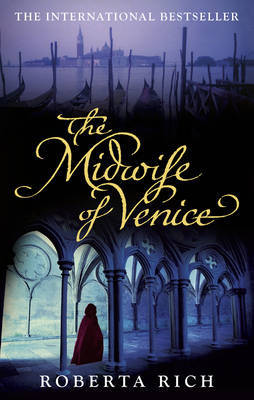
 The Midwife of Venice is set in 1575 and is the story of Hannah Levi, a midwife who lives in the Jewish ghetto in Venice. Although Jews are forbidden to attend Christian women in childbirth, when the Conte di Padovani summons her to his wife one night Hannah agrees to go with him. The Conte promises that if she assists in the birth of his heir he’ll reward her with a large sum of money – money that Hannah desperately needs so that she can pay the ransom to free her husband Isaac, who has been captured and taken to Valletta, Malta as a slave of the Knights of St John. But when it proves to be a difficult birth and Hannah is forced to use her special ‘birthing spoons’ (a device similar to forceps) she finds herself threatened with accusations of witchcraft.
The plot moves back and forth between Hannah in Venice and Isaac in Malta, until the two alternating storylines begin to come together. Luckily, I found both Hannah’s and Isaac’s adventures equally interesting to read about, so I didn’t mind leaving one character behind for a while to find out what was happening to the other.
I loved the first few chapters of this book; the story’s various locations (the Jewish ghetto, Venice’s streets and canals, the island of Malta) were vividly described without being too detailed, and it was interesting to learn about the relationship between the Christians and Jews in 16th century Venice. But halfway through, the plot started to take some dramatic twists and turns which I can only describe as unbelievable and ridiculous. Hannah was a likeable enough character, but it seemed to me that everything worked out too easily for her (and for Isaac) – there were too many coincidences, too many last-minute escapes and the villains were too easily defeated. If you can suspend your disbelief it’s all very entertaining I suppose – with murder, kidnapping, blackmail, disguises, slavery and even the plague, it’s certainly never boring – but I think I would have preferred something slightly more serious!
One other little problem I had was with the number of Italian and Jewish terms that were dropped into the text, a lot of which were unfamiliar to me. There was a glossary at the end of the book which I didn’t discover until too late – it would have been helpful to have known about it before I began instead of when I was nearly finished.
Although I prefer historical fiction novels to have a bit more depth than this one, The Midwife of Venice was fun to read. The setting and subject matter were unusual and interesting, and the fast pace and cliffhanger chapter endings made it a quick read. Oh, and I love the cover too!

 She Reads Novels