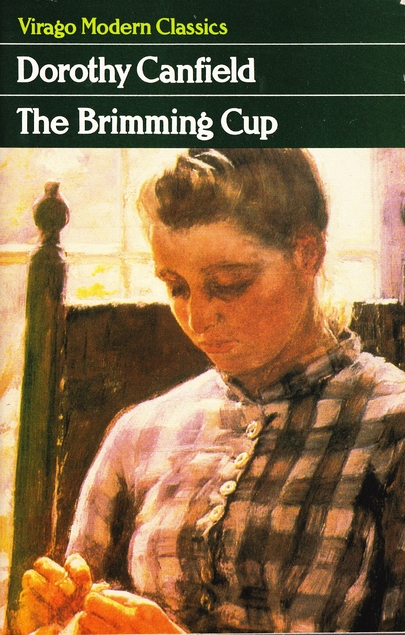
 I had never read anything by Dorothy Canfield Fisher, so when I saw that she was the next author in Jane’s Birthday Book of Underappreciated Lady Authors, I thought this would be the perfect opportunity. Ideally I would have started with her most popular book, The Home-Maker, but as I didn’t have a copy of that one, it made sense to read the one I did have instead.
The Brimming Cup opens with a prologue set in Italy in 1909 in which we briefly meet Neale and Marise, a young couple who are very much in love and making plans for the future. Marise has a very clear idea of what she wants and expects from their relationship:
“But what would poison us to death…what I’m afraid of, between two people who try to be what we want to be to each other…how can I say it?” She looked at him in an anguish of endeavor, “…not to be true to what is deepest and most living in us…that would be the betrayal I’m afraid of. That’s what I mean. No matter what it costs us personally, or what it brings, we must be true to that. We must!”
Eleven years later, Marise and Neale are married and living in Vermont. It’s 1920 and Marise has just sent their youngest child, Mark, off to school for the first time. Where once she had three children at home all day, now she has none and, with Neale so busy running the family business, Marise’s role as wife and mother is no longer the same as it used to be.
When Mr Welles, a retired office worker, moves in next door accompanied by his younger friend, Vincent Marsh, Marise begins to feel even more unsettled. Vincent makes her think differently about her life and about her relationships with her husband and children. Do the children appreciate everything she has done for them? Do they even truly love her or would they feel the same about any adult who raised them? Is her life being wasted in this quiet little town in Vermont? Forced to question all the things in which she has ever believed, Marise remembers the vow she made in Rome – that she and Neale should each be true to themselves no matter what.
I found it interesting to see how this novel, published in 1919, explores some of the attitudes, views and theories of the time surrounding issues such as childcare, parenthood, identity and marriage. As newcomers to the town, Mr Welles and Vincent Marsh introduce Marise to different ideas and opinions. Vincent’s suggestions that Marise should be making more of her talent as a pianist and break away from the role she has fallen into in the home seem very tempting – especially as she is starting to wonder whether Neale is really the man she thought he was – while Mr Welles’ interest in helping his cousin in Georgia to fight prejudice against black people also gives her something to think about.
I found a lot to appreciate and enjoy in this novel, but I can’t say that I loved the book as a whole and I’m not sure yet whether Dorothy Canfield Fisher is really an author for me. There were times when some of the writing felt a bit too sentimental for my taste and there were some plot developments towards the end, involving another family, the Powers, which felt unnecessarily melodramatic and out of balance with the rest of the story. I will probably try at least one more of her books, though, because it could just be that this one wasn’t the best of introductions for me. I’m tempted by Rough-Hewn, which was published after The Brimming Cup and seems to be a prequel, but maybe I should read The Home-Maker instead to see why so many people love it so much.
 She Reads Novels