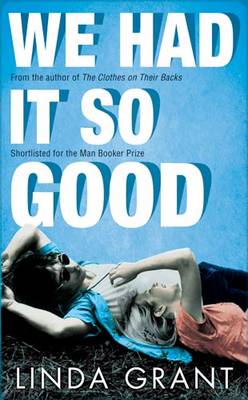
Stephen Newman is getting older and is finding it difficult to come to terms with the way his life has turned out. What happened to his hopes and ambitions, to the generation that was going to change the world?
We Had It So Good follows the story of Stephen and his family over several decades during the second half of the twentieth century and the beginning of the twenty-first. At times reading this book was almost like watching one of those nostalgic television documentaries that show us snapshots of life in the 1960s and 70s. We learn about Stephen’s time at Oxford University where he met his future wife Andrea, how he made LSD in the chemistry lab, lived in a commune, went to the Isle of Wight festival and ate macrobiotic food. As we move forward through the 1980s and 1990s we see the early days of computers and the internet, and learn what it was like to be a photo-journalist reporting on the Bosnian War. And finally, we are brought right up to date with the tragedies of 9/11 and the 2005 London bombings.
As the years go by we see how Stephen and Andrea have changed over time, have had to abandon some of their dreams, and are leading more conventional lives – but with Stephen in particular there’s always that feeling of regret, that he’s settled for second-best, and he does at one point decide that “that was what life was, perennially settling for less”.
The book doesn’t have much of a plot, concentrating instead on painting a detailed and realistic portrait of the Newman family. Despite the lack of action though, there are still some moments of drama – mainly the types of small dramas that most people will experience in their lifetime – and there were even a few surprises and revelations that I didn’t see coming. The viewpoint switches from chapter to chapter allowing us to see things through the eyes of Stephen, Andrea, and several of the other characters. Sometimes I couldn’t immediately tell who was narrating, but this seemed to be intentional. The story also moves around in time, showing us the significant moments that have shaped the lives of each of the characters.
Linda Grant’s writing is of a high quality and she develops her characters in great detail from their appearance and the clothes they wear, to their likes and dislikes, hopes and fears. And yet throughout the first half of the book I didn’t feel any personal involvement in their story and always felt slightly detached from what was going on. Although the Newmans and their friends felt believable and real to me, I didn’t think I liked them enough to want to spend 340 pages reading about their everyday lives. But halfway through the book I started to warm to some of the characters and as a result, the story became more compelling. And once I had settled into the pace of the writing, I started to enjoy it.
It was interesting to see how Stephen as an American (with a Polish immigrant father and a Cuban mother) adapted to life in England, first at Oxford and then in London. And equally interesting when the family went to America and this time it was Andrea who had to readjust. I also liked reading about the relationship between Stephen and his father, Si. Stephen and Andrea’s daughter, Marianne, is another intriguing character. And this post wouldn’t be complete without mentioning Andrea’s best friend, Grace, who is quite a sad and solitary figure, still clinging to her ideals and travelling aimlessly round the world on her own, running away from her past and searching for something unobtainable. Although she’s not the most pleasant of people, with a hard, prickly personality, I was far more interested in Grace than in the Newmans.
I should point out that I’m probably not really the target audience for this book and although I did end up enjoying it, I can see that it would probably be appreciated more by readers of Stephen and Andrea’s generation. However, the book still left me with a lot of things to think about, from bigger issues such as immigration, family relationships and generational differences to the smaller ones, such as the principles behind the advertising of washing powder!
We Had It So Good was the January selection for the Virago Book Club. I received a copy from Virago for review.
 She Reads Novels