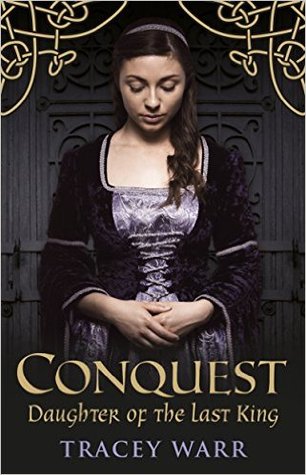
Conquest: Daughter of the Last King by Tracey Warr

One of the things I love about historical fiction is having the opportunity to read about historical figures I previously knew nothing at all about. Nest ferch Rhys, daughter of the last king of Deheubarth in Wales, certainly falls into that category, so when I was offered review copies of the first two books in Tracey Warr’s Conquest trilogy, of course I said yes!

Daughter of the Last King opens in 1093. The twelve-year-old Nest is playing on the beach with her brother when she is captured by Norman invaders who inform her that her father has been killed in battle at Aberhonddu. Taken by her captors to Cardiff Castle, Nest is placed in the household of Sybil de Montgommery, a member of a powerful Norman family who have been granted lands and titles in Wales. Although Nest has every reason to despise the Montgommery family and all they stand for, she quickly finds herself warming towards Sybil, who has been given the job of overseeing her education and training. The plan is that Nest will one day marry Sybil’s brother, Arnulf de Montgommery – but what about her existing betrothal to the Welsh prince, Owain?

Nest’s story takes place during a troubled and eventful time in the histories of England, Wales and Normandy. William the Conqueror has died and his lands have been divided, with his eldest son, Robert Curthose, inheriting Normandy and the throne of England going to a younger son, William Rufus. The two are rivals and the nobility, particularly those with land in both England and Normandy, are forced to choose between them. Sybil’s husband and her Montgommery brothers have each decided where their loyalties lie, but will they have made the right choice?

Although I have read quite a few novels set just before and during the Norman Conquest of 1066, I have read very little about the period following this – the late eleventh and early twelfth centuries. Tracey Warr goes into a lot of detail regarding the politics of the period, the rebellions, the shifting loyalties and betrayals, so that by the time I finished the book I felt that I had learned a lot. There is some overlap with the knowledge I gained from another recent read, Alison Weir’s Queens of the Conquest, but otherwise most of this was new to me. In particular, I found the focus on Welsh history interesting, especially the contrast between the Normans’ relatively quick and successful conquest of England and their attempts to conquer Wales.

Due to my unfamiliarity with so much of the history covered in this novel, I was relieved to see that the author had included some very useful material at the front of the book: genealogies for the Welsh royal families, Anglo-Norman royal family and Montgommerys; maps of eleventh century Wales, England and Normandy; and a plan of Cardiff Castle. I resisted the temptation to look anything up online because, with my complete lack of knowledge of Nest ferch Rhys and her story, I didn’t want to find out too much in advance. There was some suspense involved in waiting to see who – and whether – she would eventually marry, and I didn’t want to spoil the surprise for myself.

The one aspect of the book I’m not sure I liked was the inclusion of journal entries and letters written by a fictitious nun, Sister Benedicta, and her brother, a knight called Haith. These characters do serve a purpose in the novel, providing us with information on events which are unknown to Nest, but personally I found them a bit distracting and would have preferred to focus solely on Nest. She is such an interesting character and, although Tracey Warr points out in her author’s note that there is a limit to how much we know for certain about the real Nest, I did enjoy getting to know her. I’m looking forward to finding out how the story continues in the second part of the trilogy, The Drowned Court.

Thanks to Impress Books for providing a copy of this novel for review.

~

I would like to take this opportunity to wish you all a Merry Christmas! I’ll be back soon with my books of the year, my December Commonplace Book and maybe another review or two before New Year.

First of the Tudors by Joanna Hickson

first-of-the-tudors Yes, I’ve been reading yet another Wars of the Roses novel! One of the things I’m enjoying about reading so many books set in the same time period is seeing the variety of ways in which different authors choose to approach the same subject as they search for a new angle and some fresh insights. In First of the Tudors, Joanna Hickson takes us right back to the early days of the conflict and the beginnings, more or less, of the Tudor dynasty to tell the story of Jasper Tudor, uncle of the future Henry VII.
As the sons of Welshman Owen Tudor and Henry V’s widow, Catherine of Valois, Jasper and Edmund Tudor are half-brothers to Henry VI, who is King of England as the novel opens in 1451.  Being closely related to royalty but with no real claim to the throne for themselves, Edmund and Jasper are welcomed to court by Henry who rewards them with lands and titles, making Edmund Earl of Richmond and Jasper Earl of Pembroke. Edmund also wins the hand in marriage of Margaret Beaufort, which is seen as a great accomplishment as Margaret, despite being little more than a child, has royal blood and is one of England’s richest heiresses.

When Edmund dies at Carmarthen Castle in 1456, possibly of bubonic plague, he leaves Margaret pregnant with his child. The baby, when it is born, is named Henry and is taken into Jasper’s care (before later being placed in the custody of the Yorkist William Herbert). As the years go by and Henry grows into a man, Jasper is occupied with looking after his estates, trying to keep the peace in Wales and supporting his brother the king as unrest grows and the country heads towards civil war. Based closely on historical fact, we see all of this through Jasper’s eyes, as he narrates his own story in his own words.

But there’s also a fictional story, built around the idea that Jasper had a cousin, Sian (or Jane) Hywel, who became his mistress. There is no historical basis for this, but it is known that Jasper did have illegitimate children, so I have no problem with Joanna Hickson inventing the character of Jane, especially as she makes clear in her author’s note which parts of the novel were factual and which weren’t. However, I felt that too much time was devoted to Jane – she narrates around half of the book – and I would have preferred to concentrate more on Jasper and the other historical figures. This is just my personal opinion, though, and I’m sure other readers will like the domestic scenes and the love story more than I did.

I’ve always found Jasper Tudor intriguing, maybe partly because he tends to be overshadowed in historical fiction by other, more well-known characters. I had been looking forward to seeing him take centre stage for once, but I didn’t really find his portrayal in this novel entirely convincing. I can’t quite explain why, other than to say that his narrative voice was almost identical to Jane’s and that I could never fully believe in him as a 15th century man. I did like the portrayal of Margaret Beaufort, however, which made her seem slightly more endearing than in other fictional portrayals I’ve read! I also enjoyed the focus on Wales, the descriptions of the Welsh castles and the Welsh people who played a part in this fascinating period of history – one secondary character whom I found particularly interesting was the poet Lewys Glyn Cothi.

First of the Tudors ends abruptly, leaving the feeling that there is much more of this story still to come, and the author’s note confirmed what I had already expected: there will be a sequel and Henry Tudor will take more of a central role in that one. If you’ve never read Joanna Hickson before you may also be interested in The Agincourt Bride and The Tudor Bride, which tell the story of Catherine of Valois, or Red Rose, White Rose, the Wars of the Roses from Cicely Neville’s perspective.

Thanks to the publisher HarperCollins for providing a review copy via NetGalley.

Sleeper’s Castle by Barbara Erskine

Sleeper's Castle After reading Lady of Hay I said I wouldn’t be looking for any more of Barbara Erskine’s novels, but I couldn’t resist this latest one with its unusual title, pretty cover and intriguing synopsis! And actually, Sleeper’s Castle was a pleasant surprise; I enjoyed it much more than any of the other books I’ve read by Erskine.

Despite its name, Sleeper’s Castle is not really a castle; it’s a house near Hay-on-Wye, close to the border between England and Wales. For several years it has been home to Sue and her cat, Pepper, but when Sue decides to go back to Australia she offers her friend, Miranda, the chance to live in Sleeper’s Castle rent-free for a year in return for looking after the house and the cat. Miranda – who prefers to be known as Andy – has been going through a difficult time following the death of her partner, Graham, and is delighted to have the opportunity to get away from London for a while. She looks forward to resuming her career as an illustrator in the peace of the Welsh countryside, safe in the knowledge that Rhona – the jealous, vicious wife Graham never divorced – will never be able to find her now.

As soon as she moves into Sleeper’s Castle, Andy knows she is going to love her new home. It’s an old house, with a history dating back hundreds of years, so at first Andy is not surprised when she begins to have vivid dreams involving a young woman called Catrin who lived at Sleeper’s Castle around the year 1400. Catrin is the daughter of another dreamer – Dafydd, a bard and seer – and as she travels around Wales with her father, entertaining at the castles of his patrons, she finds herself caught up in Owain Glyndŵr’s rebellion against the English.

Most of Barbara Erskine’s books are described as time slip novels and this one really lives up to that description, with the narrative slipping seamlessly from one time period to another so that the boundaries between past and present gradually start to blur. It’s not only Andy who is aware that something unusual is occurring; while she can see into the past, Catrin can also glimpse the future. Less convincingly, there’s also a sort of psychic connection between Andy and Rhona which draws the two women together against their will.

Catrin’s story is fascinating and I could understand why Andy was captivated by it. I have to admit, I know almost nothing about Owain Glyndŵr other than that he is considered a Welsh hero for his attempt to free Wales from the rule of Henry IV, so it was good to have the opportunity to add to my knowledge. As most of the characters in the historical sections of the novel are fictional, however, and Glyndŵr himself appears only occasionally, this book serves as a starting point to finding out more rather than exploring the period in any real depth.

The present day storyline was entertaining too – I loved Bryn the gardener, Meryn the healer and Pepper the cat – but it was spoiled slightly by the Rhona subplot. Rhona’s behaviour becomes so malicious and threatening that I really couldn’t believe Andy didn’t call the police and I couldn’t accept her reasons for not doing so. Very frustrating!

Much has been made of the fact that this book is being published to coincide with the 30th anniversary of Barbara Erskine’s first novel, Lady of Hay, and is set in the same part of the world. Sleeper’s Castle is not a sequel and it’s not necessary to have read Lady of Hay first; this is an enjoyable book in its own right and I’m glad I decided to give Barbara Erskine another chance to impress me.

The Child from the Sea by Elizabeth Goudge

The Child from the Sea “To show you Roch would be such happiness,” she said. “I would show you the bay where the seals come, and perhaps they would sing to you, and the Valley of Roses at St Davids, where the stream is so cool. We would stand on the cliffs when the wind was blowing and hear the gulls screaming and the waves roaring all along the coast.”

“You love the sea?”

“I belong to it.”

Elizabeth Goudge is an author I would probably never have thought about trying if it hadn’t been for Lory of The Emerald City Book Review who is hosting a reading week devoted to Goudge’s work this week. Not knowing much about Elizabeth Goudge’s novels, I read the descriptions of some of them and The Child from the Sea sounded the most appealing to me. Although it seems to be out of print at the moment, I was able to borrow a copy from Open Library.

Goudge wrote a mixture of contemporary novels, short stories, children’s books and historical fiction; The Child from the Sea, published in 1970, is one of her historical fiction novels. It tells the story of Lucy Walter, a mistress – and possibly secret wife – of King Charles II and mother of his eldest son, the Duke of Monmouth.

The novel begins in Wales and introduces us to a young Lucy who is growing up at Roch Castle, the home of the Walter family near the Pembrokeshire coast. The story gets off to a slow start, with lots of descriptions of the scenery and countryside, Welsh customs and traditions, and some of the old myths and legends Lucy learns as a child. We also meet some of the people who live in and around Roch Castle: Lucy’s brothers, the handsome, aloof Richard and the loyal, warm-hearted Justus; her beloved nurse Nan-Nan; and Old Parson and his friend, the mysterious Sin Eater.

This first section of the book could probably have been cut a lot shorter without losing anything important, but it does all add to our understanding of who Lucy is and what a 17th century Welsh childhood may have been like. The story really picks up, though, when the action switches to London on the eve of Civil War and Lucy has her first encounter with the young Charles. Fate brings Lucy and Charles together again several years later and they fall in love, marrying secretly, but it’s not long before they are separated once more by the war raging around them.

The rest of the novel is set during Charles’s period of exile in The Hague following the Parliamentarian victory and the execution of his father, Charles I. We follow Lucy as she travels around Europe awaiting the restoration of the monarchy and hoping that one day she will be acknowledged as Charles’s wife.

Lucy Walter is a woman who really existed and really was one of Charles II’s mistresses, but very little is known about her and there doesn’t appear to be any evidence to prove whether or not she and Charles were legally married. Doing some quick research after finishing this book, it seems that the real Lucy is generally considered by historians to be a very different type of character to the gentle, loving woman portrayed in the novel. But even if this is a romanticised version of her life and her relationship with Charles, and even if it isn’t accurate in every detail, I still found it a very moving, emotional story.

Not knowing anything about Lucy before I read this book meant that I was kept in suspense wondering how the story would play out and what her eventual fate would be. I had a feeling this wasn’t going to be a book with a happy ending, and I was right. There were some heartbreaking moments in the final chapters of Lucy’s story and I had tears in my eyes at the end of the book.

I’m pleased that I gave myself plenty of time to finish this book in time for the reading week! The writing is lovely but the pace of the story is very slow and this is not a book you can rush through in a few days. You need to take your time to be able to appreciate the beauty of the writing and the insights the author is giving us into history and life in general. For this reason, and because it is quite a romantic, sentimental story, The Child from the Sea probably isn’t a book I would recommend to everyone. There’s also a spiritual aspect to the book that grows stronger as the story progresses and may not be to every reader’s taste.

I loved The Child from the Sea, though, and am pleased I chose this one as my first Elizabeth Goudge book. I will definitely be reading more!

Named of the Dragon by Susanna Kearsley

Named of the Dragon I love Susanna Kearsley’s books. I always know what to expect from them: a beautiful setting, some romance, some history, a touch of mystery and an element of the supernatural. Named of the Dragon, one of her earlier novels from 1998, is no exception.

Our narrator is Lyn Ravenshaw, a literary agent from London, who has been suffering from nightmares since being widowed and losing her baby son several years earlier. When one of her clients, Bridget Cooper, a children’s author, invites her to her boyfriend’s home in Wales for the Christmas holidays, Lyn accepts. She’s intrigued by the thought of meeting Bridget’s boyfriend, the author James Swift, and hopes she’ll be able to convince him to sign for her agency.

In Wales, Lyn and Bridget look forward to celebrating a traditional Christmas with James and his brother, Christopher, but Lyn’s holiday is disrupted by vivid and disturbing dreams in which a mysterious woman dressed in blue begs her to take care of her son. The Swifts’ neighbour, Elen, another young widow with a baby boy, is also having nightmares and Lyn soon becomes aware of a connection between herself, Elen and the woman in blue. With the help of the reclusive Welsh playwright, Gareth Gwyn Morgan, Lyn delves into local myths and legends in an attempt to make sense of what is happening.

Although I wasn’t really ready for a Christmas novel just yet (it’s only September!) I did love the Welsh setting. James and Christopher live in a farmhouse in Angle, Pembrokeshire and Kearsley describes the house and the surrounding area beautifully. I also enjoyed the descriptions of Pembroke Castle, where Lyn spends an interesting afternoon. I find that being able to see pictures of where a book is set really adds something to the reading experience and photographs of the locations mentioned in the book can be found on Susanna Kearsley’s website.

I really liked Lyn – Kearsley is very good at creating narrators who are easy to like and identify with, without seeming too good to be true – and there’s an interesting assortment of supporting characters too. Even Gareth’s dog, Chance, has a personality of his own. Bridget was a bit overwhelming at first – she’s the sort of person I would find annoying in real life and find annoying in fiction too – but I did warm to her after a while. I loved the hero of the novel, though I won’t tell you who he is (but if you know your poetry and your Arthurian legends, the fact that Lyn’s full name is Lynette might give you a clue). I just wished his romance with Lyn hadn’t been quite so subtle and that we could have seen them together more often.

There were lots of poems, myths, legends and historical facts worked into the novel, with literary quotes and references introducing each chapter. I was pleased to see that the story of Merlin and King Vortigern was included, having just read The Crystal Cave by Mary Stewart! It’s always fun to come across connections in your reading like that, isn’t it? The paranormal aspect of the story, though, didn’t seem to have any real purpose and didn’t resolve itself very satisfactorily. For that reason, this is not a favourite Kearsley novel and doesn’t really compare with her later ones such as The Firebird or The Rose Garden.

I have another of Kearsley’s books, Season of Storms, waiting to be read and am looking forward to it!

Falls the Shadow by Sharon Penman

Falls the Shadow Although I just finished reading this book at the weekend, it was actually one of the first books I started in 2014. While I think Penman’s novels are wonderful, they are not quick reads, for me at least; they’re long, complex and emotionally intense and I like to give them the time and attention they deserve.

Falls the Shadow is the second in the Welsh Princes trilogy which began with Here Be Dragons, the story of King John’s daughter Joanna and her husband Llewellyn Fawr, Prince of Gwynedd. Falls the Shadow begins where Here Be Dragons ended, but while you may prefer to read them in order so that the end of the previous book is not spoiled for you, it’s not essential. This is a complete novel in itself and tells the story of Simon de Montfort, 6th Earl of Leicester, the French nobleman who ruled England for more than a year after leading a rebellion against King Henry III in 1264.

The story begins with Simon visiting his cousin, the Earl of Chester, to ask him to restore to him the earldom of Leicester which he believes is rightfully his. The Earl agrees to his request, but Simon’s visit is also successful in another way because it is here that he meets his future wife, Eleanor (known as Nell), the sister of King Henry III. Henry reluctantly agrees to the marriage between Simon and Nell, but a dispute over debts soon leads to Simon being temporarily exiled from England – and this is only the start of the turbulent relationship between the two men.

In contrast to Henry, who is portrayed as a weak, incompetent king, Simon is a great soldier and leader who believes in a more democratic form of government. Simon’s growing disillusionment with Henry, as well as his reluctance to abandon his principles and his hopes for England, leads him into war against his King. As one character comments, “it was not treason, was but a dream bred before its time”.

We are also reacquainted with some of the Welsh characters we first met in Here Be Dragons. After Llewellyn Fawr’s death, we see that the united Wales he had worked so hard to achieve is now at risk of division and disintegration again as his descendants fight amongst themselves. It seems that only his grandson, another Llewellyn, shares his vision of a strong and independent Wales. Llewellyn’s family have some blood ties with the English royal family (Joanna was the half-sister of Henry and Nell) and the events in England also have an impact on the lives of our Welsh characters.

Thanks to Dan Jones’ book on the Plantagenets which I read recently, I was able to begin Falls the Shadow knowing some of the basic facts surrounding the de Montfort rebellion and the reigns of Henry III and his son, Edward I, but this is still a period of history I know very little about. I think this was actually an advantage because it meant the story felt fresh and new to me and I didn’t always know what was going to happen next. I am always amazed by the accuracy of Penman’s novels, right down to the smallest details, and impressed by both the extent of her research and the fact that so much information has survived through so many centuries! The way in which one particular character died, for example, seemed a bit too dramatic to be likely, but when I looked it up, yes, that was how it really happened.

Penman is also one of the few authors who writes battle scenes that I actually enjoy reading. She manages to explain the tactics and strategies in a way that I can understand and follow without becoming bored or confused. There are two main battles in this novel, both part of the Second Barons’ War – the Battle of Lewes and the Battle of Evesham (described by the medieval chronicler Robert of Gloucester as “the murder of Evesham for battle it was none”).

I loved this book, but it did feel slightly unbalanced. In the first half the Welsh story runs parallel with the English one, but in the second half Simon and Nell’s story dominates completely and very little time is spent with the Welsh characters. Having finished the book and read the author’s note, she says this was intentional; there was too much material to fit into one novel, so she made the decision to devote this one to Simon and the next one to the Princes of Wales. At first I was disappointed that the Welsh storyline was virtually abandoned halfway through the book, as I was enjoying following the rivalries between Llewellyn’s sons, Davydd and Gruffydd, and later between his grandson, the younger Llewellyn, and his three brothers, but I didn’t mind too much because Simon’s story was so compelling as well.

I didn’t realise quite how much Penman had made me love Simon until I reached the end of his story. Not knowing much about the real Simon de Montfort, it’s possible that she has romanticised his character, but I do think she did a good job of showing both his good points and his flaws. As with The Sunne in Splendour (Penman’s Richard III novel) where I approached the final chapters with a growing sense of dread, it was the same with this book as I knew there wasn’t going to be a happy ending – and yes, it was as tragic and heartbreaking as I’d expected, and yes, I cried! I’m now looking forward to the final book in the trilogy, The Reckoning, and hoping to enjoy it as much as the previous two.

Here Be Dragons by Sharon Penman

Here Be Dragons is the first in Penman’s Welsh Princes trilogy and follows the lives of King John’s daughter, Joanna, and her Welsh husband, Llewelyn ab Iorweth (known as Llewelyn the Great).

The book begins in the year 1183 when we meet Llewelyn as a ten-year-old boy, upset at having to leave Wales and move over the border into England following his mother’s marriage to an English border lord. The grandson of Owain the Great, King of Gwynedd, Llewelyn is homesick for Wales and as soon as he is old enough, he returns to Wales to reclaim his crown from his uncles. Llewelyn becomes Prince of Gwynedd and eventually rules most of Wales and devotes his life to securing the stability of his country as he believes that a united Wales will be stronger and better able to defend itself against the English.

Our other main character, Joanna, is the illegitimate daughter of King John. After her mother’s death she goes to join her father at court and when Joanna is fourteen the King arranges to have her married to Llewelyn in the hope that their marriage will help to bring peace between Wales and England. As the years go by Joanna begins to love Llewelyn but finds herself increasingly torn between her father and her husband.

As Sharon Penman’s The Sunne in Splendour is one of my favourite historical fiction novels I probably shouldn’t have waited so long to read this one, but I do tend to do that with authors I’ve enjoyed – I can never decide whether I would rather read all their books as quickly as I can or spread them out over as long a period as possible so I still have something to look forward to. I finally picked up Here Be Dragons a few weeks ago and I wasn’t disappointed – I loved it!

Penman does such a good job of making some very complicated periods of history easy to follow and understand. Before I read The Sunne in Splendour I didn’t know much about Richard III or the Wars of the Roses but by the end of the book I really felt I had learned a lot, and I had the same feeling at the end of Here Be Dragons. Of course these novels are fiction and you can’t assume that everything in a historical fiction novel will always be completely accurate, but Penman’s books are obviously very well researched and she does include an author’s note where she explains which parts of the novel are fact and which are fiction.

The relationship between Joanna and Llewellyn forms a big part of the plot, but that’s not all this book is about. As well as romance, the story also includes political intrigue, battles, feuds, rivalry between brothers, betrayal and forgiveness. I didn’t always agree with what Joanna did, but I did like her and had a lot of sympathy for her, being caught between her husband and her father; not a choice that anybody should have to make. Using Joanna, in her unique position, as one of the novel’s main characters meant we could see things from both a Welsh and English perspective and neither were portrayed as the villains. There’s no doubt that King John made a lot of mistakes and errors of judgement, but he is portrayed here as having some good qualities as well as bad ones and is shown in a better light than in other novels I’ve read about him.

Of the two Penman books I’ve read, although I loved them both I did prefer The Sunne in Splendour but that’s probably because I’m more interested in that particular period of history. I will read the other two books in this trilogy, Falls the Shadow and The Reckoning and will try not to wait so long this time before I get around to reading them!