Here Be Dragons by Sharon Penman

Here Be Dragons is the first in Penman’s Welsh Princes trilogy and follows the lives of King John’s daughter, Joanna, and her Welsh husband, Llewelyn ab Iorweth (known as Llewelyn the Great).

The book begins in the year 1183 when we meet Llewelyn as a ten-year-old boy, upset at having to leave Wales and move over the border into England following his mother’s marriage to an English border lord. The grandson of Owain the Great, King of Gwynedd, Llewelyn is homesick for Wales and as soon as he is old enough, he returns to Wales to reclaim his crown from his uncles. Llewelyn becomes Prince of Gwynedd and eventually rules most of Wales and devotes his life to securing the stability of his country as he believes that a united Wales will be stronger and better able to defend itself against the English.

Our other main character, Joanna, is the illegitimate daughter of King John. After her mother’s death she goes to join her father at court and when Joanna is fourteen the King arranges to have her married to Llewelyn in the hope that their marriage will help to bring peace between Wales and England. As the years go by Joanna begins to love Llewelyn but finds herself increasingly torn between her father and her husband.

As Sharon Penman’s The Sunne in Splendour is one of my favourite historical fiction novels I probably shouldn’t have waited so long to read this one, but I do tend to do that with authors I’ve enjoyed – I can never decide whether I would rather read all their books as quickly as I can or spread them out over as long a period as possible so I still have something to look forward to. I finally picked up Here Be Dragons a few weeks ago and I wasn’t disappointed – I loved it!

Penman does such a good job of making some very complicated periods of history easy to follow and understand. Before I read The Sunne in Splendour I didn’t know much about Richard III or the Wars of the Roses but by the end of the book I really felt I had learned a lot, and I had the same feeling at the end of Here Be Dragons. Of course these novels are fiction and you can’t assume that everything in a historical fiction novel will always be completely accurate, but Penman’s books are obviously very well researched and she does include an author’s note where she explains which parts of the novel are fact and which are fiction.

The relationship between Joanna and Llewellyn forms a big part of the plot, but that’s not all this book is about. As well as romance, the story also includes political intrigue, battles, feuds, rivalry between brothers, betrayal and forgiveness. I didn’t always agree with what Joanna did, but I did like her and had a lot of sympathy for her, being caught between her husband and her father; not a choice that anybody should have to make. Using Joanna, in her unique position, as one of the novel’s main characters meant we could see things from both a Welsh and English perspective and neither were portrayed as the villains. There’s no doubt that King John made a lot of mistakes and errors of judgement, but he is portrayed here as having some good qualities as well as bad ones and is shown in a better light than in other novels I’ve read about him.

Of the two Penman books I’ve read, although I loved them both I did prefer The Sunne in Splendour but that’s probably because I’m more interested in that particular period of history. I will read the other two books in this trilogy, Falls the Shadow and The Reckoning and will try not to wait so long this time before I get around to reading them!
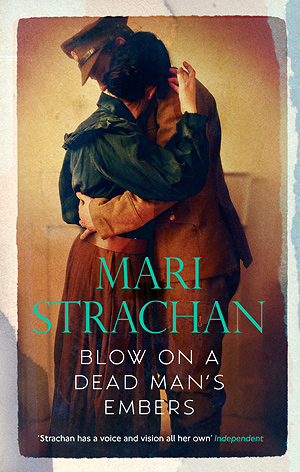
Blow on a Dead Man’s Embers by Mari Strachan

Blow on a Dead Man’s Embers has been sitting patiently on my shelf for a few months waiting until I felt it was the right time to read it. It sounded interesting and I’d heard some positive things about it, but it didn’t seem like a book that was calling out to be read immediately. Looking at the first couple of pages I noticed that it was written in third person present tense, something I often have a problem with, and this was another reason I wasn’t in any hurry to start reading. Well, it seems I was doing this book an injustice because Blow on a Dead Man’s Embers turned out to be a very moving, atmospheric novel and one I loved from beginning to end.

The book is set in a small community in Wales in the 1920s, just a few years after the end of World War I. The war has left many women grieving for a husband, a son or a brother and Non (Rhiannon) Davies is one of the lucky ones whose husband Davey has come home. But although Davey is physically unharmed he is still haunted by his experiences in the trenches. When Non finds him hiding under the kitchen table one morning she grows concerned for his mental health, but she knows that before she can help him she needs to find out exactly what happened to him during the war. Could a letter from a woman called Angela in London hold the answers?

As well as being a story about the aftermath of the Great War, this is also the story of Non and her relationships with the various members of her family. She has two teenage stepchildren to take care of, in addition to seven-year-old Osian who appears to be autistic (although this condition would not have been understood in the 1920s). Then there’s Non’s nephew, Gwydion, whose parents disapprove of his politics and his Irish girlfriend, and her mother-in-law, Catherine Davies, who makes no secret of her dislike for Non. Even the book’s minor characters are well-drawn and believable, from the Davies’ interfering neighbour, Maggie Ellis, to their tame crow, Herman.

One of the things I loved about this book was the way it looks at so many different aspects of World War I and what it was like in the years immediately afterwards. As well as Davey’s shell shock (what we would now call post traumatic stress disorder) we also meet other former soldiers with various physical or mental problems caused by the war. There are also a lot of men who are struggling to find work now that the war is over and are wandering the Welsh countryside in search of food and shelter. And we also see how the women are trying to cope with the loss of their loved ones and how some of them are in denial, unable to accept what has happened.

I don’t think I’ve ever read a novel set in Wales during this period and Mari Strachan’s descriptions of life in 1920s Wales are just how I would have imagined it. The book does use some Welsh terms which, unless you’re Welsh, may seem unfamiliar at first (the children call their grandparents Nain and Taid and their father Tada, for example) but I soon got used to them.

For a book where nothing very dramatic happens this was still a very absorbing story and after a slow start I found that I really cared about the Davies family and I wanted to read on and find out what would happen to them. At first I thought this was going to be a bleak, depressing book but it actually wasn’t because it’s told with a lot of warmth and even some humour.

Have you read any books about World War I? Which ones can you recommend?

The Champion by Elizabeth Chadwick

Considering how much I enjoy historical fiction, Elizabeth Chadwick is one of those authors I feel I should probably love. Until recently though, I had only tried to read one of her books – which I think was Lords of the White Castle – and couldn’t get into it at all. On a visit to the library a couple of weeks ago I decided it was time to give her another chance and as I don’t know much about any of her books, I chose this one almost at random.

The Champion is set in France, Wales and England towards the end of the 12th century. Our hero is Alexander de Montroi, a seventeen-year-old novice monk who runs away from the monastery after being abused by the sub-prior. Deciding to swap the religious life for the battlefield, Alexander asks his older brother, Hervi, to help him become a knight. He proves to be a skilled fighter and is soon an important member of Hervi’s camp, jousting and taking part in tourneys (tournaments).

It’s here that Alexander meets and falls in love with Monday de Cerizay, the daughter of Hervi’s friend and fellow knight. Despite having wealthy relatives in England, Monday has spent her whole life travelling around the tourney circuit. Having seen what this lifestyle has done to her parents, Monday longs to better herself. So when Alexander asks her to marry him, she panics and leaves the camp without letting him know where she is going. Years later, Monday and Alexander meet again and have to begin rebuilding their relationship all over again, despite the attempts of Monday’s rich and powerful grandfather to split them up – and the reappearance of Alexander’s sworn enemy, Eudo Le Boucher.

The medieval world Elizabeth Chadwick has created in The Champion is amazingly vivid and believable. The amount of detail she goes into when describing clothes, fabrics, food and drink etc is very impressive. In particular I thought the descriptions of the knights’ camps at the tourneys were very well written and felt realistic. Chadwick shows us the less glamorous side of a knight’s life: worrying about money, searching for a rich man to sponsor them in the tourneys, looking for work in the winter, as well as the constant travelling around from camp to camp, running the risk of being defeated in battle and losing their horse, their possessions or even their life.

There are a few real historical figures who appear in the book, including Richard Coeur de Lion (Richard the Lionheart), his brother John, Count of Mortain (the future King John of England) and the knight, William Marshal. But it’s not really necessary to be familiar with the history of this period, as the focus is very much on the fictional lives of Alexander and Monday. I liked Alexander from the beginning, though I wasn’t so fond of his brother Hervi (maybe because his first appearance in Chapter One doesn’t really endear him to the reader) but as the story progressed I loved watching his relationship with Alexander develop, playing the role of the protective older brother. In fact, I thought the male characters in this book were stronger overall than the female ones. I didn’t find Monday a very memorable character and I didn’t always agree with or understand her actions either.

Once I got into this book, I really enjoyed it. I didn’t think the romantic storyline was very original or imaginative, but the wonderful medieval setting more than made up for it. I feel more like giving Elizabeth Chadwick’s other books a chance now that I know I do enjoy her work and my failure with Lords of the White Castle was probably just a case of the wrong book at the wrong time. Any suggestions as to which one I should try next?