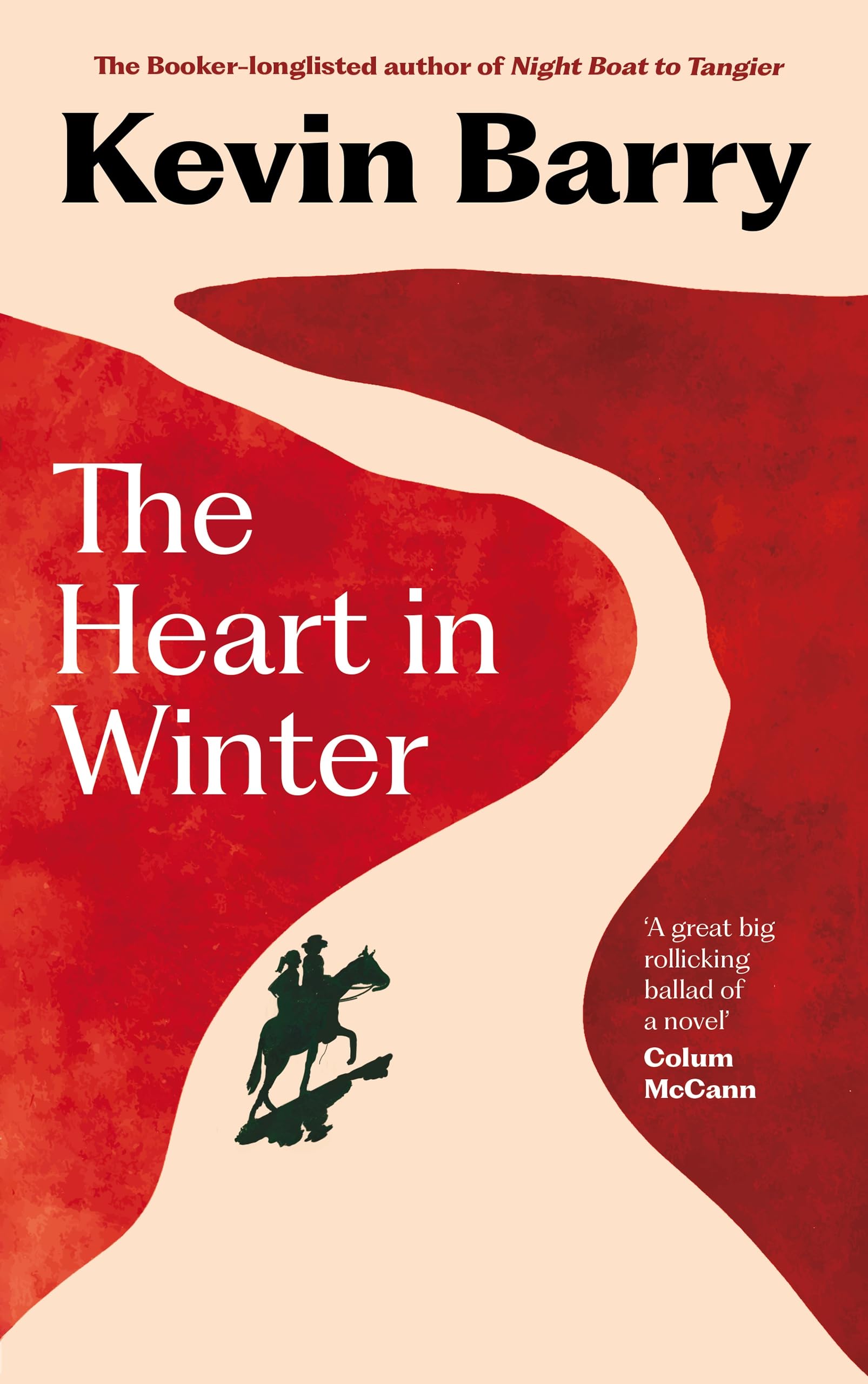
 When I first heard about The Heart in Winter last year, despite seeing some very positive reviews I decided I wasn’t interested in reading it as it didn’t sound like my sort of book. After it was longlisted for the Walter Scott Prize earlier this year, I wondered if I’d been too quick to dismiss it and as Kevin Barry is an Irish author, I decided to try reading it for Reading Ireland Month (hosted this month by Cathy of 746 Books).
When I started reading, it seemed that my fears about it were justified. It’s a western, set in 1890s Montana, with lots of drinking, lots of swearing and lots of sex. Worse, there are no quotation marks to indicate speech, something I always dislike and find distracting. Still, I was prepared to give it a chance and persevere…
Tom Rourke is an Irishman living in Butte, Montana, where he works as a photographer’s assistant and a writer of love letters for illiterate men hoping to find wives. He’s also a drunk and an opium addict, drifting through life with no real aim or direction. Everything changes for Tom when Polly Gillespie arrives in town. Polly is newly married to an older man, Anthony Harrington, the fanatically religious captain of a copper mine. She’s already having doubts about her marriage, so when she and Tom fall in love, they decide to run away together. Stealing a horse, they head out across Montana and Idaho, hoping to make it all the way to California, but Harrington won’t let his bride escape that easily and soon a posse of gunmen are in pursuit.
Once Tom and Polly left Butte and set out on their journey, I started to feel much more engaged with the story. Although their romance was very sudden (literally love at first sight, with no time to show how their relationship developed), I still found it convincing and could easily believe that these two flawed, lonely people would form an instant connection. The narrative is split between Tom and Polly on the run and Harrington’s men who are hunting them down and although it seems that the odds are against the young lovers, I still hoped things would work out for them and they would find the happiness they deserved.
I wish I could say I loved this book the way everyone else has, but that wouldn’t be true. However, I did find a lot of things to admire in it, particularly the way Barry’s use of language brought the setting so vividly to life. There are also some very colourful supporting characters, both in Butte and among the people Tom and Polly meet on their travels. As I mentioned earlier, though, I really hate the current trend for not using punctuation correctly. If the idea is to make the prose feel more immersive, it does the exact opposite for me. Apart from that, I think I’m just not a fan of westerns in general. I did enjoy Patrick deWitt’s The Sisters Brothers, but the other westerns I’ve tried since then haven’t really worked for me, not even Days Without End by Sebastian Barry, whose work I usually love.
 I won’t be at all surprised if this book is shortlisted for the Walter Scott Prize next month or even if it turns out to be the eventual winner. I just wasn’t the right reader for it, but I’m still glad I tried it and got to know Tom and Polly.

 She Reads Novels