Nonfiction November Week 2: Book Pairings – Tapestry of War and The Desert War

For Week 2 of Nonfiction November, the topic is as follows:

(Nov. 5 to 9, hosted by Sarah’s Bookshelves) – Fiction / Nonfiction Book Pairing – This week, pair up a nonfiction book with a fiction title. It can be a “If you loved this book, read this!” or just two titles that you think would go well together. Maybe it’s a historical novel and you’d like to get the real history by reading a nonfiction version of the story.

I’ve recently read two books that fit this week’s topic perfectly…

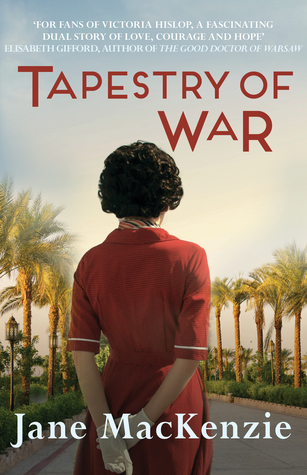
Fiction: Tapestry of War by Jane MacKenzie

Tapestry of War follows the very different experiences of two young women during World War II. In Egypt, we meet Fran Trevillian, a journalist working for the Alexandria Journal, reporting on the issues that are important to the diverse communities that have made the city their home. As Rommel’s forces draw closer to Alexandria, Fran falls in love with Jim MacNeill, a Scottish radar specialist. Meanwhile, in Scotland, Jim’s sister Catriona has finished training to be a nurse and is hoping to use her new skills to provide therapy for injured soldiers who have been sent home from the war. On the Isle of Islay, where she lives with her father, however, nursing opportunities seem limited and Catriona longs to move away to somewhere where she feels her work can really make a difference.

Although there is occasionally some drama in the stories of our two main characters and their friends, this is a very character driven novel. Both women change and grow as people as a result of the work they carry out during the war and the new relationships they develop. I enjoyed each storyline equally, drawn more to Fran’s at the beginning because it was set closer to the action, but appreciating Catriona’s more and more as the novel progressed. I became completely invested in the lives of each woman, sharing in their happiness as each finds love when they least expect it and in their sadness as the tragedy of war strikes again and again.

Most of my previous World War II reading has concentrated on the war in Europe, so my knowledge of what was happening in North Africa is more limited. I found that I was learning a lot from Tapestry of War, but I knew I needed to read some non-fiction to fill in the gaps…

Nonfiction: The Desert War by James Holland

This little book is part of the Ladybird Expert series, aimed at adult readers but published in the same format that those of us who loved Ladybird books as children will remember. Written in a clear and concise style, the left hand pages contain the text while on the right there’s a map, a photograph or an illustration.

Beginning in 1940, when the Italians, under Mussolini, entered the Second World War, James Holland takes us in chronological order through each stage of the war in North Africa, the Mediterranean and the Middle East. It’s all very factual and straight to the point, with none of the author’s own personality coming through, but in a book with only 50 pages (half of them pictures) and a lot of information to cover, that’s understandable. Battles and raids are described briefly, concentrating on the outcome and any notable tactics or weapons that were used.

The Desert War is a perfect introduction to the subject and can easily be read in less than an hour. If, when you’ve finished it, you want to explore things in more detail, some recommendations for further reading are given, although there are no references or sources provided. I didn’t mind this as all I wanted from this book was a chance to learn some basic facts and to get the timeline of events straight in my mind – it’s obviously not intended to be a comprehensive, in-depth read. Looking at the other titles in the Ladybird Experts series, I see there are several more by James Holland covering different aspects of the war, as well as books by other authors on topics as diverse as witchcraft, genetics and Beowulf.

Thanks to Allison & Busby for providing a review copy of Tapestry of War and to Penguin Random House for a review copy of The Desert War.

Do you like to read fiction and non-fiction on the same subject? Can you think of any pairs of books that go well together?

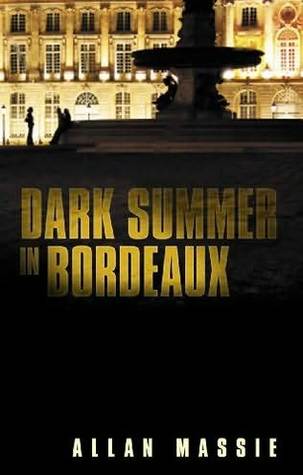
Dark Summer in Bordeaux by Allan Massie

This is the second in Allan Massie’s four-book crime series set in occupied France during the Second World War. My review is as spoiler-free as I could make it, so it should be safe to read on even if you’re new to the series, but I would definitely recommend beginning with the first book, Death in Bordeaux, as there are lots of recurring characters and some storylines which continue from book to book.

In Dark Summer in Bordeaux, we re-join Superintendent Jean Lannes of the Bordeaux Police as he is called out to deal with another crime – this time involving the murder of an elderly man, whose body has been found in a city park. As Lannes learns more about the man and how he died, some political implications begin to emerge, as well as some surprising links to the murders committed in the previous novel. Lannes comes under pressure from his superiors who want the investigations brought to a close as quickly as possible, but he is not ready to drop the case just yet – not until he finds out what is really going on here.

Investigating a murder is never going to be easy or pleasant at the best of times, but it is particularly challenging for Lannes because of the political situation in France, where the demands and concerns of the Vichy secret services, the German occupiers and the French Resistance all have to be taken into consideration. As a decent, principled person Lannes often finds himself torn between his conscience telling him to do what he knows is right and see justice done, and his common sense telling him to do as he is told and keep his family safe.

As if the stress of his job was not enough, Lannes is also worried about all three of his children, for different reasons. His eldest son, Dominique, is making plans to go and work for the Vichy regime, while Alain, whose views are rather different, wants to join Charles de Gaulle and the Free French. Meanwhile, his daughter, Clothilde, announces that she is in love with the young German officer who is stationed in their apartment block. Lannes is not very happy about any of this, but only because he is looking ahead to a time when (he hopes) the war will be over and a wrong decision taken now could have disastrous consequences. His wife, Marguerite, has her own opinions and this is causing tension in her marriage to Lannes.

As well as Lannes and his family, we also catch up with other characters from the previous book, including one of my favourite characters – Leon, the nephew of Lannes’ friend Miriam. Leon is in a particularly interesting – and dangerous – position in Vichy France, being both Jewish and gay, and this makes him a target of blackmailers and others who want to take advantage of him for their own ends. It seems that, in Bordeaux, the war is bringing out the best in some people and the worst in others. It’s a fascinating setting, even more so because I have read so little about life in France during the Occupation.

I haven’t said much about the mystery aspect of this novel, but that’s because I found it almost secondary to the setting and the characters. The murder of the man in the park is important and ties all the other threads of the story together, but I was much less interested in finding out who killed him than I was in reading about Leon’s ordeals or Alain’s support for the Resistance. I found this a more enjoyable book than the first one, probably because I already knew the characters and was invested in what happened to them. I’m looking forward to continuing with the third book, Cold Winter in Bordeaux.

I am counting this book towards the R.I.P. XIII challenge (category: mystery).

Marking Time by Elizabeth Jane Howard

This, the second in Elizabeth Jane Howard’s Cazalet Chronicles, continues the story begun in The Light Years, taking us through the early stages of the Second World War. It’s been almost exactly a year since I read the first book, but I found that I could still remember the characters and storylines and jump straight back into the story. If I’d needed a reminder, though, the book opens with a useful family tree, character list and summary of the previous novel.

Marking Time begins just as Britain declares war on Germany in September 1939 and ends just two years later, in 1941. The Cazalet family – who include ‘the Brig’ and his wife ‘the Duchy’; their daughter, Rachel; their three sons, Hugh, Edward and Rupert, with their wives and children; and an assortment of other relations, friends and servants – are gathered again at Home Place in the Sussex countryside and this is where most of them will be based during the two years the novel covers. As an upper middle class family, they are sheltered from some of the worst deprivations of the war, but eventually it does begin to affect each of their lives in all sorts of ways.

One of my criticisms of The Light Years was that the number of characters was overwhelming and the constant changes from one perspective to another made it difficult to focus. Marking Time has a slightly different format. There are still several chapters which deal with the whole family, spending a few pages with one family member, then a few pages with another, but there are also some longer sections which concentrate on one character at a time.

The characters who are given their own chapters are the three teenage girls – Louise, Polly and Clarissa (Clary) – who happen to be three of the characters I singled out as favourites in my review of The Light Years. I was delighted to have the opportunity to spend a more substantial period of time with each of the girls, getting to know them better. Louise, the eldest child of Edward and Villy, is an intriguing mixture of sophistication and innocence. In Marking Time, we see her leave home to become an actress, fall in love for the first time, and make an unwelcome discovery about another family member. Clary’s chapters are written partly in the form of diary entries and this gives her a particularly strong and distinctive voice. Clary receives some bad news quite early in the war – although we don’t yet know exactly how bad – but there are some positives to come out of this, such as an improvement in her relationship with her stepmother, Zoe. Meanwhile, Polly – Hugh and Sybil’s daughter – overhears a private conversation which throws her life into turmoil.

Despite all the problems various family members are experiencing, the novel isn’t entirely depressing; there are some funny scenes too, mainly involving the younger children, Neville and Lydia, and we see the beginnings of a touching romance between two of the Cazalet servants. Although the lifestyle of the Cazalet family is entirely different from my own – partly because of the time period in which they live, but also because of their class – I still feel that they are people I understand and care about. I enjoyed this book much more than the first and am pleased I still have another three Cazalet novels to read. The next one is Confusion and I’m looking forward to finding out how the family fare throughout the rest of the war.

This is book 14/20 of my 20 Books of Summer.

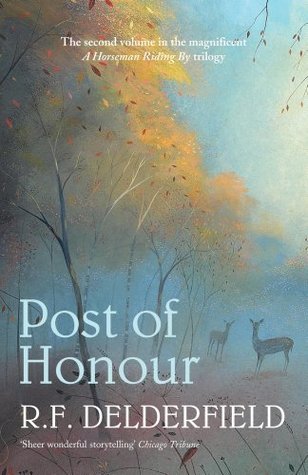
Post of Honour by RF Delderfield

Post of Honour is the second book in RF Delderfield’s A Horseman Riding By trilogy which begins with Long Summer Day, one of my favourite reads of last year. For me, this second novel is not as good as the first, but still very readable.

As this book and the first one were originally published in 1966 as one very long volume, Post of Honour picks up the story just after Long Summer Day ends in 1911, dropping us straight back into the daily lives of the people of the Sorrel Valley. A few years go by with small dramas taking place – weddings, funerals, births, deaths, new friendships being formed and new romances beginning to blossom. And then, in 1914, war breaks out in Europe and life in the Valley will never be the same again.

Although I had allowed a whole year to pass between finishing the first book and picking up this one, I found that I had no problem remembering the characters and storylines. It was lovely to be reacquainted with old friends like the former street-urchin Ikey Palfrey, the wild, untameable Hazel Potter, suffragette Grace Lovell and, of course, our hero Paul Craddock, the squire of Shallowford. The first part of the book is devoted to the First World War, showing us how these characters and many others are affected, either directly or indirectly. One of the Valley men becomes a conscientious objector while others fight in the trenches and those left at home wait for news of their loved ones. It would be unrealistic for all of our much-loved characters to return from war unscathed – so, inevitably, there are some deaths and the next section of the novel looks at how the inhabitants of Shallowford and the Sorrel Valley recover from their losses and try to move on over the next two decades.

This book covers a much longer time span than the previous one and this, in addition to the number of deaths during the wartime chapters, means the introduction of lots of new characters from the second and third generations. One of the things I remember loving about Long Summer Day was the way Delderfield brought each character, even the minor ones, fully to life. However, I don’t think he does that quite as successfully in Post of Honour and I felt that many of the new characters were little more than names on the page. With the exceptions of two of Paul’s children – Simon and Mary – and Ikey’s son, the strangely named Rumble Patrick, I simply wasn’t very interested in any of the others.

By the end of the book, another world war has begun, and I do want to see how Paul and his friends and family will fare. I will be reading the third book in the trilogy, The Green Gauntlet, but after that I’m looking forward to leaving the Sorrel Valley behind and trying some of Delderfield’s other novels – probably beginning with the one I already have on my shelf, Farewell the Tranquil Mind.

This is book 9/20 of my 20 Books of Summer.

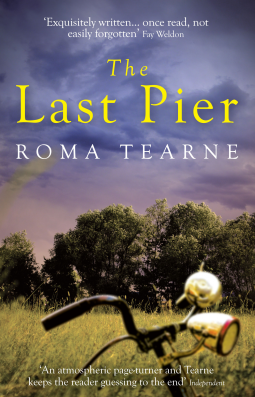
The Last Pier by Roma Tearne

This is the second novel I have read by Roma Tearne and very different from the first I read, The Swimmer, which was the story of a woman’s relationship with a Tamil refugee from Sri Lanka. I had the impression that all of her books covered similar themes of immigration, asylum and conflict in Sri Lanka, so I was surprised when I picked up The Last Pier, one of her more recent novels from 2015, and found that it was set on a fruit farm in rural England just before the start of World War II.

It’s the summer of 1939 and Cecily Maudsley is thirteen years old – that difficult age, no longer a young child but not an adult yet either. Cecily watches enviously as Rose, her beautiful sixteen-year-old sister, becomes the centre of attention that summer and catches the eye of every man in Suffolk, it seems. But Rose’s life is not as perfect as it appears; we learn in the very first chapter that a tragedy is going to take place – and that Cecily will be blamed for it.

The Last Pier is a novel in which secrets, revelations and surprises play an important part, so I will have to be careful not to say too much. Some of the secrets take a long time to be revealed; in fact, Cecily herself only uncovers the whole truth twenty-nine years later when she returns to England after a long absence. Part of the novel is written from the perspective of the young Cecily, giving an account of the events of 1939 as they happen, and part from the perspective of the older Cecily, remembering moments from the past. The way Roma Tearne handles the passing of time is very effective, moving between past and present to unveil the clues that we must put together before the full picture can be seen – but it also means the story feels very fragmented, which can be confusing at times.

There’s plenty of suspense as we wait to find out exactly what happens to Rose and who is responsible for it, and there is a feeling of danger and foreboding which hangs over the whole novel. At the same time, the outbreak of war is approaching, bringing with it the sense that very soon the lives of all of the Maudsleys will be changed forever. The novel covers an aspect of the Second World War which I haven’t read about very often – the fate of Italian people who were living in Britain at the beginning of the war – and this is explored through the story of the Molinello family who had arrived in Suffolk from Tuscany more than a decade earlier and opened an ice cream parlour not far from the Maudsleys’ farm. The two families have become very close over the years and, when Italy’s role in the war causes the Molinellos to be regarded with suspicion, the Maudsleys find that their fortunes have become entwined with their Italian friends’.

Cecily is particularly interested in what happens to the Molinello family because she is in love with Carlo, one of the Molinello sons. However, it seems to her that Carlo, like everyone else, only has eyes for Rose. As Cecily’s jealousy increases, she begins to watch Rose’s movements, following her when she can and eavesdropping on conversations. She also becomes curious about Robert Wilson, a stranger who claims to have been sent to Suffolk on government business, to carry out a survey of the farmland in preparation for the war. By watching and listening, Cecily picks up lots of little pieces of information about Rose, about Mr Wilson and about everyone else on the farm, but she lacks the maturity and experience to be able to understand the implications of what she has discovered.

Roma Tearne writes so well from the point of view of a teenage girl. I could really feel Cecily’s confusion as she tries to make sense of the things she has learned, her frustration at not quite being able to grasp what is going on, and her envy towards her sister, who appears to have everything Cecily wants and doesn’t have. I loved this beautifully written novel and I’m pleased that I’ve been reminded of Roma Tearne’s books, seven years after reading The Swimmer. I’m looking forward to reading some of her others.

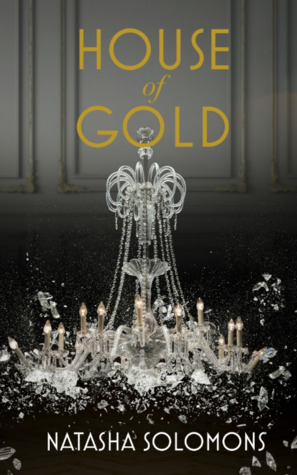
House of Gold by Natasha Solomons

It’s been a long time since I read my first Natasha Solomons book, The Novel in the Viola. Although I enjoyed it, for some inexplicable reason I had never really thought about reading any of her other books until I spotted her new one, House of Gold, which was published in the UK last month. I think it was the simple, elegant cover that caught my attention, at a time when covers in general are becoming increasingly intricate and brightly coloured, but the story sounded appealing too…and it was. I loved it.

House of Gold tells the story of a fictional banking family, the Goldbaums, who are loosely based on the real-life Rothschilds. When we first meet the family in 1911, they are fabulously wealthy and hugely influential, with branches in five European capital cities. In a move intended to strengthen the ties between the Austrian and the British branches, a marriage has been arranged between Greta Goldbaum and her cousin Albert. This is nothing new – Greta has grown up with the knowledge that “the Goldbaum men were bankers, while the Goldbaum women married Goldbaum men and produced Goldbaum children”, but she has no desire to marry Albert and is sure they won’t be compatible. Of course, the wedding must go ahead anyway and Greta is forced to leave her parents’ home in Vienna to start a new life as a married woman in England.

The relationship between Greta and Albert is at the heart of the novel and I enjoyed watching them get to know each other, trying each in their own way to make their marriage work but not always succeeding. It’s not always easy, especially not for Greta, but even when things are at their worst she finds some fulfilment in transforming the gardens of Temple Court, the British Goldbaums’ estate in Hampshire, and as a result of taking on new responsibilities and developing new interests, she is able to grow as a person.

There is much more to the novel than this, though. Within a few short years of Greta’s marriage to Albert, the First World War begins, bringing with it new challenges, new difficulties but also new opportunities. With European governments desperate for money to fund their war efforts, the services of the Goldbaums are as much in demand as ever, but as a Jewish family they find that their position is no longer as secure as it has been in the past. For Greta, there is the additional problem of being stuck in the middle, with different branches of her family on opposite sides of the conflict.

Natasha Solomons takes us right to the centre of the action, with characters such as Greta’s beloved brother Otto and her French cousin Henri becoming directly caught up in the war that is tearing Europe apart. We also learn a lot about the role of money in war; to quote Otto, “Money has no passport and every passport…it has little respect for borders. Money, like water, finds a way.”

There’s so much going on in this novel…so many characters to meet and so many interesting stories to follow. Maybe that’s why, after being completely gripped by the lives and adventures of the Goldbaums, I was slightly disappointed by the unexpectedly abrupt ending and by subplots which seemed to lack a proper resolution. I hope that means Natasha Solomons might be planning a sequel. It would certainly be possible, but if not I will just have to go back and read her earlier novels. I have Mr Rosenblum’s List, The Gallery of Vanished Husbands and The Song Collector to choose from.

The Oaken Heart by Margery Allingham

Having read several of Margery Allingham’s detective novels, I was intrigued to come across The Oaken Heart, an account of life in her small English village during the Second World War. Originally published in 1941, it was apparently based on letters written to some American friends and expanded into a book at the suggestion of her publisher. It’s interesting to think that she was writing this while the war was still taking place and when nobody knew how much longer it would last or what the outcome would be.

Allingham’s village was Tolleshunt D’Arcy in Essex, but she refers to it in the book as ‘Auburn’ after a line from the poem The Deserted Village by Oliver Goldsmith. She is obviously very proud of Auburn and the way the people who live there work together to cope with whatever the war throws at them; it’s true that all towns and villages have their own unique characteristics, but I think it’s also true that the wartime experiences of the residents of Auburn will have been similar to the experiences of people in other parts of Britain.

Like many other villages, Auburn, in 1938 when the book opens, is still suffering from the effects of the previous war which ended just twenty years earlier. There’s a sense that Allingham and her friends are putting all their faith in Neville Chamberlain, not really believing or wanting to believe that war could possibly happen again. Of course, it does happen again – after a year of preparations, gas mask distributions and discussions of who should take in how many evacuees. The subject of evacuees is an important one to the people of Auburn; at first they are excited at the thought of groups of little schoolchildren from London arriving in the village (since the First World War there has been a shortage of young people in Auburn), but the reality is very different – hundreds of young mothers and babies! Allingham’s descriptions of the newcomers, the culture differences and how the villagers dealt with all of this are quite funny to read about.

I have never read anything about Margery Allingham as a person before, so I don’t know what she was supposed to be like or what impression the people who knew her had of her, but based on her own words in The Oaken Heart, she seems very likeable and down-to-earth. She makes a few references to her writing career now and then (she was working on Traitor’s Purse at the time), but there is never any sense of self-importance or superiority over anyone else in the village. Her writing style is warm, conversational and, as you would expect, very readable.

This is a wonderful book, which I would recommend to anyone who enjoys reading about life during the war. The fact that it is a first-hand account written in 1941 rather than a memoir written years later gives it another layer of interest. As we reach the final page, there is still no end to the war in sight and nobody has any idea if or when it’s all going to stop. I was sorry that the book ended when it did, as I would have liked to have continued reading about the people of Auburn and to find out how they fared later in the war.